Non pacem sed gladium: the scandal of faith and Mary the sword of Simeon
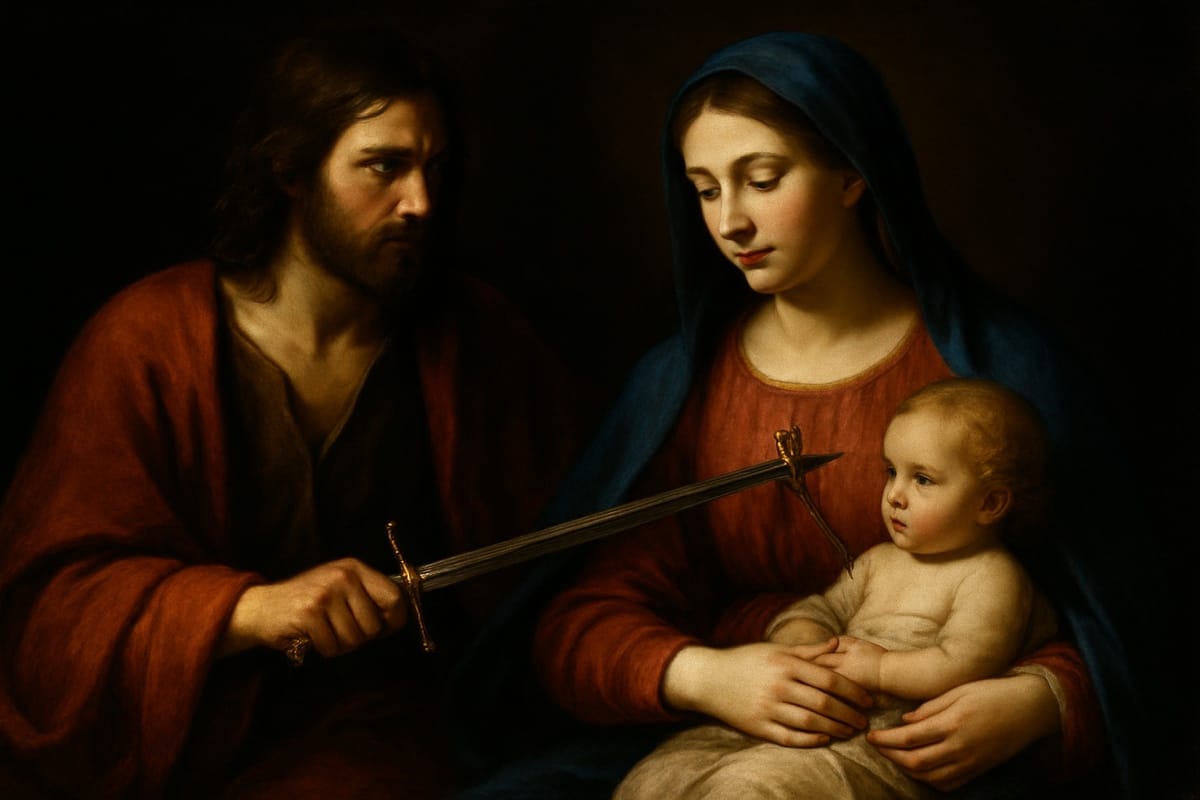
Nolite arbitrari quia venerim pacem mittere in terram. Non veni pacem mittere, sed gladium.
Mt 10:34
Mt 10:34-11:1 constitutes the climax of Matthew’s missionary discourse: after the practical instructions (Mt 10:1-15), the announcement of the persecutions (Mt 10:16-23), and the catechesis on fear (Mt 10:24-33), Jesus sets forth the ultimate logic of His mission, He did not bring peace, but the sword. This shocking statement needs to be read in its literary context: it is not a glorification of violence nor a contradiction of the “blessed are the peacemakers” of the Sermon on the Mount. It is the description of the effect of faith in a divided world: adherence to Jesus inevitably creates division between those who adhere and those who do not, including within one’s own family.
The implicit citation of Mic 7:6, “the son despises the father, the daughter rises up against the mother,” places Jesus’ statement within a prophetic framework: the division that Jesus announces is the eschatological division that the prophets associated with the final judgment. The “sword” of Mt 10:34 is not the sword of civil war but the sword of discernment, the one that separates the one who adheres in faith from the one who does not. This “sword” divides because faith is a choice that cannot be made by proxy: each person must decide for himself, and that individual decision can create lines of division within the closest family.
I. “Whoever loves father or mother more than Me”: the hierarchy of loves
“Whoever loves father or mother more than Me is not worthy of Me” (Mt 10:37), Jesus does not reject filial love nor parental love. He establishes a hierarchy. Love for Christ must be the ordering love that gives meaning to all the other loves. Whoever loves his parents “more than” Jesus has made his parents his supreme value, and this, in the context of a persecution in which parents can ask their child to renounce the faith, makes love for one’s parents an obstacle to discipleship.
“Whoever does not take up his cross and follow Me is not worthy of Me” (Mt 10:38), the “cross” here is not yet the cross of the Passion (which the disciples would not have understood at this point in the Gospel) but the “cross” in the Roman sense: the instrument of execution that those condemned to death carried. The image is brutal: the disciple who follows Jesus is like a condemned man on his way to execution. The radicality of the language is deliberate, Jesus is not minimizing the cost of discipleship.
The “hierarchy of loves” that Jesus establishes is not emotional insensitivity. The Gospels show a Jesus who weeps at the death of Lazarus (Jn 11:35), who has compassion on the crowds, who loves His disciples “to the end” (Jn 13:1). The hierarchy does not suppress human love, it orders it. The disciple who loves Christ above all things is, paradoxically, able to love his own more genuinely, because love for Christ frees human love from the weight of the absolute dependence and the idolatry that can turn love into possession.
Mary lived this hierarchy in an exemplary way: she loved the Son with all a mother’s love but never kept Him for herself, never prevented the fulfillment of the mission, never placed maternal love above the will of God. “Do whatever he tells you” (Jn 2:5), at the wedding at Cana, Mary does not hold the Son back but launches Him into the public mission. The Mary of the Gospels is not the mother who holds on but the mother who sends, the one who subordinates maternal love to the Son’s mission.
II. “Whoever loses his life for My sake will find it”: the paradox of the cross
“Whoever finds his life will lose it. And whoever loses his life for My sake will find it” (Mt 10:39), the central paradox of discipleship is the paradox of life: whoever tries to preserve his life at all costs (including the cost of renouncing the faith) ends up losing what makes life meaningful. Whoever risks his life for the faith finds life in its fullness. This paradox is the core of the theology of martyrdom: the martyr is not the one who loses but the one who gains, the life that seems lost in death is the life that is found in the resurrection.
The “sword” that divides families, that can cause a son to be handed over by his parents (Mt 10:21), is the same “sword” that Simeon prophesied to Mary: “a sword will pierce your soul” (Lk 2:35). Simeon’s “sword” is interpreted by tradition as Mary’s suffering compassion in the Passion, the sorrow of seeing the Son condemned, scourged, crucified. But it is also, more profoundly, the “sword of discernment” that pierces Mary’s soul: the one that separates human maternal love from maternal love ordered by faith.
Mary “lost” the Son in the flight into Egypt, in the episode of the twelve-year-old in the Temple, in the separation of the public mission, at Calvary. And in each of these “losses,” Mary found the Son more profoundly: not as a possession but as a gift, not as an exclusive son but as the universal Savior. Simeon’s “sword” pierced Mary’s soul and, in piercing it, freed her from possessive love for oblative love, the love that gives without holding back.
III. “Whoever receives you receives Me”: the dignity of the one sent
“Whoever receives you receives Me. And whoever receives Me receives Him who sent Me” (Mt 10:40), the logic of representation: the one sent represents the one who sent him, and to receive the one sent is to receive the one who sent him. This logic applies to the mission of the Church: to receive the Christian missionary is to receive Christ. To receive Christ is to receive the Father. The chain of representation is the structure of the mission, the one sent bears the authority and the presence of the one who sent him.
“Whoever gives one of these little ones a cup of cold water to drink, because he is a disciple, truly I say to you, he will not lose his reward” (Mt 10:42), the reward of the simplest act of hospitality toward the missionary is real. The “cup of cold water” given to the disciple exhausted by the road has eschatological value: God does not forget even the least service rendered in the name of Christ. The “sword” that divides is balanced by the “reward” that welcomes, the missionary discourse ends not with division but with the promise that welcome has eternal consequences.
Mary was the first to “receive” the one sent by God, the angel of the Annunciation. Her “fiat” was the first act of welcoming the divine envoy in the history of salvation. And because she welcomed the one sent, she welcomed the One Sent (Christ) and, through Him, the Father who sent Him. The Annunciation is, in this sense, the primordial realization of Mt 10:40: Mary who received the messenger received the message, and in receiving the message she welcomed the Word that the message announced.
IV. The “Sword” that does not separate but unites: Maria mediatrix
The final paradox of Mt 10:34-39 is that the “sword” that divides is also, in the last analysis, the one that unites. The division that faith causes, the one that separates the one who believes from the one who does not believe, including within the family, is a provisional division in the eschatological perspective: the final judgment is the moment in which the “sword of discernment” completes its work. Meanwhile, the “sword” creates real suffering, real divisions, real losses.
The Marian tradition associated Mary with the role of mediatrix precisely in the situations in which the “sword” divides: persecuted Christians who invoke Mary as intercessor before their persecutors, children who pray for parents without faith, spouses who pray for their partners separated from the faith. Mary, who lived the “sword” in her own soul, is invoked by those who feel that same “sword,” because she knows from experience what it is to love someone who is on the other side of the division.
“I have not come to bring peace but the sword,” Jesus’ statement is not the last word of the Gospel. The last word is the promise of the Risen One: “I am with you all days, even to the end of the ages” (Mt 28:20). The “sword” is provisional. The presence is definitive. And Mary, who was present in the “sword” of Calvary, is present in the “company” of the pilgrim Church, mother of those who have been divided by faith, intercessor for those who are still on the other side of the sword, hope that division is not God’s last word about human families.
Postgraduate Program in Mariology
Would you like to deepen your formation in Mariology? Discover the Postgraduate Program in Mariology of Locus Mariologicus, an academic formation that unites theological rigor, spiritual life, and the living tradition of the Church.
Would you like to study Mariology seriously?
This article draws on the works in the Locus Mariologicus library. The Postgraduate Program in Mariology takes you to the same source, with academic guidance: Scripture, the Fathers of the Church, and the Magisterium, from the first dogma to contemporary questions.





Responses