“They always see the face of the Father in their angels”: Exodus, guardian angels, and Mary
Angeli eorum in caelis semper vident faciem Patris mei qui in caelis est.
Mt 18,10b
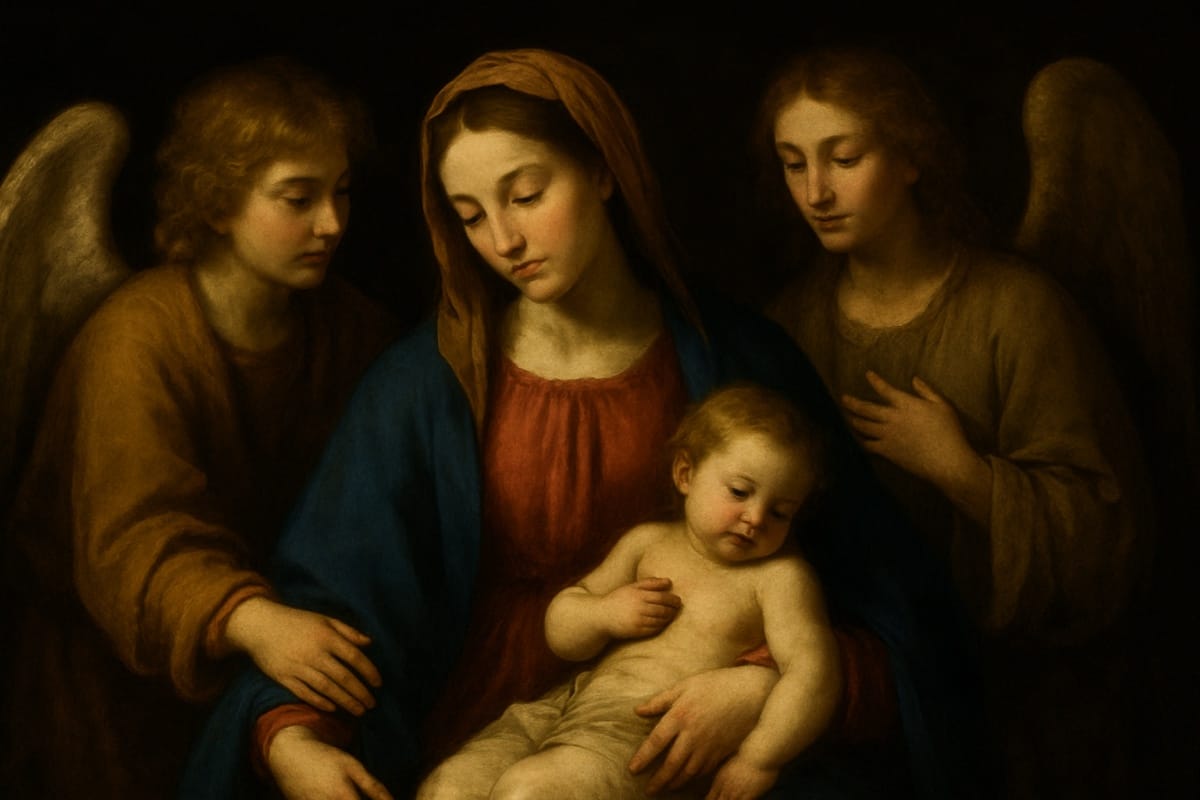
The feast of the Guardian Angels joins Exodus 23, where God promises to send an angel to guard Israel on their journey to the promised land, to Matthew 18, where Jesus warns against despising the little ones, for their angels always see the face of the Father. Both texts describe the same angelic nearness: to the people on the way (Exodus) and to each little one (Matthew). Mary, who was greeted by Gabriel, is the model of the creature who received angelic protection in its fullest extent.
I. The first reading: Exodus 23:20-23a
God promises to send an angel toTo guard Israel on the way and lead it to the place that I have prepared“The guardian angel is the escort of the pilgrimage, the divine presence that accompanies the path from Egypt to Canaan.”Pay attention to him and obey his voice, for my name is in him.“The angel with the name of God is not an autonomous being but the divine presence in the form of escort.”
“Annunciation”If you hear His voice and do all that I say(v.22): Obedience to the angel is obedience to God. The guardian angel is not an alternative path to God but the escort that leads to the God who sent him. The feast invites us to recognize the divine protection that accompanies each disciple on their pilgrimage, as Israel was accompanied from Egypt: not magical protection but a presence that guides and guards.
II. The Gospel: Matthew 18:1-5, 10
The warning of «do not despise any of these little ones(v.10) It is founded on a theological affirmation: its angels always see the face of the Father. The guardian angels of the little ones are not distant guardians but are present before the Father in perpetual intercession. To despise a little one is to despise someone whose intercessor stands before the face of God.
The convergence of Mt 18 with the promise of Exodus sketches the complete picture: the angel who guards on the way (Exodus) is the same one who always sees the face of the Father (Matthew). The guardian is not absent from the Father’s sight while he guards: he guards precisely because he sees the Father. Angelic protection is simultaneously temporal (on the way) and spiritual (before the Father).
III. Guardian Angels: protection and intercession
The two readings describe two dimensions of the angelic ministry: protection on the journey (Exodus) and intercession before the Father (Matthew). The guardian angel does not choose between accompanying and praying; he accompanies precisely because he prays, and he prays because he accompanies. The feast invites gratitude for a protection that is simultaneously physical (on the journey) and spiritual (before the Father).
“Annunciation”Pay attention” (Ex 23,21): The invitation to pay attention to the guardian angel is the invitation to pay attention to the divine escorts that the path offers. The little ones whose angels see the face of the Father are those who have not learned to pay no attention: children who naturally trust, as Jesus recommends in Mt 18,3. The spiritual childhood that Teresita celebrated yesterday is the disposition that guardian angels presuppose.”
IV. Mary guarded by Gabriel: protected to protect
Mary’s relationship with the angelic world has a privileged starting point: Gabriel, who greeted her, was the archangel who prepared for the Incarnation. TheHail, full of grace.
The greeting of Gabriel (Lk 1:28) is the most solemn angelic salutation in Scripture: Mary was not simply guarded by an angel, but greeted by the archangel of the Incarnation. The protection promised to Israel in Ex 23 was given to Mary in the highest form: the angel who has “the name of God” (v.21) descended upon her who was to conceive the Son of God.
The feast of the Angels of the Guard proposes Mary as a model of the guardianship that angels exercise: to accompany on the path, to see the face of the Father, and to intercede for the little ones entrusted to them. Mary, who was guarded by Gabriel, became the spiritual mother of all the little ones that Jesus placed at the center of the disciples. Mary, Queen of the Angels, is the creature who received and embodies most fully the mission of the angel who “guards on the path” and who “sees the face of the Father.”
Post-Graduate Studies in Mariology
Do you want to deepen your formation in Mariology? Get to know the Graduate Program in Mariology from Locus Mariologicus – an academic formation that combines theological rigor, spiritual life, and the living tradition of the Church.




Responses