Marian Psalms and Canticles: The Biblical Prayer of Mary
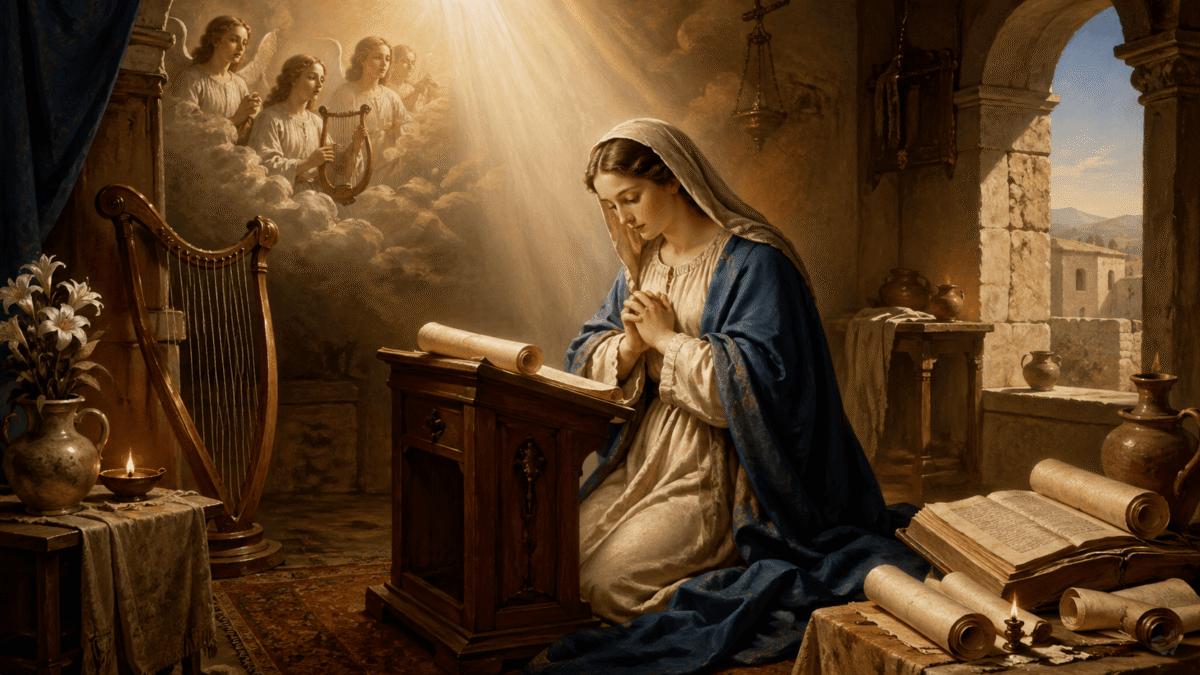
Marian psalms and canticles, the biblical prayer of Mary
Mary prayed the Psalms, the prayer book of Israel. She grew up in them, learned from them the language of the relationship with God, and let herself be shaped by their spirituality. Marian exegesis identifies a set of Psalms and biblical canticles that tradition associates in a special way with the figure of Mary.
The Magnificat and the canticle of Hannah
The Magnificat (Lk 1:46-55) is the Marian canticle par excellence. But its root lies in the canticle of Hannah (1 Samuel 2:1-10), the mother of Samuel. Mary knew this canticle by heart and drew inspiration from it. The parallel between Hannah, a barren mother who receives the gift of a child, and Mary reveals the continuity of God’s action in the history of Israel.
Psalm 45 (46): a royal epithalamium
Psalm 45 is a nuptial poem that sings the beauty of the queen who gives herself to the king. The Mariological tradition applied it to Mary as the daughter of the King who presents herself to the Lord: “Hear, O daughter, and see, and incline your ear: forget your people and your father’s house.” The break with family in order to obey the divine call resounds in Mary’s Fiat.
The Song of Songs and Mary
The Song of Songs was interpreted by the Fathers of the Church both ecclesially (the Bride is the Church) and marially (the Bride is Mary). The antiphons of the Divine Office frequently apply texts of the Song of Songs to Mary: “Who is this that comes up from the desert like a column of smoke?” (Song 3:6).
Deepen your studies: explore Mariology, Marian Theology, Marian apparitions, and the Postgraduate Program in Mariology.
Magisterium of the Church
Cantica mariana, Magnificat, Benedictus, Nunc Dimittis, ex Scriptura Sacra hauriunt et in Liturgia Horarum praecipuum locum obtinent.
Paulus VI, Const. Ap. Laudis Canticum (1 novembris 1970)
📚. Literal translation: The Marian canticles, Magnificat, Benedictus, Nunc Dimittis, draw from Sacred Scripture and hold a place of prominence in the Liturgy of the Hours.
Postgraduate Program in Mariology
Would you like to deepen your formation in Mariology? Discover the Postgraduate Program in Mariology of Locus Mariologicus — an academic formation that unites theological rigor, spiritual life, and the living tradition of the Church.
Would you like to study Mariology seriously?
This article grows out of the works in the Locus Mariologicus library. The Postgraduate Program in Mariology takes you to the same source, with academic guidance: Scripture, the Fathers of the Church, and the Magisterium, from the first dogma to contemporary questions.




Responses