Mary the faithful one: the pilgrim of faith
Mary the faithful one, the pilgrim of faith
Faith is the most characteristic note of Mary’s spiritual life. Elizabeth proclaims her “blessed because she believed” (Lk 1:45) before any other praise. For the theological tradition and for the Second Vatican Council, Mary is the faithful one par excellence, a model for the whole Church, precisely because her faith was a difficult, dramatic, and pilgrim faith, not an easy certainty.
Faith at the Annunciation
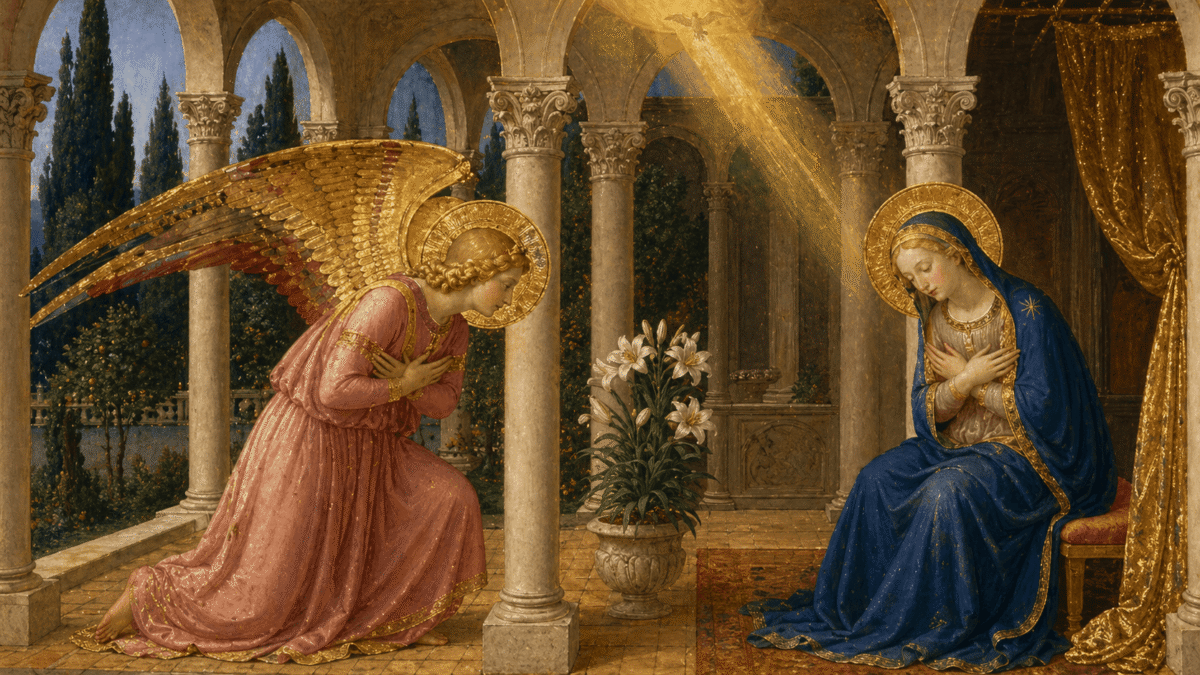
The Annunciation casts Mary immediately into faith. The angel’s greeting, “full of grace, the Lord is with you” (Lk 1:28), invites her to understand herself in a new ontological dimension that surprises and “troubles” her. When the angel announces to her the divine and virginal motherhood, Mary is confronted with what is absolutely impossible by human measure. Her faith is a paradoxical faith: to consent to bear the Son of God while remaining a virgin, and to do so through the overshadowing of the Holy Spirit upon her. The “Behold the handmaid of the Lord; let it be done to me according to your word” (Lk 1:38) is the confession of a total humility, but above all the act of a free and conscious abandonment to the word of God that becomes creative. Several scholars see in Mary’s fiat an analogy with the fiat of creation: the new creation begins with an act of paradoxical faith.
Faith throughout the life of Jesus
All the subsequent events of Mary’s life are comprehensible only in the light of faith. The extreme poverty in Bethlehem, the birth in a manger, the exile in Egypt: where is the “kingdom” that the angel had promised (Lk 1:32-33)? Luke records the way in which Mary lived this tension: “Mary kept all these things, pondering them in her heart” (Lk 2:19). It is not a pacified meditation, but an anguished search for the meaning of the events. When Jesus, at twelve years of age, remains in the Temple without telling His parents and answers, “Did you not know that I must be about My Father’s business?” (Lk 2:49), Mary’s incomprehension is explicitly affirmed by the evangelist (v. 50). She learns that this Son does not fit into her own categories. During the public life, Jesus repeatedly relativizes family ties (Mt 12:46-50; Lk 11:27-28), calling Mary to deepen her faith continually, a faith that is never a secure possession but an ever-renewed openness.
Faith at the Cross
The evangelist John is the only one who mentions Mary’s presence “by the cross” (Jn 19:25). This detail is theologically dense: there, where the faith of the disciples had reached its limit, Mary remains standing. Her faith passes through the most radical trial: to see her Son die as one condemned. The scene of the entrusting of the disciple to Mary and of Mary to the disciple (Jn 19:26-27) confers upon this “remaining” of Mary beside the Cross a universal salvific meaning: she receives the spiritual motherhood of the nascent Church and accepts, in faith, the testament of her Son.
Mary the pilgrim of faith according to Vatican II
The Lumen Gentium formulates in masterly fashion the synthesis of Mary’s faith: “The Blessed Virgin advanced in the pilgrimage of faith and faithfully maintained her union with her Son unto the Cross” (LG 58). The conciliar text underscores that Mary was not a “merely passive instrument in the hands of God” (LG 56), but cooperated with freedom and obedience. This affirmation is decisive: Mary is the faithful one, not merely the privileged one. Her “yes” was the act of a person who could have said “no.” The qualifier “pilgrim” is equally decisive: Mary’s faith was a journey, with stages of incomprehension and of advancing in darkness, and not a direct vision. “Advanced” indicates progress, dynamism, growth that does not stop.
Mary, model of the faith of the Church
The Lumen Gentium presents Mary as type and model of the Church precisely because of her faith: the Church “contemplates her hidden holiness and imitates her charity” (LG 64). Just as Mary’s virginal motherhood became possible through faith, so the Church begets children of God through the faith received in the Word and celebrated in baptism. In Mary there is no division between the “woman” and the “faithful one”: her full human fulfillment is born entirely of her faith. This unity is the most timely model for the contemporary Christian, tempted to confine faith to the private sphere. Mary teaches us to incarnate faith in life, to make supernatural every ordinary event of existence. She who was called “blessed among women” (Lk 1:42) is so not only because she biologically bore the Son of God, but above all because she “had the courage to believe the unbelievable” (Lk 1:45).
Deepen your studies: explore Mariology, Marian Theology, Lumen Gentium and Mary, and the Postgraduate Program in Mariology.
Magisterium of the Church
Beata quae credidisti: perficientur ea quae dicta sunt tibi a Domino.
Luke 1:45 (Clementine Vulgate)
📚. Literal translation: Blessed is she who believed, for the things that were spoken to her by the Lord shall be fulfilled.
Maria peregrinationem fidei percurrit, et in ea fide sua unionem cum Filio servavit usque ad Crucem.
St. John Paul II, Enc. Redemptoris Mater, n. 14 (March 25, 1987)
📚. Literal translation: Mary journeyed through the pilgrimage of faith, and in that faith she maintained her union with the Son unto the Cross.
Postgraduate Program in Mariology
Would you like to deepen your formation in Mariology? Discover the Postgraduate Program in Mariology of Locus Mariologicus – an academic formation that unites theological rigor, spiritual life, and the living tradition of the Church.
Would you like to study Mariology seriously?
This article grows out of the works in the Locus Mariologicus library. The Postgraduate Program in Mariology takes you to the same source, with academic guidance: Scripture, the Fathers of the Church, and the Magisterium, from the first dogma to contemporary questions.

Responses