Presence of Mary: the spiritual presence of the Mother in Christian life
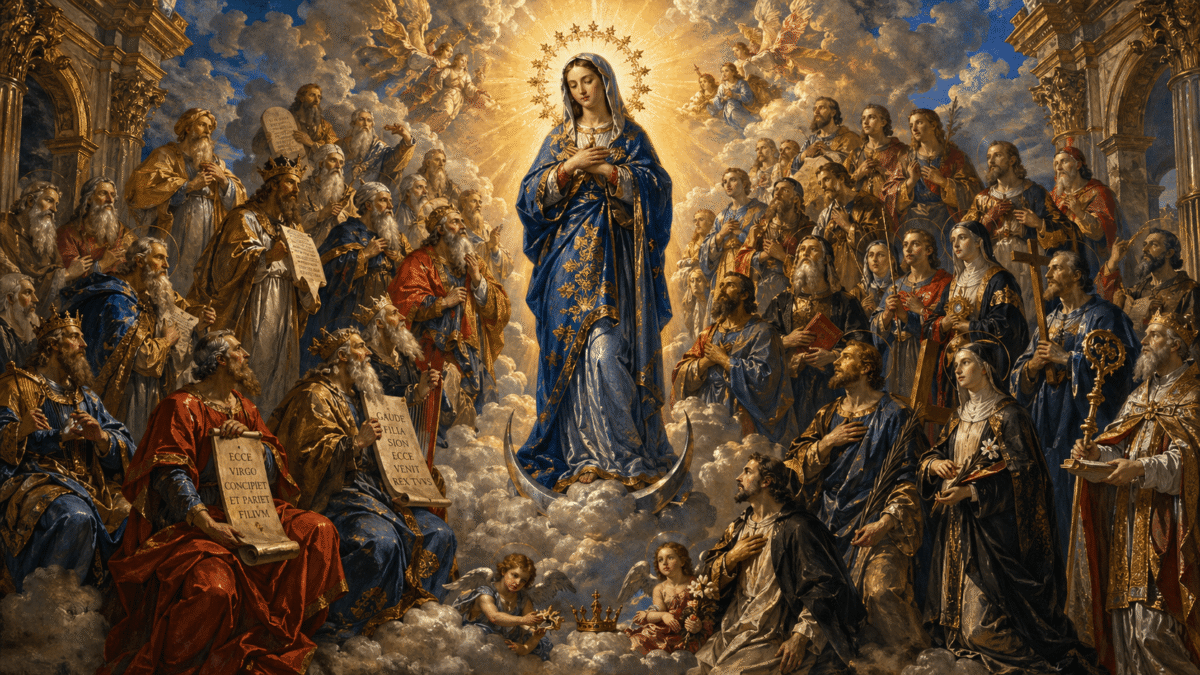
Presence of Mary, the spiritual presence of the Mother in Christian life
The theme of the presence of Mary in Christian life gathers into a synthesis all the titles and prerogatives of the Mother of God and translates them into an existential language: not mere coexistence, but the personal and profound intercommunication between the glorified Virgin and each of the faithful. Contemporary personalist philosophy (Marcel, Mounier, Lévinas) has deepened the concept of presence as “the awareness that someone is with me,” a communion that overcomes the barriers of space and of death, and it is precisely this concept that best translates the mystery of Mary in the Church.
The presence of Mary in the life of Jesus
The infancy gospels bring out the historical and maternal presence of Mary in the life of Jesus, from the virginal conception (Lk 1:31) to the hidden life of Nazareth. The Second Vatican Council sums up this presence: “she offered herself totally as the handmaid of the Lord to the person and the work of her Son, putting herself at the service of the mystery of redemption under him and with him” (LG 56). At Cana, Mary exercises “the role of spiritual mother of the disciples, in the sense that it is through her faith that they are led to faith in Jesus.” At Calvary (Jn 19:25-27), Jesus officially proclaims the spiritual motherhood of Mary over the Church, represented in John. “In conceiving Christ, in giving birth to him, in nourishing him, in presenting him to the Father in the temple, in suffering with her Son as he died on the cross, she cooperated in an altogether special way in the work of the Savior” (LG 61).
The presence of Mary in the early Church and in tradition
In Acts 1:14, Mary appears at the heart of the first nucleus of the nascent Church, “assiduous and of one accord in prayer” with the apostles in the Upper Room. Luke establishes a parallel between the Annunciation and Pentecost: at the two births, that of Jesus and that of the Church, the Mother of Christ is dynamically present. The patristic tradition attests this presence: Ambrose of Milan uses the expression praesentia Mariae. Chromatius of Aquileia affirms that “one cannot speak of the Church if Mary, the mother of the Lord, is not present in her.” Germanus of Constantinople writes that Mary “dwells with us in spirit.” Bernard of Clairvaux affirms that “the whole universe shines with the presence of Mary.”
Theological interpretations of the Marian presence
Theology distinguishes five modalities of Mary’s presence. The intellective presence: immersed in God in the beatific vision, Mary sees, knows, and accompanies each of the faithful. The affective presence: with her maternal love, the Virgin is close to each one in time and in space. The operative presence: love is essentially operative, and Mary acts in us by moral or physical-instrumental causality. The real presence (Ragazzini): the Virgin is present through a communication of life and a participation in her fullness of grace. The pneumatic-personal presence (a modern interpretation): in the light of the mystery of the Assumption, the historical acts of Mary can be re-presented in Christ and in the Spirit beyond time and space. Mary glorified is our contemporary and can reach all her children hic et nunc.
The Assumption as the foundation of the universal presence
The Assumption of Mary in body and soul is the theological key to her universal presence: “Taken up to heaven, she did not lay aside this saving mission, but by her manifold intercession continues to obtain for us the gifts of eternal salvation. By her maternal charity, she cares for the brethren of her Son who, still pilgrims, are placed in the midst of dangers and anxieties” (LG 62). Glorified, Mary is not subject to the limits of space and time: she lives a new spiritual presence, able to reach all her children. The spiritual conclusion of this truth is clear: “It is impossible to honor the ‘full of grace’ without honoring in oneself the state of grace, that is, friendship with God, communion with Him, the indwelling of the Holy Spirit” (MC 57).
Deepen your studies: explore Mariology, Marian Theology, Marian apparitions, and the Postgraduate Program in Mariology.
Magisterium of the Church
Hi omnes erant perseverantes unanimiter in oratione cum mulieribus et Maria Matre Iesu et fratribus eius.
Actus Apostolorum 1,14 (Vulgata)
📚. Literal translation: All these were persevering with one accord in prayer with the women, and with Mary, the Mother of Jesus, and with his brethren.
Postgraduate Program in Mariology
Would you like to deepen your formation in Mariology? Discover the Postgraduate Program in Mariology of Locus Mariologicus – an academic formation that unites theological rigor, spiritual life, and the living tradition of the Church.
Learn what the Church teaches about Mary, Mediatrix of All Graces.
Would you like to study Mariology seriously?
This article grows out of the works in the Locus Mariologicus library. The Postgraduate Program in Mariology takes you to the same source, with academic guidance: Scripture, the Fathers of the Church, and the Magisterium, from the first dogma to contemporary questions.




Responses