He Has Risen as He Said: Acts 10, Col 3, and the Empty Tomb in Jn 20.
Vidit et credidit.
Jn 20:8
Easter Sunday, the heart of the liturgical year, brings together three texts that proclaim the central fact of the Christian faith: God raised Jesus from the dead. Acts 10:34a, 37-43 presents Peter bearing witness to the resurrection before Cornelius: we saw, we ate, we drank with Him after He rose. Col 3:1-4 invites the baptized to seek the things that are above, because their life is hidden with Christ in God. Jn 20:1-9 recounts Mary Magdalene’s going to the tomb at daybreak, the stone removed, the running of Peter and of the beloved disciple, and the moment in which the beloved disciple saw and believed. The three texts describe the same movement: from the tomb to life, from concealment to manifestation, from death to glory.
I. The First Reading: Acts 10:34a, 37-43
Peter takes the floor in the house of Cornelius, the Roman centurion, and delivers the first missionary discourse to pagans. He sums up what happened: “You know what took place throughout Judea, beginning in Galilee, after the baptism preached by John” (Acts 10:37). God anointed Jesus of Nazareth with the Holy Spirit and with power, and He went about doing good and healing all who were under the power of the devil (v. 38). The Jews put Him to death, hanging Him on a tree. “But God raised him on the third day and granted that he become visible, not to all the people, but to the witnesses predestined by God: to us, who ate and drank with him after he rose from the dead” (vv. 40-41). Peter concludes: Jesus was appointed judge of the living and the dead, and all who believe in Him receive the forgiveness of sins through His name (vv. 42-43). Easter is not philosophy: it is testimony. Peter does not argue; he narrates. The resurrection is a fact lived, eaten, drunk, not a theory.
II. The Second Reading: Col 3:1-4
“If you have been raised with Christ, seek the things that are above, where Christ is seated at the right hand of God” (Col 3:1). Paul does not say that you will be raised in the future: he says that you have been raised. Baptism is already a participation in the resurrection of Christ. The consequence is immediate: seek what is above, not what is of the earth. “Your life is hidden with Christ in God” (v. 3). This concealment is not absence: it is the form of Christ’s presence in the time between the Ascension and the Parousia. “When Christ, your life, appears, then you too will appear with him in glory” (v. 4). The disciple’s Easter has two phases: the phase of concealment, in which the new life is hidden beneath the appearance of everyday things, and the phase of manifestation, which will coincide with the glorious coming of Christ.
III. Evangelium: Jn 20:1-9
On the first day of the week, while it was still early morning, Mary Magdalene goes to the tomb and finds the stone removed. She runs to tell Peter and the beloved disciple: “They have taken the Lord from the tomb, and we do not know where they have laid him” (Jn 20:2). The two of them run. The beloved disciple arrives first but stays at the entrance. Peter goes in: he sees the linen cloths on the ground and the cloth that had covered Jesus’ head, folded up and set apart. The beloved disciple goes in. “He saw and believed” (v. 8). The text adds with honesty: “for as yet they did not understand the Scripture, that he must rise from the dead” (v. 9). Easter faith is not born of a prior deduction: it is born of contact with the empty sign and of openness to what the sign points to. The folded cloth, the linen cloths on the ground, the tomb that keeps what is no longer there: these are signs that the beloved disciple read with the eyes of love before understanding them with reason.
IV. Mary and the Sabbath of Faith
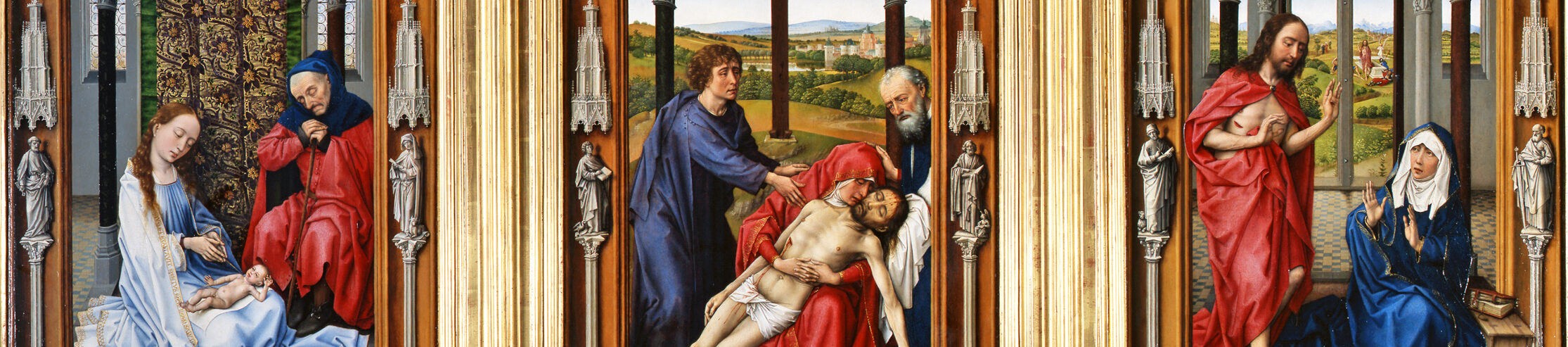
Jn 20 does not mention the Virgin Mary on Easter day. But the contemplative tradition perceived that Mary is the central figure of Holy Saturday: the only one who kept the faith while the Son was in the tomb and the disciples had fled or doubted. Col 3 says that the life of the baptized is hidden with Christ in God: Mary lived this radical concealment on Holy Saturday, with the life of the Son hidden beneath the stone, awaiting the manifestation that she could only believe without yet seeing. Acts 10 affirms that the apostles ate and drank with the Risen One: tradition, from at least the fifth century, attributed to Jesus the first apparition to His Mother, before Mary Magdalene, before Peter, before the disciples of Emmaus, because the love of the Mother was the one that had waited the most. Easter Sunday is the fulfillment of what Mary kept vigil over in the silence of the Sabbath. The stone that the disciples read with surprise, Mary read with hope: she knew, with a faith that no disciple had yet attained, that the Son would return.
Postgraduate Program in Mariology
Would you like to deepen your formation in Mariology? Discover the Postgraduate Program in Mariology at Locus Mariologicus – an academic formation that unites theological rigor, spiritual life, and the living tradition of the Church.


Responses