Go into All the World: Acts 1, Eph 1, and the Ascension of the Lord in Mt 28
Ecce ego vobiscum sum omnibus diebus usque ad consummationem saeculi.
Mt 28:20
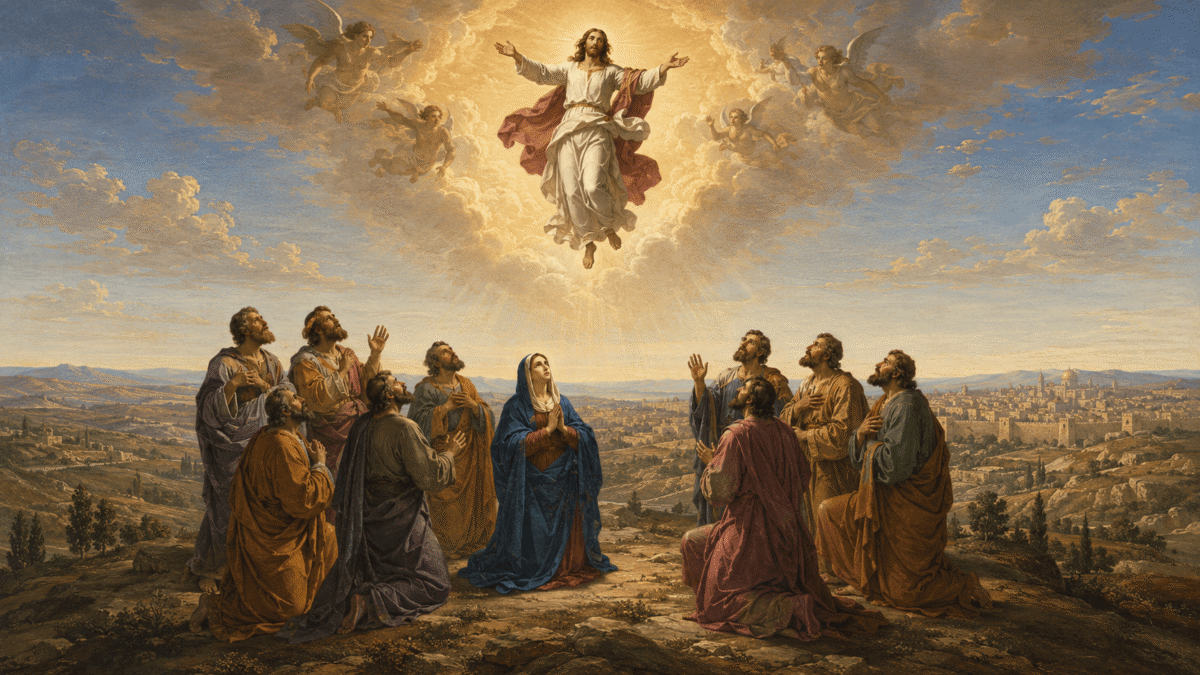
The Ascension of the Lord closes the time of the appearances of the Risen One and opens the time of the Church’s mission in the world. Acts 1:1-11 recounts the end of the appearances: Jesus appeared for forty days speaking of the Kingdom, commanded them to await the Spirit, and was lifted up in a cloud before the disciples. Eph 1:17-23 contemplates the cosmic significance of the Ascension: Christ was placed above every power and principality, as head of the Church, which is his body. Mt 28:16-20 recounts the missionary mandate: all authority has been given to Jesus, go and make disciples of all nations, I am with you all days until the end of time. The three texts describe the same paradox: the visible departure of Jesus is the beginning of a more universal and abiding presence.
I. The First Reading: Acts 1:1-11
Luke begins the Acts with the Ascension of the Lord, recalling what he had recounted in the Gospel: Jesus presented himself alive after the Passion, with many convincing proofs, appearing to them for forty days and speaking of the Kingdom of God. He commands them not to depart from Jerusalem, but to await the promise of the Father, the baptism in the Holy Spirit. The apostles ask whether it is now that he is going to restore the kingdom to Israel. Jesus answers: “It is not for you to know the times or the seasons… but you will receive the power of the Holy Spirit who will come upon you, and you will be my witnesses in Jerusalem, in all Judea and Samaria, and to the ends of the earth” (Acts 1:7-8). He is then lifted up, and a cloud takes him from their sight. Two men in white appear: “Men of Galilee, why do you stand there looking up to heaven? This Jesus, who has been taken up from you into heaven, will come in the same way as you have seen him go into heaven” (v. 11). The promise of his return frames the whole mission of the Church: the time between the Ascension and the Parousia is the time of witness.
II. The Second Reading: Eph 1:17-23
Paul, contemplating the Ascension of the Lord, asks that God give the reader the spirit of wisdom to enlighten “the eyes of your heart, so that you may know what is the hope of his call, what are the riches of the glory of his inheritance among the saints” (Eph 1:17-18). The power of God that raised Christ is the same power at work in the faithful. That power seated Christ “at his right hand in the heavenly places, above every principality, power, virtue, and dominion, and above every name that can be named” (vv. 20-21). “And he put all things under his feet and made him supreme head of the Church, which is his body, the fullness of him who completes all things in all” (vv. 22-23). The Ascension is not a withdrawal of Christ: it is his exaltation to the point at which he can be the head of a universal body, the Church, in all times and in all places.
III. Evangelium: Mt 28:16-20
For Matthew, the Ascension of the Lord coincides with the missionary mandate: the eleven disciples went to Galilee, to the mountain to which Jesus had directed them. When they saw him, they fell down in adoration: “but some doubted” (Mt 28:17). Matthew’s honesty in recording the doubt at the very moment of adoration is revealing: paschal faith coexists with human frailty. Jesus approaches and speaks: “All power in heaven and on earth has been given to me” (v. 18). The Ascension is not a limitation of Christ’s power: it is its universalization. “Go therefore and make disciples of all nations, baptizing them in the name of the Father and of the Son and of the Holy Spirit, teaching them to observe all that I have commanded you” (vv. 19-20). The missionary mandate is Trinitarian: the mission sets out from the authority of the Son, is carried out in the name of the Trinity, and is sustained by his abiding presence: “Behold, I am with you all days, until the end of time” (v. 20). The Jesus who departs is not the Jesus who abandons: he is the Jesus who remains in a new, universal, and definitive way.
IV. Mary and the Ascension of the Lord
Acts 1:14 tells us that, after the Ascension, the disciples returned to the Upper Room and “persevered with one accord in prayer, together with the women and with Mary, the mother of Jesus, and with his brethren.” Mary was present at the Ascension and was in the Upper Room awaiting the Spirit. She who had received the Spirit at the Annunciation now awaits, together with the whole nascent Church, the Spirit who will come upon all. Eph 1 contemplates Christ as head of the Church: Mary is the most eminent member of that Church, the one who most fully received the grace of the head. Tradition calls her “above all the angels and all the saints,” not through merits of her own but through the fullness of what she received from her risen Son. Mt 28 ends with “I am with you all days, until the end of time”: Mary, in the Assumption, is the creature who most fully lives this abiding companionship of the Son. Where the disciples still await the end of time, Mary is already in the presence of the risen Son, and from there she intercedes for all who are still journeying through the time between the Ascension and the Parousia.
Mary’s presence between the Ascension and Pentecost is not a biographical detail but a theological key. Luke, the only evangelist to name her among those who “persevered with one accord in prayer” (Acts 1:14), presents her as the living bond between the time of the Son and the time of the Church. She who had conceived the Word by the action of the Spirit at the Annunciation is now in the Upper Room, at the heart of the community that is about to receive the same Spirit in order to bring forth the Body of Christ in the world. As John Paul II recalls in Redemptoris Mater, there is a pneumatological symmetry between Nazareth and the Upper Room: the Spirit who came down upon Mary to form the humanity of the Son now comes down upon the Church to form his mystical body, and Mary is present at both moments as mother and as disciple.
Eph 1 sheds still deeper light on Mary’s place. If Christ is the head of the Church, and if the Church is “the fullness of him who fills all in all” (Eph 1:23), Mary is the first fruits of that fullness. In her the Church has already attained that toward which all humanity is journeying: full communion with the glorified Lord. The Assumption is the Marian prolongation of the Ascension of the Lord: as the Son was raised in body and soul to the right hand of the Father, so the Mother was raised in body and soul to be with the Son. The Ascension opens the way; the Assumption shows that this way reaches its term in a human creature, the first member redeemed in her entirety.
Mt 28 confirms this Marian reading. The promise “I am with you all days, until the end of time” is fulfilled in a singular way in her who already lives in the unveiled presence of the Son. Mary’s motherhood, received at the foot of the cross (“behold your mother,” Jn 19:27), now extends to the whole Church in mission: she accompanies the disciples sent to all nations, interceding from heaven so that the missionary mandate may not remain without fruit. The Mariology of the Ascension of the Lord is therefore inseparable from a missionary ecclesiology: where the Church goes, Mary precedes her by her intercession, and where the Church arrives, Mary is already waiting as the icon of what the Church is to be.
V. Conclusion: The Ascension of the Lord as a Missionary and Marian Mystery
The three liturgical texts of the solemnity of the Ascension of the Lord converge in a single theological movement: what appears to be a departure is in fact the establishment of a new presence. Acts 1 recounts the historical gesture: Jesus is lifted up and the cloud takes him from the eyes of the disciples, but the two men dressed in white redirect their gaze from heaven to earth, from contemplation to mission. Eph 1 offers the cosmic key: what happened in Jesus concerns everything that exists, because He was made head over all things for the Church. Mt 28 translates the event into a mandate: the universal authority of the Risen One becomes, in the Church, a universal mission, sustained by the promise of a presence that knows no end.
The Ascension is therefore at once a farewell and a sending, an absence and a presence, an end and a beginning. It is the end of the appearances and the beginning of the faith that believes without seeing; it is the absence of the visible body and presence in the sacrament, in the Word, and in the Spirit; it is a farewell to the disciples of Galilee and a sending to the disciples of all nations. The Ecce ego vobiscum sum of Mt 28:20 is not a consolation for the grief of departure: it is the formula of the new history, in which the Lord is closer to the Church by being at the right hand of the Father than he would be if he remained in a single place in Galilee.
In this mystery, Mary is the figure who draws all the threads together. She is present at the Ascension as mother; she is in the Upper Room as disciple; she lives in the Assumption as the first fruits of the glorified Church; she intercedes as mother of the pilgrim Church. To contemplate her in the Ascension of the Lord is to contemplate the destiny promised to all the baptized: to go, to proclaim, to baptize, to teach, and, in the end, to be raised up to the Lord who promised to be with us all days until the consummation of the ages. Ecce ego vobiscum sum omnibus diebus usque ad consummationem saeculi: this promise holds the entire history of the Church, and it holds, before all others, the Mother who first received it and first lived it in its fullness.
Postgraduate Program in Mariology
Would you like to deepen your formation in Mariology? Discover the Postgraduate Program in Mariology of Locus Mariologicus — an academic formation that unites theological rigor, spiritual life, and the living tradition of the Church.



Responses