Whoever Loses His Life Will Find It; Rom 6:4; Mk 10:17. Thirteenth Sunday
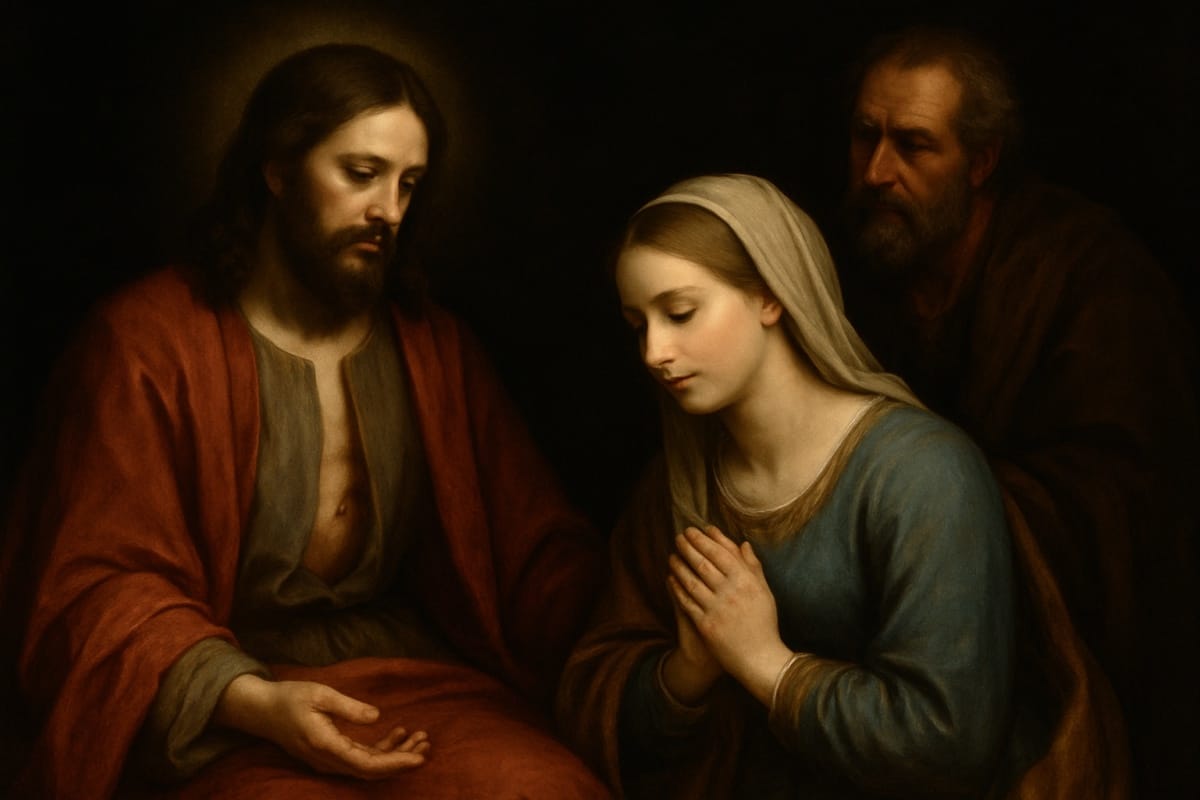
Qui invenerit animam suam, perdet illam: et qui perdiderit animam suam propter me, inveniet eam.
Mt 10:39
The Thirteenth Sunday in Ordinary Time, Year A, brings together three texts centered on the gift of self that generates life. 2 Kgs 4:8-11, 14-16a presents the woman of Shunem, who welcomes the prophet Elisha with radical hospitality: she prepares a room for him, and Elisha, in gratitude, promises her a son she was not expecting. Rom 6:3-4, 8-11 presents baptism as death and resurrection with Christ: whoever dies with Christ in baptism enters a new life that transcends death. Mt 10:37-42 gathers the paradoxes of discipleship: loving Jesus more than one’s own parents, taking up the cross, losing one’s life in order to find it, receiving the messenger as one would receive Christ himself. The three texts describe the same movement: the gratuitous gift that generates life where there was no hope, the death that opens onto life, the loss that turns into gain.
I. The First Reading: 2 Kgs 4:8-11, 14-16a
A woman of Shunem, a woman of means, urged Elisha to eat at her house. Whenever he passed by, he would stay there. She said to her husband: “We know that this man of God who is always passing our way is a holy man. Let us make him a small walled room on the roof and put a bed, a table, a chair, and a lamp there for him, so that he can stay there when he visits us” (2 Kgs 4:9-10). Elisha, wishing to repay her hospitality, asked his servant what he could do for her. She was asking for nothing. The servant told him: she has no son, and her husband is old. Elisha called the woman and said to her: “Next year, at this very season, you shall embrace a son” (v. 16a). The woman of Shunem did not ask for the son: she received him because of her hospitality to the prophet. Generosity draws down blessing, not as a transaction but as God’s gratitude toward an open heart.
II. The Second Reading: Rom 6:3-4, 8-11
“Do you not know that all of us who have been baptized into Christ Jesus were baptized into his death? ” (Rom 6:3). Baptism is not merely a rite of initiation: it is a real participation in the death of Christ. “We were buried with him by baptism into death, so that as Christ was raised from the dead by the glory of the Father, we too might walk in newness of life” (v. 4). The resurrection of Christ is not an event external to the baptized person: it is the model and the agent of his own new life. “If we have died with Christ, we believe that we shall also live with him” (v. 8). “Consider yourselves dead to sin and alive to God in Christ Jesus” (v. 11). Lent and baptism are the same event: the death that opens onto life, the burial that prepares for the resurrection.
III. Evangelium: Mt 10:37-42
Jesus concludes his missionary instructions with the paradoxes of discipleship. “Whoever loves father or mother more than me is not worthy of me. Whoever loves son or daughter more than me is not worthy of me” (Mt 10:37). Love for Jesus does not suppress love for one’s parents or children: it transcends it as the ultimate criterion. “Whoever does not take up his cross and come after me is not worthy of me” (v. 38). The cross is not a metaphor for inevitable suffering: it is the deliberate choice to follow the Crucified One. “Whoever would save his life will lose it. But whoever loses his life for my sake will find it” (v. 39). This is the central paradox of the Gospel: the life that is held on to for oneself withers; the life that is given away finds its fullness. And the promise of identification: “Whoever receives you receives me. Whoever receives me receives the one who sent me” (v. 40). Even the cup of cold water given to a little one will have its reward (v. 42): the logic of the gift knows no loss, even in the smallest gesture.
IV. Mary and the Total Gift of Self
The woman of Shunem prepared a room for the prophet; Mary prepared her own body as a room for the Son of God, a space of total and gratuitous welcome. Just as the woman of Shunem, because of her hospitality to the prophet, received a son she had not asked for, Mary received the gift of being the Mother of God not through merit but through grace. Mt 10:37 speaks of loving Jesus more than father or mother; Mary is the human being who loved Jesus with a higher love than anyone else, and at the same time loved as a mother more fully than any other mother. In Mary, a mother’s love and a disciple’s love do not compete: they coincide and deepen each other. Rom 6 speaks of dying and rising with Christ through baptism; Mary, according to the doctrine of the Assumption, lived this baptismal mystery in a singular and definitive way, associated with the death and resurrection of her Son before all the other members of the body. She who lost everything at the foot of the Cross found everything in the Assumption: the promise of Mt 10:39 fulfilled in its highest form.
Postgraduate Program in Mariology
Would you like to deepen your formation in Mariology? Discover the Postgraduate Program in Mariology of Locus Mariologicus — an academic formation that unites theological rigor, spiritual life, and the living tradition of the Church.




Responses