The Filial Relationship with Mary of Saint Thérèse of the Child Jesus

Introduction
Unlike Islam, which extols God’s transcendence almost exclusively, Christianity places immanence at the center, confessing in Him the almighty “Father,” the “Father” of all (Eph 4:5), from whom all fatherhood in heaven and on earth proceeds (Eph 3:15). It follows that the Christian’s true relationship with the Lord is that of a “son” and a member of the household (Eph 2:19), enabled to call Him by the sweet name of Abba, Father (Gal 4:6), and to conduct himself toward Him, sustained by the gift of piety, with filial trust, with love prevailing over fear.
At the thought that God is our Father, Thérèse of the Child Jesus and of the Holy Face was moved to tears. And, with a brilliant insight, she did not hesitate to place divine fatherhood and adoptive sonship as the doctrinal foundation of her Way of Childhood. The motherhood of Mary is a reflection of the fatherhood of God. This motherhood acted in a vivid and penetrating way on Thérèse’s soul, especially since she had an open, lively, and expansive personality.
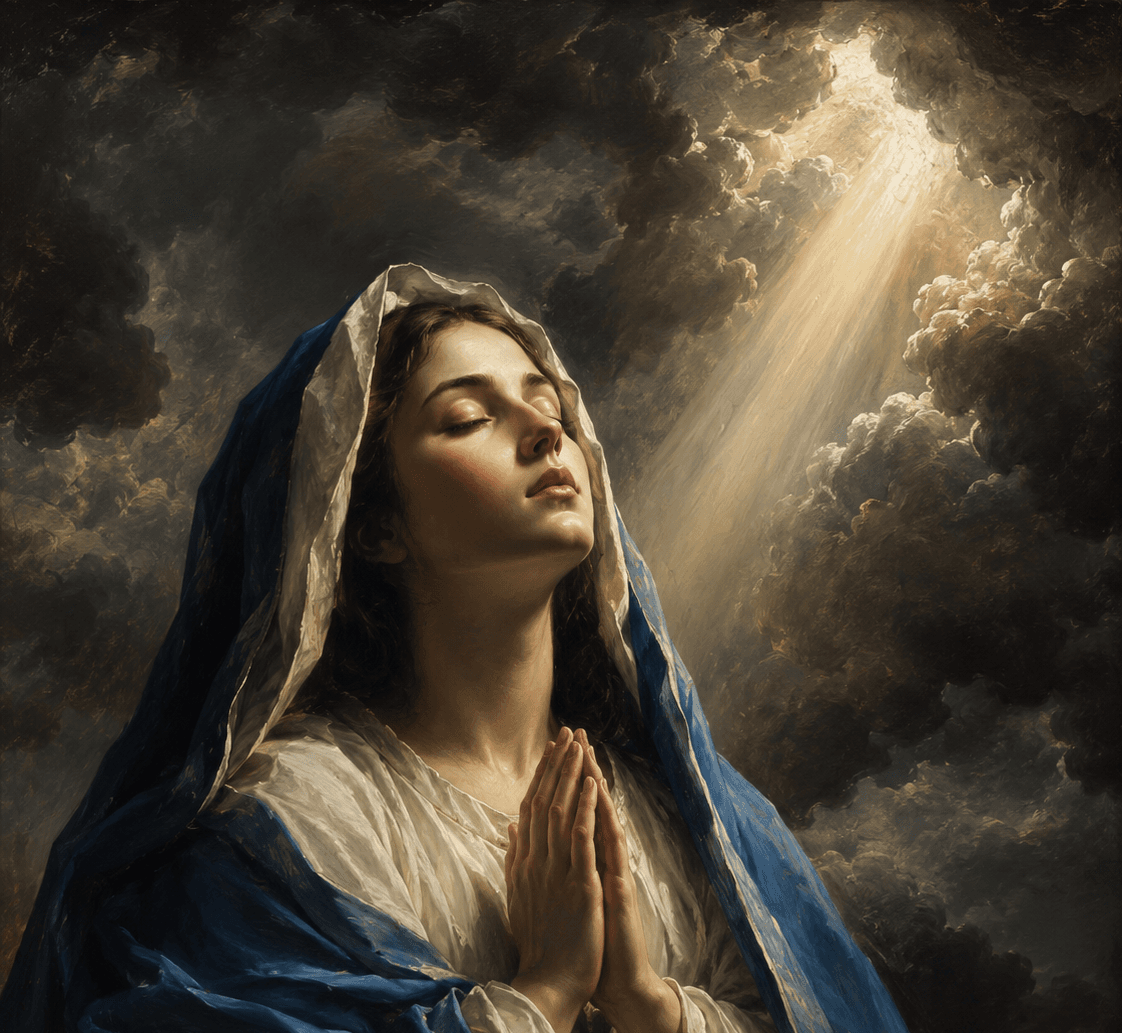
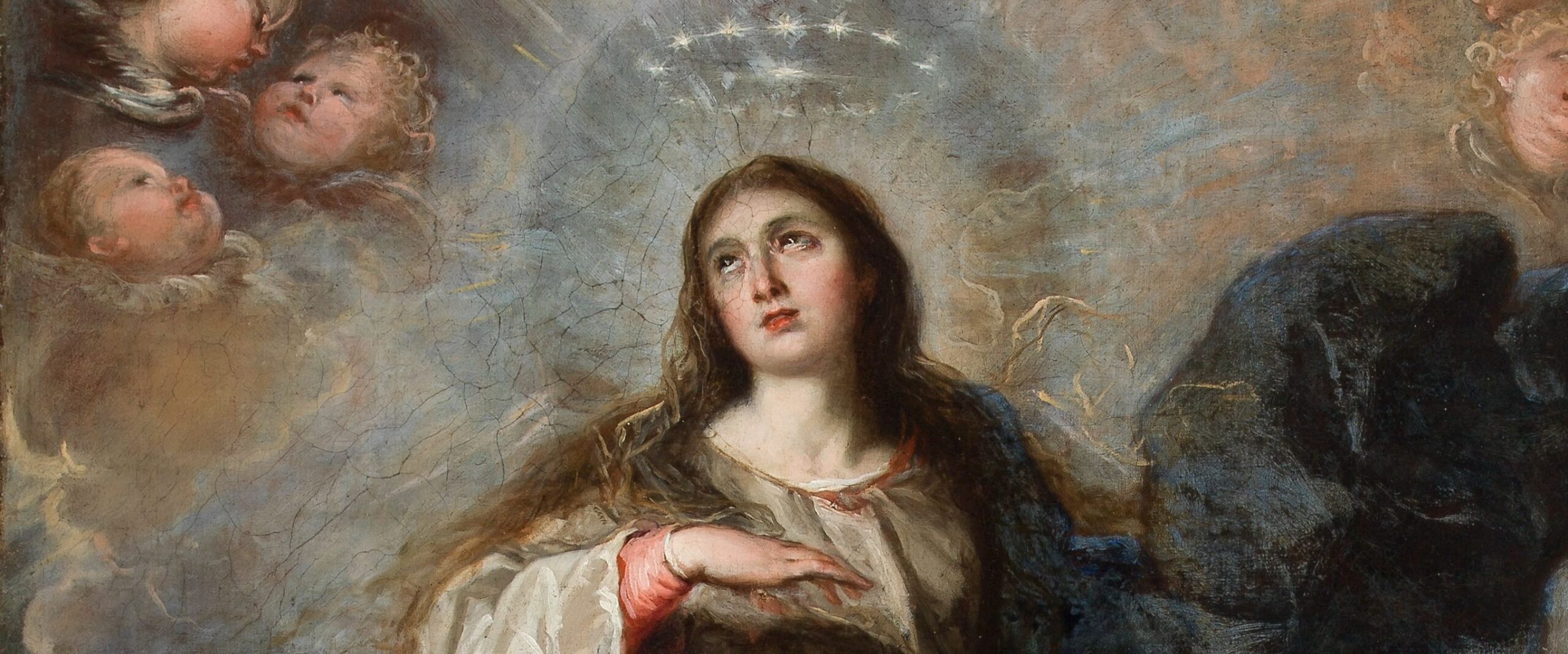
In her collection of holy cards, one was particularly dear to her: symbolically, it represented the two motherhoods of the Blessed Virgin, divine and spiritual, united. The image showed the Virgin Mary seated, tenderly holding on her lap, in addition to the little Jesus, fruit of her virginal womb, another child, as if representing every soul entrusted to her maternal care. What most captivated our Saint in the person of Mary was her goodness of heart. An incomparable goodness, which made her a supremely lovable mother. The name of Mary alone brought Thérèse joy and consolation. In Thérèse’s eyes, Mary was a dear, gentle, tender, most cherished, incomparable mother: of all mothers, the most merciful. A mother, therefore, worthy of boundless love. A Mother given to us, precisely as such, by Jesus in His agony on the cross. And toward us she bears the same love as Jesus.
Before so lovable a mother, or rather, to use the words of Carmelite authors, one who is “super-lovable” and “most super-lovable,” what could and should Thérèse’s habitual attitude be? Without a doubt, that of a daughter: not a servant, not a slave, but solely and exclusively a daughter. We have, moreover, her categorical and indisputable testimony. With firm conviction, Thérèse declared to Mary: “Holy Virgin, here I am, a little creature: I am by no means your servant, but I am your daughter. Mother of Jesus, you are also my mother.” The most beautiful thing is that she places Mary’s motherhood at the foundation of her filial condition: physical motherhood, with respect to the person of Jesus; spiritual motherhood, with respect to the brethren of Jesus, of whom she is one. Hence, she is Mary’s daughter. By proclaiming herself Mary’s “daughter,” and acting as such toward her, our Saint lived the Marian spirituality of her Order in its most genuine form. And through her writings, she confirmed the purest aspect of that spirituality.
Around 1650, in the novitiate of the Discalced Carmelites at Pastrana, the Marian practice of “Perpetual Slavery” was introduced. In the act of consecration, or “Protestation,” the Carmelite promised to live continually as a “slave” of Mary, surrendering himself and his merits to her by a free, total, and irrevocable gift. This practice of “slavery” did not last long, since it proved contrary to the genuine spirit of Carmel. Thérèse of the Child Jesus and of the Holy Face, as an authentic Carmelite, would never have signed a commitment of this kind. On the contrary, in her various writings, she never tires of proclaiming herself a “Daughter of Mary.” As the synthesis and definitive seal of her whole existence, in her swan song, Why I Love You, O Mary, precisely in the last stanza and in the last word, she rejoices to proclaim herself Mary’s daughter: “I want to sing, Mary, because I love you so / And ever repeat that I am your daughter.”
Simplicity, Trust, and Love in the Relationship with Mary
Throughout her earthly pilgrimage, Saint Thérèse of the Child Jesus wove a heavenly relationship of filial sentiments with the Blessed Virgin, animated by simplicity, trust, and love, the three characteristics of her “Way of Spiritual Childhood.” These three movements were natural to Thérèse, so deeply rooted in her soul that they conditioned each of her interior reflexes and marked every exterior attitude. It is not surprising, therefore, to see them emerge so often in her relations with Mary, all the more so since they were radically strengthened by a mother–daughter correlation that fostered familiarity and intimacy.
A) Simplicity
Simplicity, first of all, as a synonym for spontaneity, frankness, sincerity, and transparency. A simplicity that excludes duplicity, hypocrisy, formalism, complicated attitudes, and tortuous paths. A simplicity that, in Thérèse’s case, amounts to a lucid awareness of her condition as a little and poor creature. A simplicity that explains her stance, compared to that of the blessed Seraphim: they did not cover their faces with their wings, but looked at everything and everyone, God, Mary, the Saints, with unveiled faces. A simplicity that led her to beseech the Virgin to make her soul a level ground, free of obstacles, so that a beautiful tent might be pitched there, adorned with Mary’s virtues, and harmonious concerts might be held in it with the participation of the inhabitants of heaven, angels and saints. Simplicity in mortifications. Instead of imitating the great saints in bodily macerations, for which she felt small and unfit, she limited herself to practicing the “little virtues,” following Mary’s example and striving to scatter flowers at the feet of Jesus. Simplicity in prayer. For her, prayer consisted in a surge of love, a cry of gratitude, a gaze of love turned toward heaven. This explains the difficulty, which she candidly confessed, of praying the rosary at length and in haste. On the other hand, an Our Father and a Hail Mary, prayed from the heart, brought her indescribable relief. Simplicity, finally, which, besides accounting for her delicate attitude toward the Holy Family, led her to turn directly to the Virgin for a particular favor, rather than going to the Lord in person, almost as if she were sounding out His will through Mary. Simplicity, joined to modesty and discretion, was a constant in Thérèse’s life. Although it caused her to pass unnoticed, and even to be “disqualified” in the eyes of some of the sisters, it made her extremely pleasing in the eyes of God, to the point of being called the greatest saint of modern times by Pope Pius X. Thérèse herself, however, had heard from an older sister that the soul becomes more pleasing to the Lord the more it exercises itself in simplicity: by simplifying itself, it becomes ever more like God.
B) Trust
To simplicity she joined trust, that is, faith and abandonment carried to the extreme, after going beyond all intermediate limits. A striking testimony to this lofty trust is Thérèse’s own explicit confession: if she had on her conscience the guilt of every possible crime, she would not hesitate for an instant to throw herself, her heart broken with contrition, into the arms of Jesus, knowing well the merciful love with which He welcomed the prodigal son. A trust that prompted her to call Mary by the diminutive “Mama” instead of the formal “Mother.” A trust that fostered the desire to throw herself into her arms with the abandonment of a child toward its mother, much as she did with Jesus. Or else to use the arms of Jesus as an “elevator” to raise herself to the heights of holiness, like a weak little bird carried by His strong arms, He being the Divine Eagle. A trust that led Thérèse to claim for herself, as Mary’s daughter, the “maternal inheritance” of the virtues and merits of the great Mother of God. A trust so deep that it inspired in Thérèse “Marian sayings” so daring that they might cause perplexity, similar to those she said as a child to her mother Zélie, such as: “I wish you would die so that you could go to heaven.” For example, she did not hesitate to tell the Virgin that she is less fortunate than we are because, unlike us, she has no Holy Virgin to admire and love. And also that Mary is less rich than we are, since, while we possess her together with Jesus, she had to deprive herself of Him to leave Him free to evangelize the kingdom and accomplish our redemption. And, in an almost final sentence: “Holy Virgin, if I were the Queen of Heaven and you were Thérèse, I would want to be Thérèse so that you might be the Queen of Heaven.”
C) Love
Simplicity and trust: two wings with which Thérèse managed to rise very high, traversing the infinite regions of love. Among the divine attributes, she preferred mercy above all, valuing love more than fear. Her impulse of trust and abandonment in God, rather than shutting herself up in the anguish of her own weaknesses, exercised a beneficial and comforting influence on the piety of the baptized. As a hammer against the remnants of the cold heresy of Jansenism, Thérèse gained one more title to be proclaimed a Doctor of the Church: a hammer providentially raised up by the Holy Spirit. She fulfilled this mission precisely by exalting mercy above justice, love above fear. For her, it is not dread, not servile fear, but love alone that enlarges the spirit and gives saving value to works: a love that grew in her from childhood and that, over time, became an unfathomable abyss. The attribute of the Lord that most moved and won her over was love: merciful love, to which she chose to offer herself, rather than to divine justice, as a victim of holocaust, through the hands of Mary. Only in love did Thérèse finally find the motive and the purpose of her vocation, the complete fulfillment of her many desires: to be a warrior, a priest, an apostle, a martyr, a doctor. Whether or not this flame of love should be considered a sublimation of natural love does not alter the reality. And in the concrete reality of her daily life, Thérèse made love the driving force of every movement: the unifying center, on both the natural and the supernatural level. The object of her love? Her parents, her sisters, her sisters in the convent, and many others besides. The Lord? She loved Him from childhood. Jesus? She loved Him to the point of folly. For Him she lived on love, and for Him she died of love. And she ended her life gazing at Him, crucified, and saying: “My God…, I love You.” And what of Mary? In her many expressions of love for Jesus, one can glimpse, as in a watermark, the inseparable reflection upon Mary. For the Virgin, Thérèse cherished a tender, trusting, boundless love. And she never tired of repeating it. No saint or servant of God whom she venerated (Saint Joseph, Teresa of Ávila, John of the Cross, Anne of Jesus, Saint Agnes, Saint Cecilia, Joan of Arc, Stanislaus Kostka, Théophane Vénard), none, absolutely none, could compete with the love she reserved for the great Mother of God. Often a fleeting glance at one of her images of Mary, and she had several, was enough to bring her serenity and jubilation, to the point that she saw them as a foretaste of the happiness of heaven. In the inevitable difficulties, her recourse to Mary was natural and trusting, in the certainty that she would receive her help at the moment of need and would never be disappointed. Before beginning to write her memoirs at the request of Mother Agnes of Jesus, her first act was to implore Mary to guide her hand, so that everything she wrote would be true. During her last illness, anxious not to disturb, with her fits of coughing or deep sleep, the sisters who were attending her, she would turn, as was her custom, to the Blessed Virgin, certain of being heard, yet resigned to His will.
In conclusion: simplicity, trust, and love together formed a triad of attitudes that continually animated Thérèse’s relations with the Virgin. Besides constituting the axis of her personal life and of her Way of Spiritual Childhood, these attitudes allowed Thérèse to reflect the threefold impulse derived from the contemplative component of the Carmelite charism: an impulse toward interiority, familiarity, and intimacy.
Conclusion
In the spirituality of Saint Thérèse of the Child Jesus, the relationship with Mary was marked by simplicity, trust, and love, three pillars that constituted her Way of Spiritual Childhood and guided her daily life. Thérèse saw in Mary not only a Mother, but a constant and accessible presence, whose closeness fostered intimacy and familiarity. Reflecting the contemplative essence of the Carmelite charism, Thérèse did not seek great outward manifestations, but lived deeply a spirituality centered on trusting love, without fear or scruples, always surrendering herself into the arms of the Heavenly Mother. In this way, she teaches us that, in our relationship with Mary, true devotion is expressed in total trust, pure love, and simplicity of heart, thus mirroring the merciful love of God.
The lesson we can draw from Thérèse’s life is that, by embracing these virtues and recognizing ourselves as children of Mary, we are invited to live a spiritual life closer to God, marked by humility and loving self-surrender.
Delve deeper into your studies: explore Mariology, Marian Theology, Marian apparitions, and the Postgraduate Program in Mariology.
To deepen Marian devotion in the spirit of Saint Thérèse, consult the Apostolic Exhortation Marialis Cultus by Pope Paul VI.
Postgraduate Program in Mariology
Would you like to deepen your formation in Mariology? Discover the Postgraduate Program in Mariology of Locus Mariologicus, an academic formation that unites theological rigor, spiritual life, and the living tradition of the Church.
Would you like to study Mariology seriously?
This article grows out of the works in the Locus Mariologicus library. The Postgraduate Program in Mariology takes you to the same source, with academic guidance: Scripture, the Fathers of the Church, and the Magisterium, from the first dogma to contemporary questions.


Responses