Come and eat without money: Isa 55, Rom 8, and the feeding of the multitudes in Mt 14
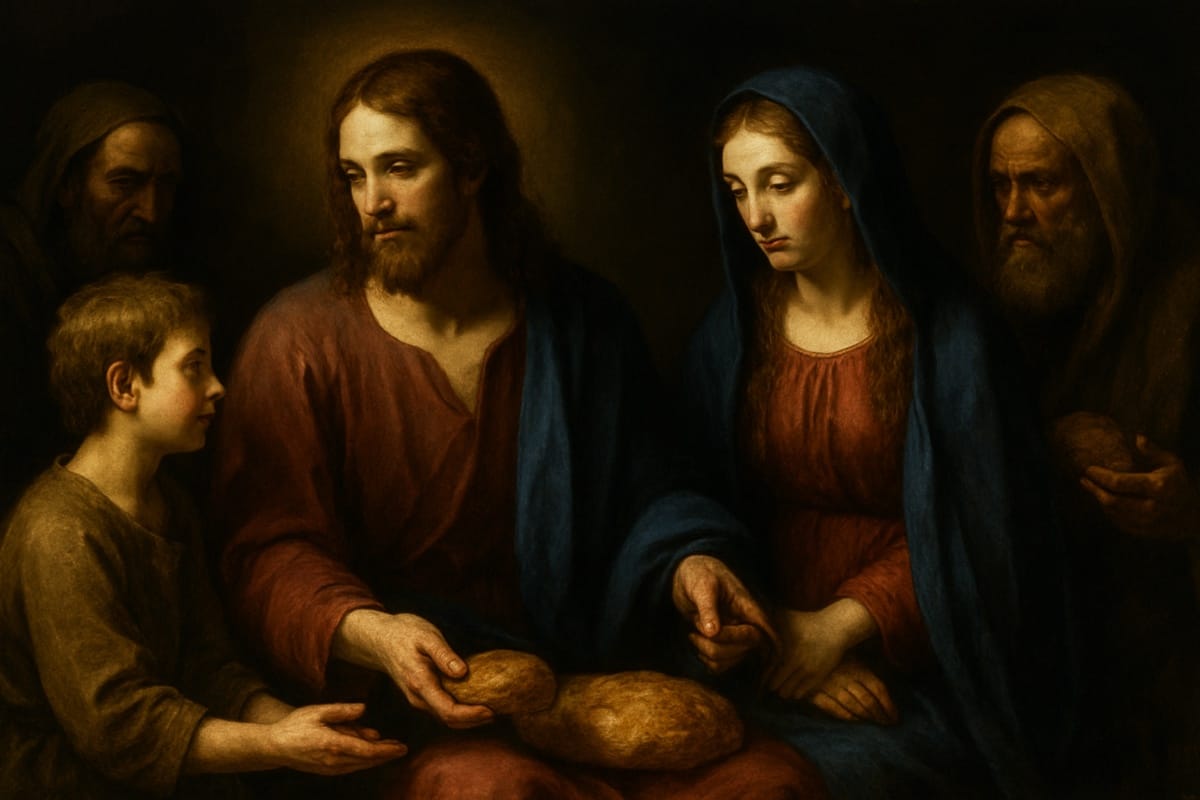
“Quis nos separabit a caritate Christi?” (Rom 8:35)The eighteenth Sunday of Ordinary Time, Year A, weaves together three texts focusing on God’s gratuity and the certainty of His love. Isaiah 55:1-3 invites the poor and thirsty to come and eat without money or price: God’s bread is not for purchase. Romans 8:35-39 proclaims that nothing can separate a believer from Christ’s love: neither death nor life, nor any power. Matthew 14:13-21 narrates the feeding of the five thousand: Jesus feeds five thousand men with five loaves and two fish, a gesture foreshadowing the Eucharist. The three texts depict the same gift: God freely and definitively provides sustenance without anything being able to stop Him.I. First Reading: Isaiah 55:1-3“Come all of you who are thirsty; come to the waters. And those who have no money, come, buy and eat; come, buy wine and milk without money, without cost” (Isaiah 55:1). The Isaiah oracle flips market logic: what God offers has no price because it is not a commodity. It is the covenant. “Why do you spend your money on that which is not bread, and your labor on that which does not satisfy?” (v.2). The prophet diagnoses human problems: spending on things that don’t nourish, pursuing things that don’t fill. The solution is simple: “Listen to me carefully and eat what is good, so that your soul may be satisfied with abundance” (v.2). The condition isn’t payment: it’s listening. Whoever listens eats. Whoever eats lives. The Davidic covenant God offers freely (v.3) forms the basis for all this gratuity: God gave Himself in covenant before any human merit.II. Second Reading: Romans 8:35-39Paul poses a rhetorical question: “Who shall separate us from Christ’s love? Tribulation, distress, persecution, famine, nakedness, danger, sword?” (Rom 8:35). The list includes humanity’s worst experiences: not the absence of comfort, but real hunger, real danger, real threat of the sword. And the answer is categorical: “In all these things we are more than conquerors through Christ who loved us” (v.37). Victory isn’t the absence of suffering; it’s the presence of love transforming it. The final guarantee is absolute: “Neither death nor life, nor angels nor principalities, nor present nor future, nor powers, nor height nor depth, nor anything else in all creation can separate us from God’s love manifested in Christ Jesus our Lord” (vv.38-39). “Any other creature” closes the list: there are no exceptions.III. Gospel: Matthew 14:13-21Jesus retreats to a desert place upon learning of John the Baptist’s death. Crowds follow him on foot. As evening falls, the disciples ask Jesus to send the crowd away so they can buy food in the neighboring villages. Jesus replies: “They do not need to go away. Give them something to eat” (Mt 14:16). The disciples object: all they have is five loaves and two fish. Jesus says: “Bring them here.” He orders the crowds to sit down on the grass. “He took the five loaves and the two fish, looked up to heaven, offered thanks, broke the loaves, and gave them to the disciples, who in turn distributed them to the crowd” (v.19). Everyone ate and was satisfied; there were twelve baskets full of leftovers. There were about five thousand men present, not counting women and children. The sequence “took, looked up to heaven, blessed, broke, gave” echoes the institution of the Eucharist (Mt 26:26): the multiplication of loaves is a foreshadowing of the gift that Easter will make permanent. It is Isaiah 55 in action: God freely feeds those who follow him far away, those who have left their villages where food can be bought.
IV. Mary and the Free Bread
Isaiah 55 invites us to come and eat without money. The greatest free gift of God to humanity was precisely what Mary received before anyone else: the Word made flesh in her womb, without her merit or price possible, purely an act of divine initiative. Mary is the one who lived Isaiah 55 from within: she who received the Bread from Heaven before the world knew there was Bread from Heaven. When Jesus fed the five thousand, Mary, whose presence in this scene the Gospel does not mention, had already experienced the silent multiplication: for nine months, the bread that would feed humanity grew within her. The assurance of Romans 8:39, “Nothing can separate us from the love of God manifested in Christ Jesus,” found its most radical verification in Mary: neither the anguish of flight to Egypt, nor the loss in the Temple, nor the incomprehension of relatives, nor the agony on the Cross could separate Mary from the Son’s love. In each of these moments, Mary lived the certainty that Paul articulates: those who are in Christ’s love are more than conquerors, even when everything seems lost.Post-Graduate in Mariology
Want to deepen your formation in Mariology? Discover the Post-Graduate Program in Mariology from Locus Mariologicus – an academic formation that combines theological rigor, spiritual life, and the living tradition of the Church.


Responses