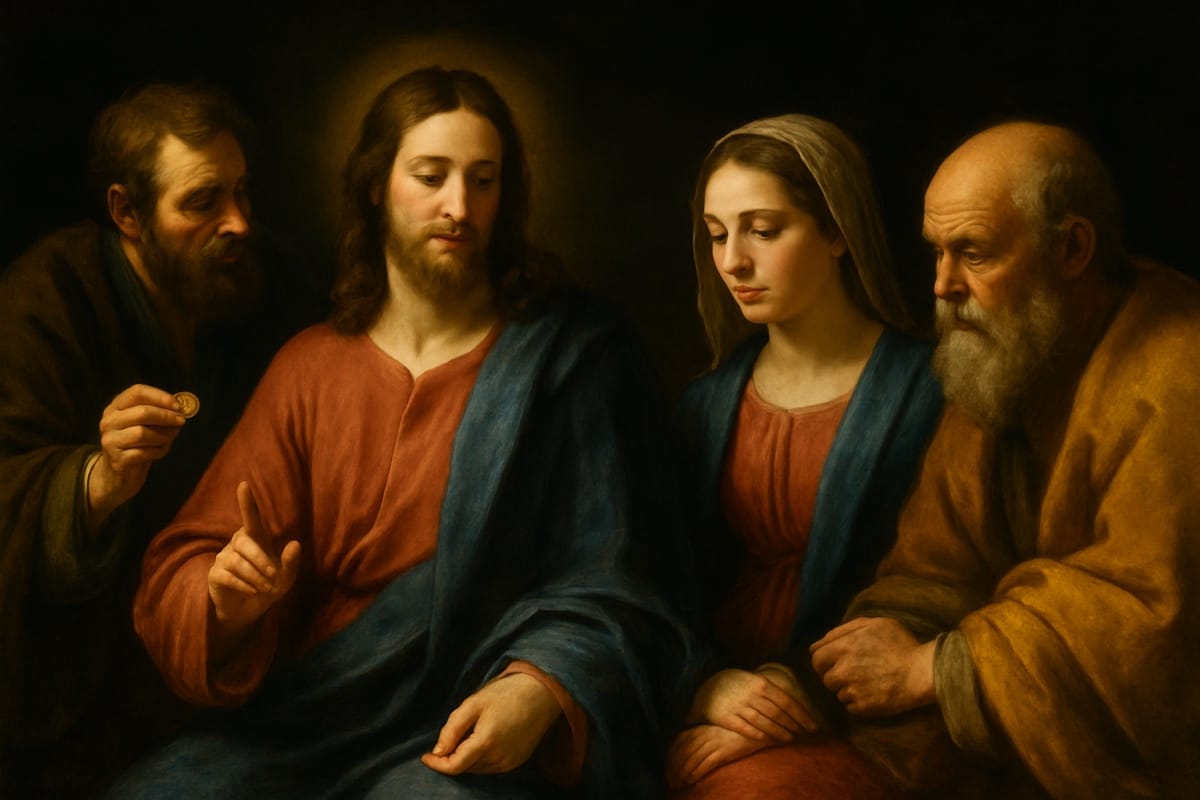
“Give to Caesar what is Caesar’s, and to God what is God’s: Isa 45:1, 1 Tim 1:1, and the question of the tax in Mt 22.”
Scripture:
“Give to Caesar what is Caesar’s, and to God what is God’s.” (Matthew 22:21)
Reflection:
The 29th Sunday of Ordinary Time, Year A, weaves together three texts focusing on God’s sovereignty over history, using unexpected instruments, and distinguishing between what belongs to Caesar and what belongs to God.
I. The First Reading: Isaiah 45:1-6
God addresses King Cyrus of Persia: “Thus says the Lord to his anointed, to Cyrus, whom I have taken by the right hand to subdue nations before him and to strip kings of their armor” (Isaiah 45:1). “Anointed” (mashiach) is a title reserved for Israel’s kings, and attributing it to a pagan king is provocative and theologically bold. The explanation follows: “For Jacob my servant’s sake, and Israel my chosen, I called you by your name; I bestowed on you a title of honor, though you did not know me” (v. 4). Cyrus acts for Israel without realizing it, serving as God’s instrument without conscious awareness. The conclusion transcending the immediate political context: “I am the Lord, and there is no other; there is no God besides me” (v. 5). Israel’s liberation from Babylonian captivity is not a geopolitical accident but the act of a God who governs the entire history, using pagan kings as his tools.
II. The Second Reading: 1 Thessalonians 1:1-5b
Paul begins his first letter to the Thessalonians with a prayer of thanksgiving for their work of faith, labor of love, and perseverance of hope in our Lord Jesus Christ (1 Thessalonians 1:3). The three theological virtues—faith, love, and hope—are described as active forces shaping their existence. Paul’s assurance is rooted in their election: “We know, brothers beloved by God, that you were chosen by the word of God, which has had its effect in you, and that you have come to faith in Jesus Christ” (vv. 4-5). The Gospel has an inherent power that transcends the preacher’s eloquence; it is the Spirit’s power at work in those who receive it.
III. The Gospel: Mt 22:15-21
The Pharisees and Herodians conspired together, an extraordinary event given their political adversaries, to trap Jesus. The question is carefully crafted to be without an answer: “Is it lawful to give tribute to Caesar or not?” If he says yes, he appears to be collaborating with the Roman occupier. If he says no, he is subversive and could be arrested. Jesus asks for a coin of the tribute. “Whose image and inscription is this?” “Caesar’s.” “Therefore, give to Caesar what is Caesar’s and to God what is God’s” (Mt 22:21). The answer is not an evasion; it is a profound theological distinction. The coin with Caesar’s image belongs to Caesar: it is reasonable to return it. But the creature with God’s image belongs to God: and this claim has no exception. The political question of the tribute is relativized by the theological question of the image: what was done to God’s image belongs to God, and that is far more significant than any political obligation.
IV. Mary and the Image of God
Jesus’s answer, “give to God what is God’s”, evokes the question of the image. The human being, created in the image of God (Gen 1:27), is what should be given to God. Mary gave to God the most perfect of human beings: the very Son of God made flesh, who is the image of the invisible Father (Col 1:15). In Mary, giving to God what is God’s reached its peak: she who received the Son gave him to the world and gave him back to the Father on the Cross. Isaiah 45 describes Cyrus as God’s instrument unaware. Mary is the opposite: an instrument of God with full knowledge and full consent. She knew the Scriptures, she knew the promise, and she said, “be it done unto me according to thy word.” 1 Thessalonians 1 celebrates active faith, diligent love, and persistent hope. Mary is the perfect model of the three virtues: her faith was active (from the Fiat to the Cross and to the Cenacle), her love was diligent (she served until the end), and her hope persevered when nothing seemed left.
Postgraduate specialisation in Mariology
Would you like to deepen your formation in Mariology? The Locus Mariologicus postgraduate programme is a specialisation that brings together theological rigour, spiritual life and the living tradition of the Church. The next class begins in 2027.





Responses