The Canaanite Woman and the House of Prayer for All Peoples: Is 56, Rom 11, and Mt 15
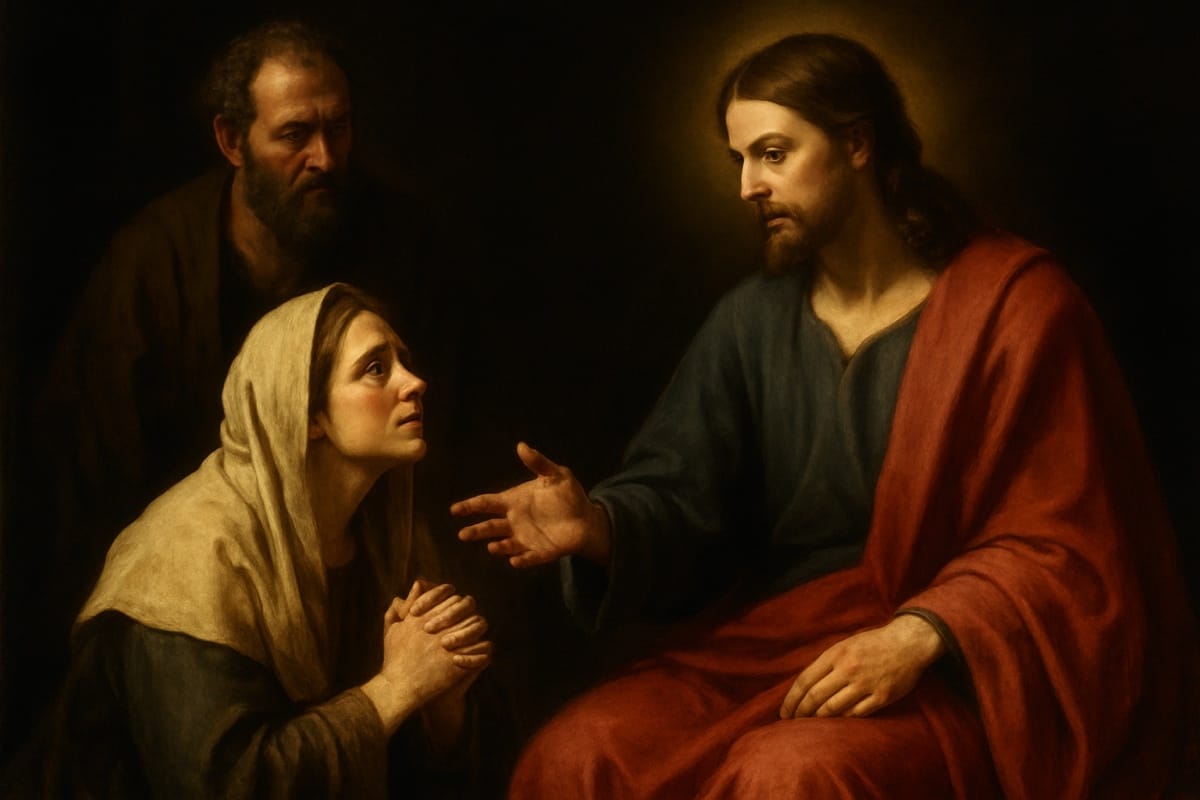
O mulier, magna est fides tua: fiat tibi sicut vis.
Mt 15:28
The Twentieth Sunday in Ordinary Time, Year A, brings together three texts centered on the universality of salvation and the perseverance of faith. Is 56:1, 6-7 declares that the house of God will be a house of prayer for all peoples, including the foreigners who join themselves to the Lord. Rom 11:13-15, 29-32 affirms that the gifts and the call of God are irrevocable and that He has consigned all to disobedience in order to have mercy on all. Mt 15:21-28 recounts the obstinate faith of the Canaanite woman: Jesus seems to ignore her, the disciples ask Him to send her away, but she insists and Jesus proclaims: “Great is your faith.” The three texts converge: salvation does not shut itself up within one group, the mercy of God goes beyond the expected boundaries, and the faith that perseveres prevails.
I. The First Reading: Is 56:1, 6-7
The Lord declares: “Keep judgment and practice justice, for my salvation is close at hand and my justice about to be revealed” (Is 56:1). And then He opens a boundary unheard of for the thinking of that time: “The foreigners who have joined themselves to the Lord to serve him, to love the name of the Lord and to be his servants, all who keep the sabbath without profaning it and hold fast to my covenant, these I will bring to my holy mountain and gladden in my house of prayer” (vv. 6-7). And the conclusion is the phrase that Jesus will quote in the temple: “For my house shall be called a house of prayer for all peoples” (v. 7). The temple is not the property of one people: it is the place where all who love the Lord meet. The identity of the people of God is defined not by blood but by the covenant, by love for the divine name, by the practice of justice.
II. The Second Reading: Rom 11:13-15, 29-32
Paul, the apostle of the Gentiles, explains the paradoxical logic of the history of salvation. He glorifies his ministry among the pagans with one purpose: “to stir my own countrymen to jealousy” (Rom 11:14), so that some may be saved. The reasoning is bold: “If their rejection brought the reconciliation of the world, what will their admission be but a resurrection from the dead”? (v. 15). And the principles that structure everything: “The gifts and the call of God are irrevocable” (v. 29). God does not change His mind about those He has called. And the conclusion embraces everyone: “God has consigned all to disobedience in order to have mercy on all” (v. 32). “All” appears twice: all in disobedience, all in mercy. Not as an arithmetical balance, but as a description of the breadth of the divine love that lets no one escape the need for grace, and does not wish to let anyone escape the offer of mercy.
III. Evangelium: Mt 15:21-28
Jesus withdraws to the region of Tyre and Sidon, pagan territory. A Canaanite woman comes crying out: “Lord, Son of David, have pity on me! My daughter is gravely possessed by a demon” (Mt 15:22). Jesus does not answer her a word. The disciples ask Him to send her away, because she keeps shouting after them. Jesus answers with an apparent limitation: “I was not sent except to the lost sheep of the house of Israel” (v. 24). The woman prostrates herself and asks: “Lord, help me” (v. 25). Jesus hardens His reply: “It is not right to take the bread of the children and throw it to the little dogs” (v. 26). The woman’s answer is masterly: “True, Lord, yet even the little dogs eat the crumbs that fall from the table of their masters” (v. 27). Jesus proclaims: “O woman, great is your faith! Let it be done as you wish” (v. 28). Her daughter was healed at that very moment. The resistance of Jesus is not rejection: it is the test that faith needed in order to reveal its full stature. The Canaanite woman is the model of the prayer that does not give up, that turns a limitation into an argument, that uses her very exclusion as a reason to be included.
IV. Mary and the House of Prayer for All
Is 56 promises a house of prayer for all peoples. Mary stands at the center of that universality: in Acts 1:14, the Upper Room where the disciples persevered in prayer had Mary in its midst, gathering Jews and Gentiles around the same Spirit. The house of prayer that Is 56 prophesied begins to be realized in the Upper Room, and Mary is its heart. The faith of the Canaanite woman sheds light on another Mariological episode: Cana. At Cana, Mary asks Jesus and He answers with an apparent limitation (“My hour has not yet come”), just as He answered the Canaanite woman with silence and then with the saying about the children and the dogs. Mary, like the Canaanite woman, does not give up: she says to the servants, “Do whatever He tells you.” And Jesus acts. Mary’s prayer has the structure of the Canaanite woman’s faith: she insists without demanding, she turns the limitation into trust, she awaits God’s moment without forcing it. Rom 11:32 says that God wills to have mercy on all: Mary is the mediatrix who intercedes for all, because she knows, from her own experience, that the Son does not resist those who persist with humility.
Postgraduate specialisation in Mariology
Would you like to deepen your formation in Mariology? The Locus Mariologicus postgraduate programme is a specialisation that brings together theological rigour, spiritual life and the living tradition of the Church. The next class begins in 2027.



Responses