Immaculate Conception: What It Is, Its Meaning, and the Dogma
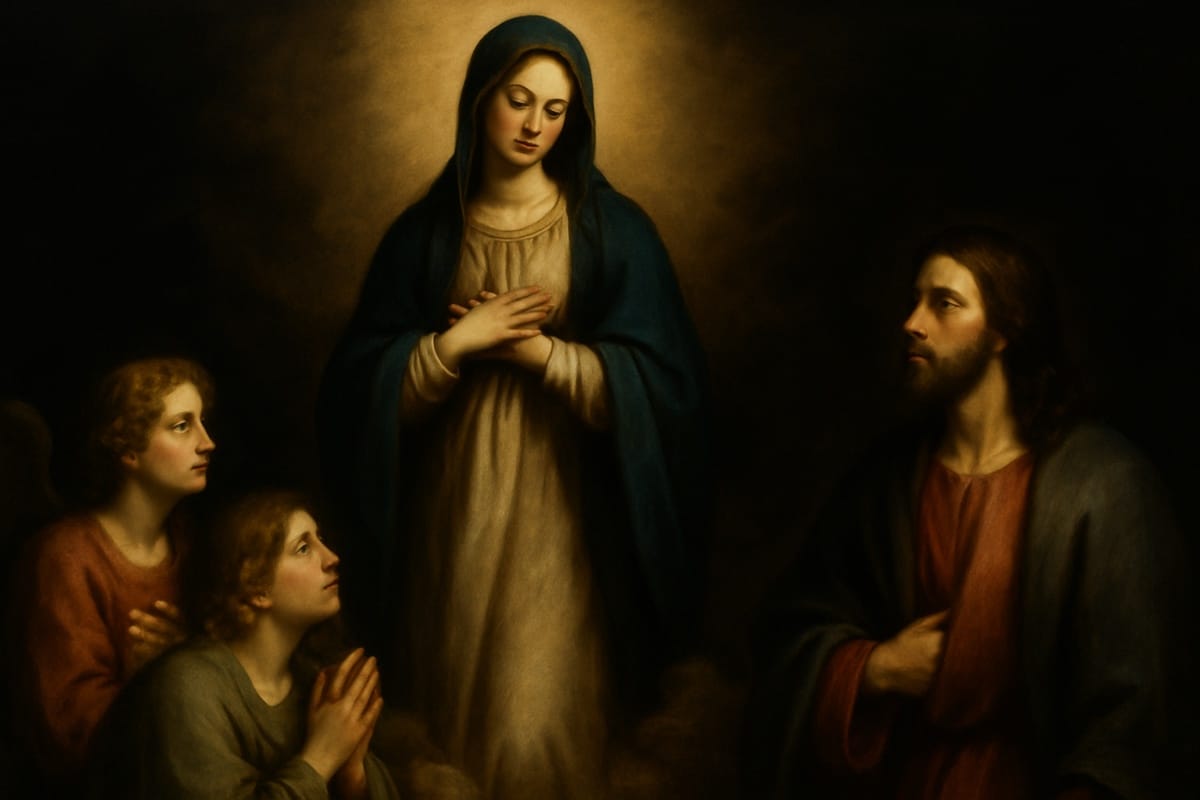
The Immaculate Conception is the dogma according to which the Virgin Mary was preserved from all original sin from the first instant of her conception, by a singular grace of God, in view of the merits of Jesus Christ. It was defined by Pope Pius IX in 1854. Here we explain its meaning, its biblical roots, the long history of its discernment, and what it means for the Christian life.
What Is the Immaculate Conception?
It means that Mary, from the instant she was conceived in the womb of her mother (Saint Anne), was never under original sin. Not by her own merit, but because she was redeemed in a more perfect way: instead of being freed from sin after contracting it, she was preserved from contracting it, in view of the future merits of Christ (CCC 491-492).
A Frequent Confusion
The Immaculate Conception does not refer to the conception of Jesus, nor to the virginity of Mary. It refers to the conception of Mary herself. These are distinct truths: the virginal conception of Jesus is another matter.
Biblical Roots
The dogma has two great supports in Scripture: the greeting of the angel, “Hail, full of grace” (Lk 1:28) – a title that indicates a singular fullness -, and the Protoevangelium of Gen 3:15, the total enmity between the Woman and the serpent. There Tradition reads Mary’s complete victory over sin.
A Long History of Discernment
Faith in Mary’s original holiness is present from the Fathers onward, but its formulation matured slowly. In the Middle Ages it was much debated: Saint Bernard and even Saint Thomas Aquinas expressed reservations (how to reconcile the preservation with the universal redemption of Christ?). The decisive answer came from the Franciscan Blessed Duns Scotus: God could do it, it was fitting, therefore He did it (“potuit, decuit, fecit”) – and He did it in such a way that Mary was the one most perfectly redeemed by Christ. The liturgy gradually took up the feast centuries before the definition.
The Definition of the Dogma (1854)
On December 8, 1854, Pope Pius IX, in the bull Ineffabilis Deus, solemnly defined the Immaculate Conception as a truth of faith. Four years later, at Lourdes (1858), Our Lady confirmed it to Saint Bernadette with the words: “I am the Immaculate Conception”.
What It Means for Us
The Immaculate Conception does not set Mary apart from us: it shows what the grace of Christ can do in a human creature, and anticipates in her the destiny of holiness to which the whole Church is called. She is the first fully redeemed – a sign of hope for all the redeemed.
See also
Explore this theme more deeply through all our articles in the Immaculate Conception archive.
Frequently Asked Questions
Is the Immaculate Conception about Mary or about Jesus?
About Mary: her conception without original sin. The virginal conception of Jesus is another truth.
When was the dogma defined?
On December 8, 1854, by Pope Pius IX, in the bull Ineffabilis Deus.
If Mary had no sin, did she need to be saved?
Yes. She was redeemed by Christ in an even more perfect way: preserved from contracting sin, instead of freed from it afterward.
Text of the Locus Mariologicus Institute, founded in Rome. Scientific direction by Prof. Dr. Daniel Cerqueira Afonso (PhD, Marianum).
This truth is one of the Church’s four Marian dogmas.
See also
Would you like to study Mariology seriously?
This article grows out of the works in the Locus Mariologicus library. The Postgraduate Program in Mariology takes you to the same source, with academic guidance: Scripture, the Fathers of the Church, and the Magisterium, from the first dogma to contemporary questions.


Responses