The Visitation of Mary to Elizabeth (Lk 1:39-56): The Encounter and Its Meaning
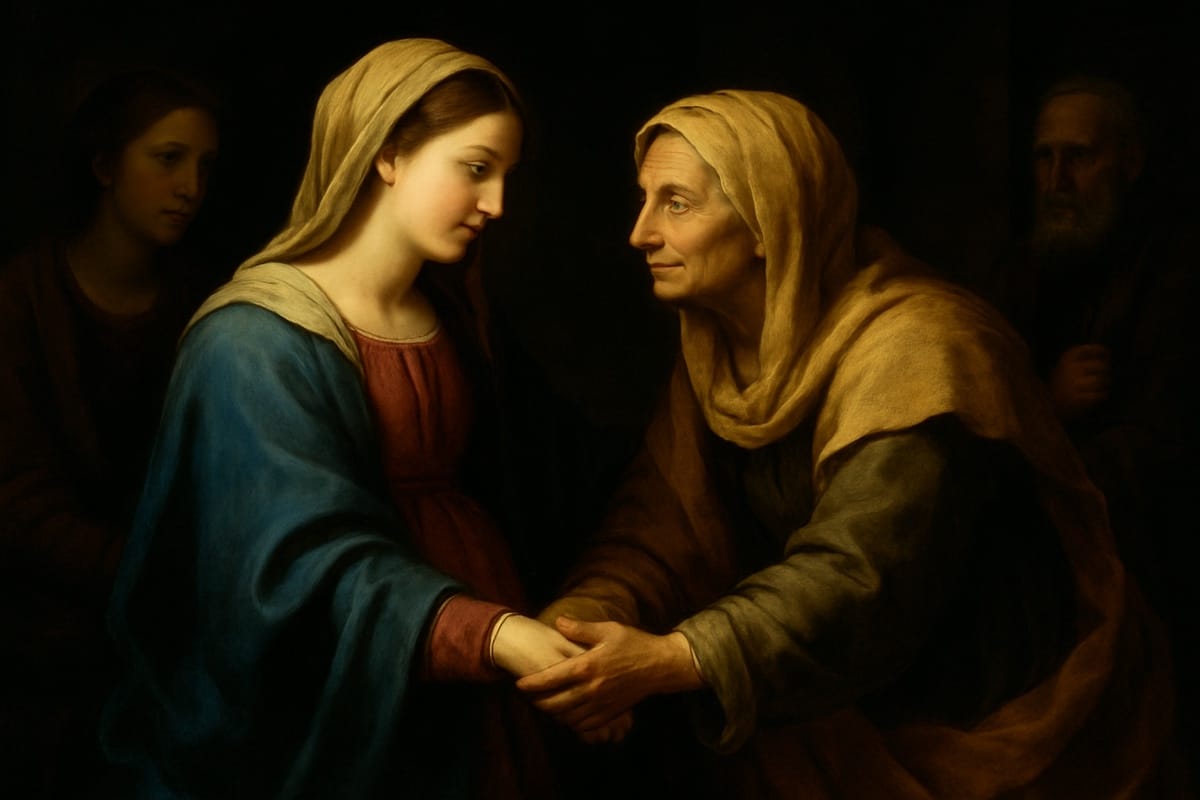
The Visitation (Lk 1:39-56) narrates Mary’s journey, right after the Annunciation, to visit her kinswoman Elizabeth, who was expecting John the Baptist. It is one of the most beautiful episodes of the infancy Gospel: the encounter of two mothers and of two children yet unborn, the recognition of the Messiah, and the canticle of the Magnificat. From this encounter is also born the second part of the Hail Mary. This guide explains the text and its meaning.
The text (Lk 1:39-45)
“In those days Mary arose and went with haste into the hill country, to a city of Judah. She entered the house of Zechariah and greeted Elizabeth. When Elizabeth heard Mary’s greeting, the child leaped in her womb, and Elizabeth was filled with the Holy Spirit. And she exclaimed with a loud cry: Blessed are you among women, and blessed is the fruit of your womb! How does it happen to me that the mother of my Lord should come to visit me?… Blessed is she who believed, for what was spoken to her from the Lord will be fulfilled.”
Mary, the new Ark of the Covenant
Elizabeth’s words – “How does it happen to me that the mother of my Lord should come to me?” – echo those of David before the Ark of the Covenant: “How shall the Ark of the Lord come to me?” (2 Sam 6:9). Mary, who bears the Lord in her womb, is thus presented as the new Ark who brings the presence of God. John the Baptist’s leap of joy in the womb evokes David’s dance before the Ark: the precursor already exults before Him who is to come.
Elizabeth’s confession of faith
Filled with the Holy Spirit, Elizabeth proclaims three things that have the value of a true confession of faith:
- “Blessed are you among women” – praise of Mary’s singular blessing, words that, joined to the angel’s greeting, form the Hail Mary.
- “The mother of my Lord” – the first recognition, in the Gospel, of Mary as Mother of the Lord, the biblical root of the title Theotokos.
- “Blessed is she who believed” – Mary is proclaimed blessed not first for her motherhood, but for her faith, in parallel with her “yes” at the Annunciation.
Continuity and progress
The Visitation is the direct consequence of the Annunciation: Mary goes to Elizabeth to verify the sign the angel had given her (Lk 1:36) and, above all, to bring the good news of salvation and the presence of the Lord. What the angel had announced in private is now confirmed and proclaimed aloud by Elizabeth, under the action of the Spirit. The scene culminates in the Magnificat, in which Mary returns to God all the praise.
Frequently Asked Questions
When is the Visitation celebrated?
On May 31, bringing the month of Mary to a close.
Does the Hail Mary come from the Visitation?
Yes, in part: “Blessed is the fruit of your womb” are words of Elizabeth at the Visitation, joined to the angel’s greeting at the Annunciation.
Why did John the Baptist “leap” in the womb?
It is the gesture of exultation of the precursor who recognizes the presence of the Messiah – an echo of the joy before the Ark of the Covenant.
See also
Would you like to study Mariology seriously?
This article grows out of the works in the Locus Mariologicus library. The Postgraduate Program in Mariology takes you to the same source, with academic guidance: Scripture, the Fathers of the Church, and the Magisterium, from the first dogma to contemporary questions.



Responses