Our Sorrow and Our Lady of Sorrows

The liturgical memorial of Our Lady of Sorrows, celebrated on September 15, invites us to reflect on human suffering in the light of Mary’s compassio. Before the cross of her Son, the Mother did not withdraw and did not fall silent: she remained, she suffered, and in that suffering she became the mother of all who weep. This reflection travels through the seven sorrows of Mary not as a catalog of sadness, but as a spiritual path that transforms our sorrow into compassion and paschal hope.
The feast of September 15 places Mary’s compassio within a precise horizon: not a devotional sentimentalism, but Mary’s co-participation in the redemptive mystery of her Son, just as Lumen Gentium 58 defines it. The central theological question is to distinguish authentic devotion to Mary’s suffering from the risk of a sentimental absolutization that empties the Cross of its salvific meaning.
The liturgy of September 15: Mary’s compassio and the human limit of suffering
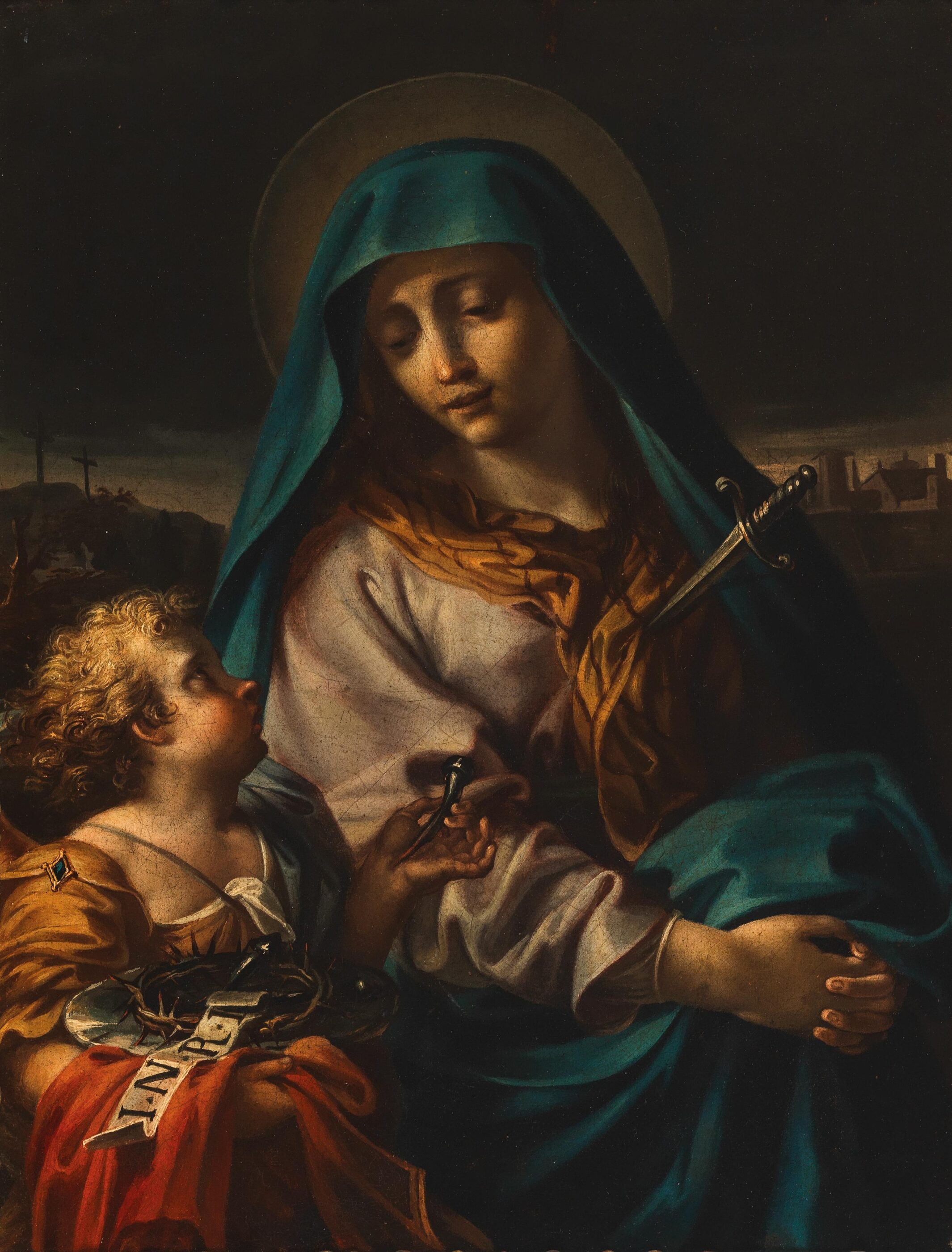
The exact name of the liturgical memorial of September 15 is precisely the epithet of Our Lady of Sorrows. It identifies a person, that is, a sorrowing woman, Mary the mother of Jesus. The devotional forms contemplate the situations of pain and the afflictions of that same person, that is, the seven sorrows of Mary. September 15 therefore represents an opportunity to stand close, with compassionate attention, to a suffering human person such as Mary was, and to renew our commitment to extend that same attitude of compassion toward those who suffer, such as those afflicted by the various forms of pain encountered in daily life.
Pain is an inalienable inheritance of human life. It is a transitory situation, a passage toward harbors of stable joy. To suffer is a stage of existence: “The whole creation groans and suffers until now in the pains of childbirth, and not only it, but we ourselves too, who have the firstfruits of the Spirit, groan inwardly as we await adoption as sons, the redemption of our body” (Rom 8:22-23). One cannot renounce pain, just as one cannot renounce life.
It is possible to ask for relief, for lessening, for the removal of the cup of sorrow (cf. Mt 26:42). It is possible to give value to pain by transforming it into a sacrificial offering (cf. Phil 2:17). Mutual compassion is possible, bearing one another’s burdens and sorrows (cf. Gal 6:2). The celebration of the Virgin of Sorrows is a pause in which to rethink our convictions of faith, which at times waver before the impact of our own pain or the pain of others. To assess the reaction in the face of pain, often steeped in despair or rebellion, and the common feeling regarding the pain of others, not always shared but, on the contrary, frequently deadened by indifference, insensitivity, and evasive fears.
Mary’s compassion (Lumen gentium 58): between authentic devotion and the risk of sentimental absolutization in contemporary theology
Marian devotion suffers an impaired outcome if the figure of the Virgin of Sorrows is absolutized. On earth, Mary was an afflicted woman; her earthly history includes human sorrows. But her present reality is no longer that of an afflicted woman, but rather that of a woman in glory, for she shares fully in the glory of the Lord, just as during her mortal life she shared experiences of pain.
This truth of faith, the Assumption into heavenly glory in soul and body, illuminates the truthfulness of Marian iconography. Although we obviously do not disregard the image of the Virgin of Sorrows, it seems that the most coherent images are not tearful and plaintive figures, but rather those of the woman in glory, together with her Son, indeed within the glory of the Trinity. The images of the Virgin of Sorrows are therefore more like punctuation marks that capture moments of sorrow, useful as a message of hope and a spur to compassion. The history of devotion to the Virgin of Sorrows instructs us.
Marian piety ‘discovered’ the Virgin of Sorrows rather late. Scholars observe that this cult shone forth only in the second millennium and gradually expanded. Its foundation is perfectly orthodox, because it is evangelical: the first devotional attentions refer to Mary’s presence at the foot of the Cross of Jesus and meditate on the sorrows of the Mother and the sorrows of the Son.
The Gospel of John (cf. Jn 19:25-27) is sober in recalling this scene; it emphasizes the mutual entrusting of Mary and of the beloved disciple, left as a gift by Jesus (hence the name commendatio of the celebrative memorial, beginning in the fifteenth century). It does not dwell on listing their respective afflictions: those of the Crucified had been foretold in the prophecies (cf. Is 52:14-53:12) or would be recalled in the liturgies of the Church (cf. Phil 2:6-8). Those of the Mother are recorded by no sacred writer (hagiographer).
It will be Marian piety that unfolds the crown of Mary’s sorrows. Before we dwell on compassion for those sorrows, Marian devotion needs to pause and recall the meaning of these painful events and to ask why Mary is called the Virgin of Sorrows. Put aphoristically, worship is refined by culture. Mary was afflicted because her vocation was to be the mother of the Messiah, a vocation that would also pass through the Passion and Death on the Cross, in order to attain life in the Resurrection and to secure new life for sinful human creatures.
Mary suffered her sorrows because she was an available handmaid, fulfilling the word of the Lord, which also cost her sufferings, just as Christ Himself, although He was a Son, learned obedience through the things He suffered (Heb 5:8). Mary shared in the limit of the Son who is also the Son of God. That limit is the Cross of Jesus, which took upon itself the sin and the sufferings of humanity.
The Mother of the Crucified was the first to complete in her own flesh what was lacking in the afflictions of Christ for the sake of His body, the Church (cf. Col 1:24). With the Incarnation, God willed to need a virgin mother; with the Redemption, Christ willed to need an afflicted mother; with the Resurrection, the Lord willed that one woman should share first, and that afterward every human creature should have the opportunity to share, in the new and eternal life.
The historical stages of devotion to the seven sorrows: Servites, mendicant orders, and the Tridentine liturgy
Devotion to the Virgin of Sorrows has become the spiritual patrimony of various religious institutions; many Congregations of Sisters and some of Religious take the name of the Sorrowful Mother. The celebration of the Seven Sorrows on September 15 was, from 1668, the liturgy of the friar Servants of Mary, through whom it was extended to the Western Catholic rites; this Order still keeps in its ritual the Solemnity of Mary at the Cross, on the Friday of the fifth week of Lent.
But even before that, for at least five centuries, Marian piety had unfolded the stages of Mary’s sorrow into seven events, some drawn from the Gospel narratives, others inferred by likelihood. The devout have at their disposal the crown of the Sorrowful Mother, a rosary of seven stages or sorrows interspersed with seven Ave Marias, as well as the Via Matris Dolorosae, an itinerary analogous to the Via Crucis, limited to seven stations within the seven sufferings of Mary.
This euchological formula constitutes a cultic homage of compassion and a stimulus of behavioral inspiration to comfort and to share. Its present structure leads to meditation on a painful event of the past and to committed attention in the present. The course of this rite is selective, but it remains open to updating. Everything begins with the prophecy of Simeon, who announces to Mary the sword that will pierce her soul (cf. Lk 2:34-35), always interpreted as the sword of sorrow and even multiplied by seven, that is, many times over: but the sword also represents the penetrating word of God (cf. Heb 4:12-13), demanding and consoling.
Next comes the contemplation of the sufferings during the childhood of Jesus: the flight into Egypt with Joseph and Mary to escape the madness of Herod (cf. Mt 2:13-14), emblem of everyone who is persecuted. The loss in the temple in Jerusalem (cf. Lk 2:41-52), emblem of the suffering caused by misunderstandings. Calvary represents the summit of the sorrow of Mary and of Jesus, Mother and Son. There is the meeting on the road to Calvary, where tradition has also placed the afflicted mother, a representation of compassionate solidarity. The death on the Cross and, there beside it, the mother (cf. Jn 19:25-27), on whose lips piety places the words of the prophet: “All you who pass by along the way, consider and see whether there is any sorrow like my sorrow” (Lam 1:12), a sign of sharing in the most painful limit, which is death, and at the same time an act of reconciliation with one’s own death. The deposition from the Cross (cf. Mk 15:42-46), the plastic representation of all piety. The burial (cf. Jn 19:38-42), a sorrow relieved by the expectation of the Resurrection.
The Christian understanding of suffering in the light of the experience of Our Lady of Sorrows is explored more deeply in the encyclical Redemptoris Mater by John Paul II.
In a world such as the one we live in today, where suffering, violence, divisions, and death prevail, it seems that there is nothing to be done, to the point that we are inclined to close ourselves still further within our shell in order to defend ourselves and to think about saving our own soul. But the sufferings of Christ and of Mary are not satisfied with our devotions; they teach us and enable us to bear witness to the love of the Crucified and of the Sorrowful Mother, a love that becomes inspiration and encouragement. This acclamation can illuminate the meaning of the celebration of Mary’s sufferings: “Blessed are you, Queen of martyrs: associated with the passion of Christ, you have become our mother, a sign of hope on our way”.
Deepen your studies: explore Mariology, Marian Theology, Marian apparitions, and the Postgraduate Program in Mariology.
Postgraduate Program in Mariology
Would you like to deepen your formation in Mariology? Discover the Postgraduate Program in Mariology of Locus Mariologicus – an academic formation that unites theological rigor, spiritual life, and the living tradition of the Church.
Would you like to study Mariology seriously?
This article grows out of the works in the library of Locus Mariologicus. The Postgraduate Program in Mariology brings you to that same source, with academic guidance: Scripture, the Fathers of the Church, and the Magisterium, from the first dogma to contemporary questions.




Responses