Akathist: Marian hymn of Eastern Christianity
# Akáthistos: The Most Venerated Marian Hymn in Eastern Christianity
## Origin and Composition
The *Akáthistos* (from Greek *akáthistos*, “not sitting”) is likely composed in the 5th or 6th century, attributed to Romano Melodo or Saint German of Constantinople. Its structure is masterful: 24 stanzas (one for each letter of the Greek alphabet), alternating between longer (*oikoi*) and shorter (*kontakia*) stanzas, with each long stanza ending in the refrain, “Rejoice, O Virgin Mother!”
## Theological Structure
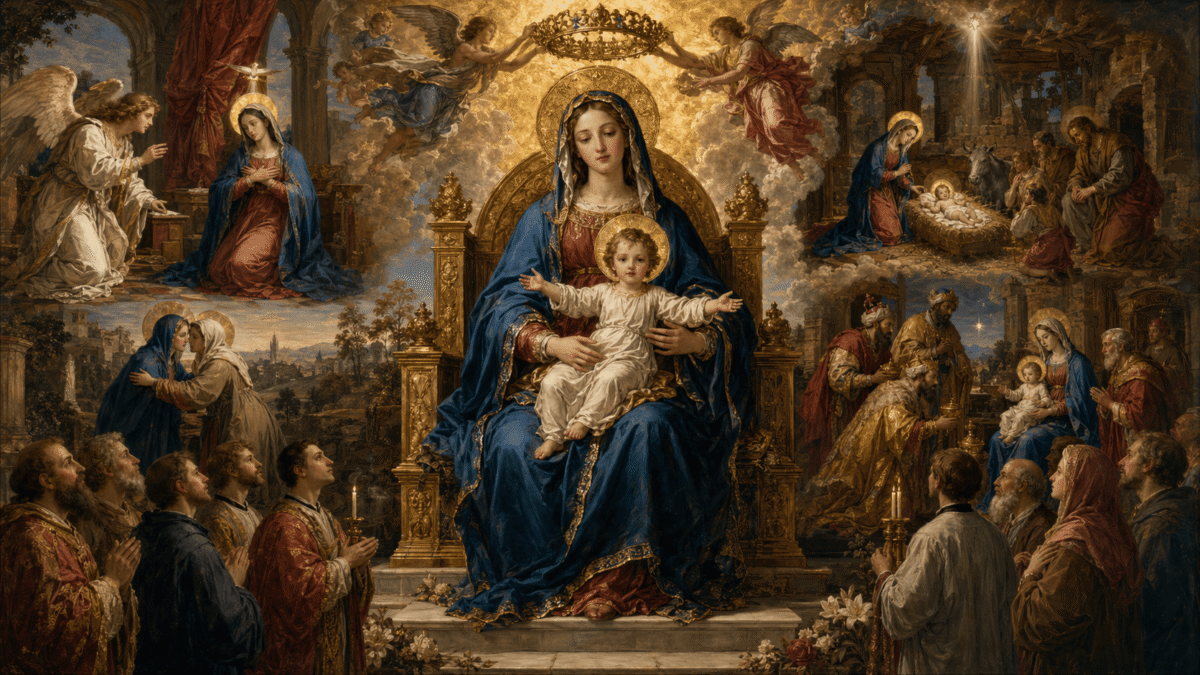
The hymn explores key mysteries of Mary’s life: the *Annunciation*, *Visitation*, Christ’s birth in Bethlehem, and the adoration of the Magi. The second part delves into Marian titles and privileges: Mary as “*porta paradisi*,” “*refúgio mundi*,” and “*aurora solis mystici*.”
Theologically, the *Akáthistos* is a poetic treatise on Mary’s divine motherhood, with each stanza accumulating biblical and typological images that illuminate the Incarnation through her unique role.
## Liturgical Use
In Byzantine liturgy, the *Akáthistos* is sung in full during the fifth week of Great Lent (Saturday of the Akáthistos). In Greek, Russian, Romanian, and other Eastern rites, it is also recited in parts throughout the year. In the West, the *Akáthistos* has gained popularity in ecumenical prayer movements.
## Church Magisterium
> “It is truly meet and just that we should praise and honor from the heart him who chose his Mother, the Son of God, for his mercy.” — Pope Benedict XIV, Apostolic Constitution *Gloriosae Dominae* (September 27, 1748)
**Translation:**
> *Oriental Hymnography, of which the Akathist is the pinnacle, is the greatest document of the Eastern theological understanding of the Theotokos.*
— Pope Saint John Paul II, Enc. *Redemptoris Mater*, n. 33 (25 March 1987)
—
**Post-Graduate Program in Mariology**
Would you like to deepen your formation in Mariology? Discover the *Post-Graduate Program in Mariology* from Locus Mariologicus – an academic formation that combines theological rigor, spiritual life, and the living tradition of the Church.
To enroll or learn more, click here →




Responses