Marian Anthropology: Mary and the New Vision of the Human Being
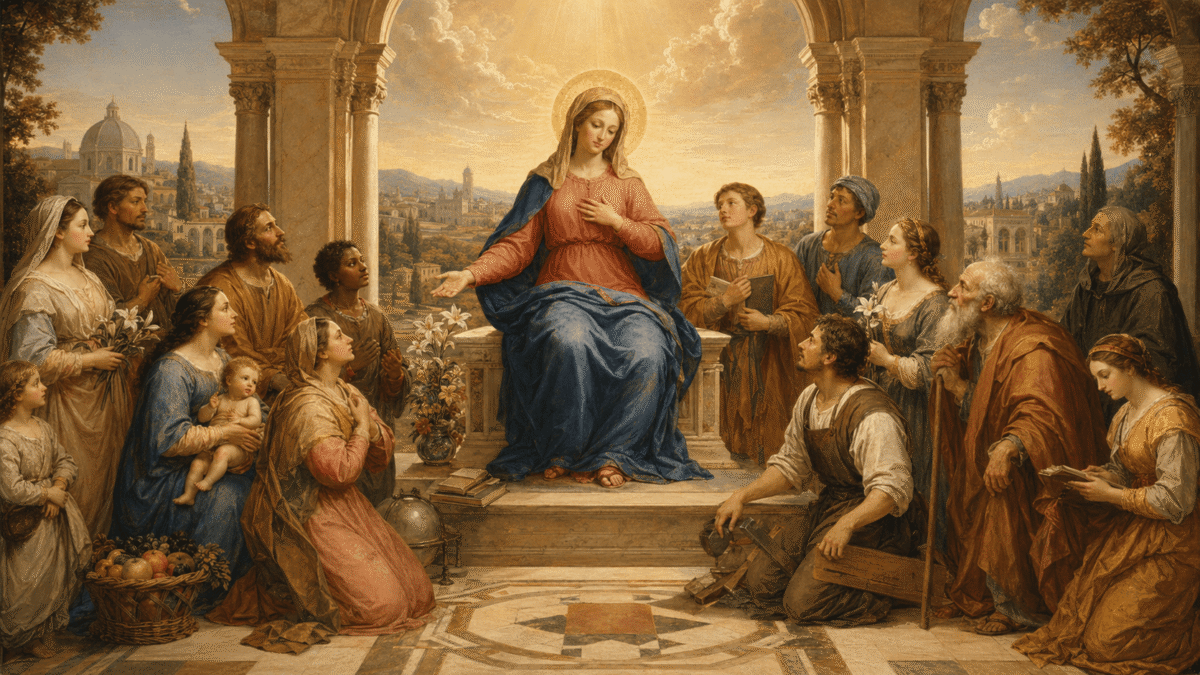
Marian anthropology, Mary and the new vision of the human being
Marian anthropology is the field of Mariology that studies Mary’s contribution to the Christian understanding of the human being. Starting from the Second Vatican Council and from theologians such as Salvatore De Fiores and M. X. Bertola, this reflection proposes a new vision of the human person, of the feminine and of the common vocation of men and women in the light of the figure of Mary of Nazareth.
The Anthropological Question and the Feminine
Classical Christian anthropology was influenced by a dualistic vision of the human being, in which the feminine was frequently presented as derivative or deficient. This perspective, present in some currents of patristic thought, reduced woman to her biological function and subordinated her spiritually. Contemporary theology overcomes this dualism, affirming that man and woman alike are the full expression of the “homo” created in the image of God, and that the feminine is not a special case but a constitutive dimension of the human.
Mary as the Full “homo”
The Second Vatican Council presents Mary as type and image of the Church (LG 63, 65, 68). This datum is not only ecclesiological but profoundly anthropological. Mary is the full realization of what it means to be human before God. Her fiat, her free and total acceptance of God’s plan, does not describe merely a virtue but a way of being: the way of one who is completely open to the action of the Spirit. In this sense, Mary is a model not only for women but for every human being who agrees to enter into God’s primordial plan.
The Feminine as Sacrament of God
Bertola and De Fiores propose understanding the feminine not only as a biological category but as a theological category. The feminine, understood as openness, receptivity and welcome, is the proper mode through which God communicates Himself to humanity. Mary of Nazareth, as the woman who says “behold, the handmaid of the Lord,” becomes the sacrament of the feminine: the visible and efficacious sign of how God meets humanity and invites it to salvation. This reading does not subordinate woman, but recognizes in the feminine a privileged form of mediation of the divine.
The Magnificat as an Anthropological Manifesto
The Magnificat is read by this theological current as an anthropological and social manifesto. Mary’s proclamation, which cast down the mighty and exalted the humble, supplies the criteria for evaluating humanity and history: the true realization of the human being is measured by participation in the journey of the other, especially of the weakest. Mary’s doulé, her “behold, the handmaid of the Lord,” is the renunciation of a private program in order to place oneself at the service of God’s plan, which wills to save the world.
Mary and Christ: The Salvific Partnership
The patristic tradition identified in Mary-Christ a solidarity in the design of salvation, set against the solidarity of Eve-Adam in disobedience. The Gospel of John, especially at Cana and on Calvary, presents “the Woman” as the partner of Jesus at the inaugural moment and at the culminating moment of salvation. This perspective confirms that Christian anthropology is always an anthropology of relationship: man and woman, together, share in the same salvific mission. Mary, with her program of listening, active waiting and service to the weakest, offers the model of a world rebuilt on foundations different from those of the logic of domination.
Deepen your studies: explore Mariology, Marian Theology, Magnificat and the Postgraduate Program in Mariology.
Magisterium of the Church
In Virgine Maria omnia sunt relata ad Christum et ab ipso dependent. Propter hoc Ecclesia in ea clare agnoscit imaginem et initium eius quod ipsa esse vult et sperat.
Second Vatican Council, Dogm. Const. Lumen Gentium, n. 68
📚 Literal translation: In the Virgin Mary everything is referred to Christ and depends on Him. For this reason the Church clearly recognizes in her the image and the beginning of what she herself wills to be and hopes for.
Postgraduate Program in Mariology
Would you like to deepen your formation in Mariology? Discover the Postgraduate Program in Mariology of Locus Mariologicus, an academic formation that unites theological rigor, spiritual life and the living tradition of the Church.
Would you like to study Mariology seriously?
This article grows out of the works in the Locus Mariologicus library. The Postgraduate Program in Mariology brings you to the same source, with academic guidance: Scripture, the Fathers of the Church and the Magisterium, from the first dogma to contemporary questions.




Responses