Immaculate Heart of Mary: biblical foundation, history, and spirituality
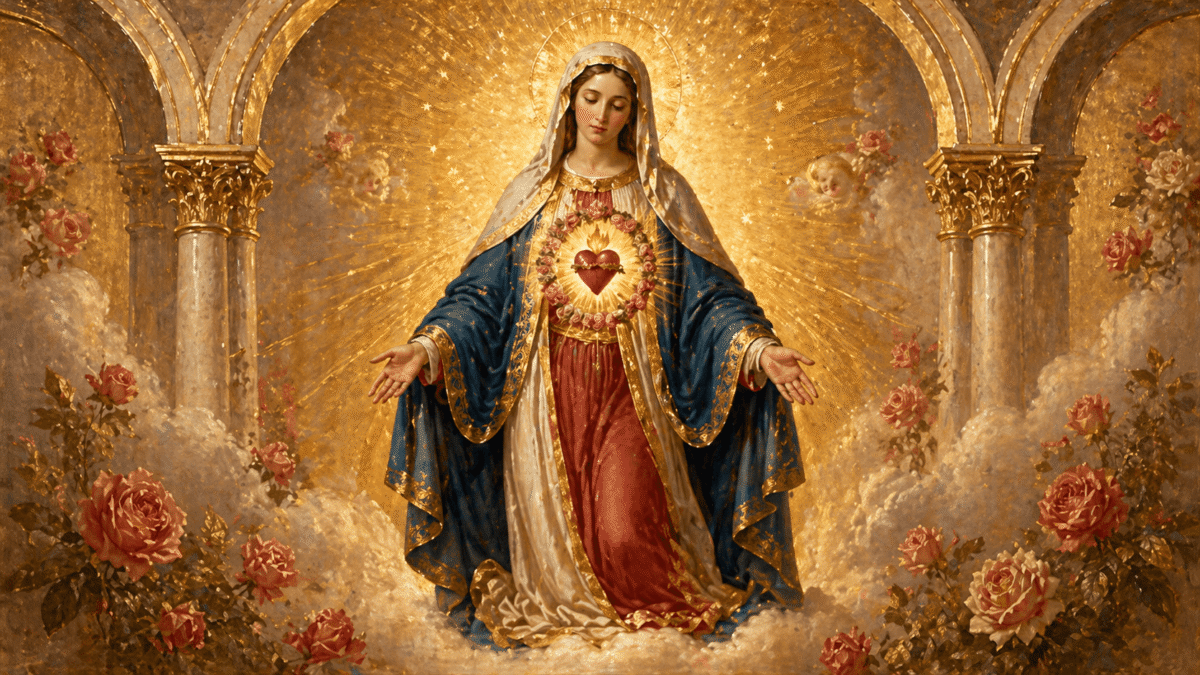
Immaculate Heart of Mary, biblical foundation, history, and spirituality
Devotion to the Immaculate Heart of Mary has deep roots in Scripture, a rich patristic and medieval tradition, and was definitively renewed by Saint John Eudes in the seventeenth century and by the Apparitions of Fatima in the twentieth. In biblical vocabulary, the heart (kardia) is the center of the whole spiritual, psychological, and moral life of the person. Applied to Mary, it expresses the deepest interiority of her adherence to God and her participation in the saving mysteries of her Son.
Biblical foundation
Two Lucan texts constitute the scriptural basis of this devotion: “Mary kept all these things, pondering them in her heart” (Lk 2:19) and “His mother kept all these things in her heart” (Lk 2:51). These texts, interpreted according to the apocalyptic literary genre, situate the heart of Mary as the cradle of all Christian meditation on the mysteries of Christ. Mary is the wise woman who “keeps and ponders” (sundéllein) the events in order to actualize their saving content. To this is added the word of Simeon: “And a sword will pierce through your own soul also” (Lk 2:35). For the patristic and theological tradition, these texts show that the heart of Mary was the privileged place of her interior association with the whole redemptive work of her Son.
Patristic and medieval tradition
Beginning with the Fathers of the Church, the theme of “conceiving the Word in the heart before conceiving Him in the womb” was developed. Augustine formulated it classically: “Materna propinquitas nihil Mariae profuisset, nisi felicius Christum corde quam carne gestasset.” The School of Helfta (thirteenth century) elaborated a mystical spirituality centered on the heart of Mary as the place of repose of the divinity. Saint Bernard, Ambrose, Origen, and the whole Latin and Greek patristic tradition contributed to deepening this theme. In the medieval age, devotion to the heart of Mary was closely united to the devotions of the Ave and of the Gaude, which stand at the origin of the Rosary.
Saint John Eudes and the liturgical feast
Saint John Eudes (1601-1680) is the “evangelist, apostle, and doctor” of devotion to the Sacred Hearts of Jesus and Mary. With him appear the first religious congregations dedicated to this cult, the first liturgical feasts with their own office and Mass (the first celebration took place on February 8, 1648, in the Diocese of Autun), the first systematic works on the theology of this devotion, the first confraternities, and the first ecclesiastical approvals. For John Eudes, the “Heart of Mary” expresses the source and the principle of all her greatness, privileges, and virtues. It is above all her love and her charity, “because love and charity are the measure of merit and the principle of all holiness.” In 1855, Pius IX finally granted a proper Mass and office for the feast to the whole Church. In 1944, Pius XII raised the feast to a double rite of the second class for the whole Latin Church.
Fatima and the contemporary renewal
The Apparitions of Fatima (1917) constitute the “new springtime” of devotion to the Immaculate Heart. In June 1917, Our Lady declared to Lucia: “Jesus wishes to make use of you to make me known and loved. He wants to establish in the world devotion to my Immaculate Heart.” The revelations of Pontevedra (1925) and of Tuy (1929) completed the message with the request for the reparatory Communion on the first Saturdays and for the consecration of Russia. On October 31, 1942, Pius XII consecrated the world to the Immaculate Heart of Mary. On March 25, 1984, John Paul II renewed this consecration in an explicit and universal way. The liturgical feast of the Immaculate Heart of Mary is currently celebrated on the Saturday after the Sacred Heart of Jesus, in the Roman Calendar reformed after Vatican II.
Spiritual and theological meaning
Devotion to the Immaculate Heart is inseparable from devotion to the Sacred Heart of Jesus. Pius XII affirmed that God “willed to associate the Virgin Mary indissolubly with Christ in the accomplishment of the work of human redemption,” and that, for this reason, the Christian people must render to the Heart of Mary “similar homages of piety, love, gratitude, and reparation.” John Paul II, in his first encyclical Redemptor hominis (1979), described the heart of Mary as the place where “the mystery of the redemption was formed,” and from which “this virginal and at the same time maternal heart always accompanies the work of her Son.” The spirituality of the Immaculate Heart invites the faithful to an interior life of meditation on the mysteries of Christ, of reparation, of readiness for the Holy Spirit, and of conformity to the will of God, following the example of Mary.
Deepen your studies: explore Mariology, Fatima, Consecration to Mary, and the Postgraduate Program in Mariology.
Magisterium of the Church
Maria autem conservabat omnia verba haec, conferens in corde suo.
Luke 2:19 (Clementine Vulgate)
📚 Literal translation: But Mary kept all these words, pondering them in her heart.
Ad Cor Immaculatum Virginis Mariae Deus totius mundi et Ecclesiae salutem ordinavit.
S. Ioannes Paulus II, Acta Apostolicae Sedis 74 (1982), p. 484, Venerationi Cordis Mariae
📚 Literal translation: It pleased God to ordain to the Immaculate Heart of the Virgin Mary the salvation of the whole world and of the Church.
Postgraduate Program in Mariology
Would you like to deepen your formation in Mariology? Discover the Postgraduate Program in Mariology of Locus Mariologicus, an academic formation that unites theological rigor, spiritual life, and the living tradition of the Church.
Would you like to study Mariology seriously?
This article grows out of the works in the Locus Mariologicus library. The Postgraduate Program in Mariology takes you to the same source, with academic guidance: Scripture, the Fathers of the Church, and the Magisterium, from the first dogma to contemporary questions.




Responses