Our Lady of Częstochowa: the Black Queen of Poland
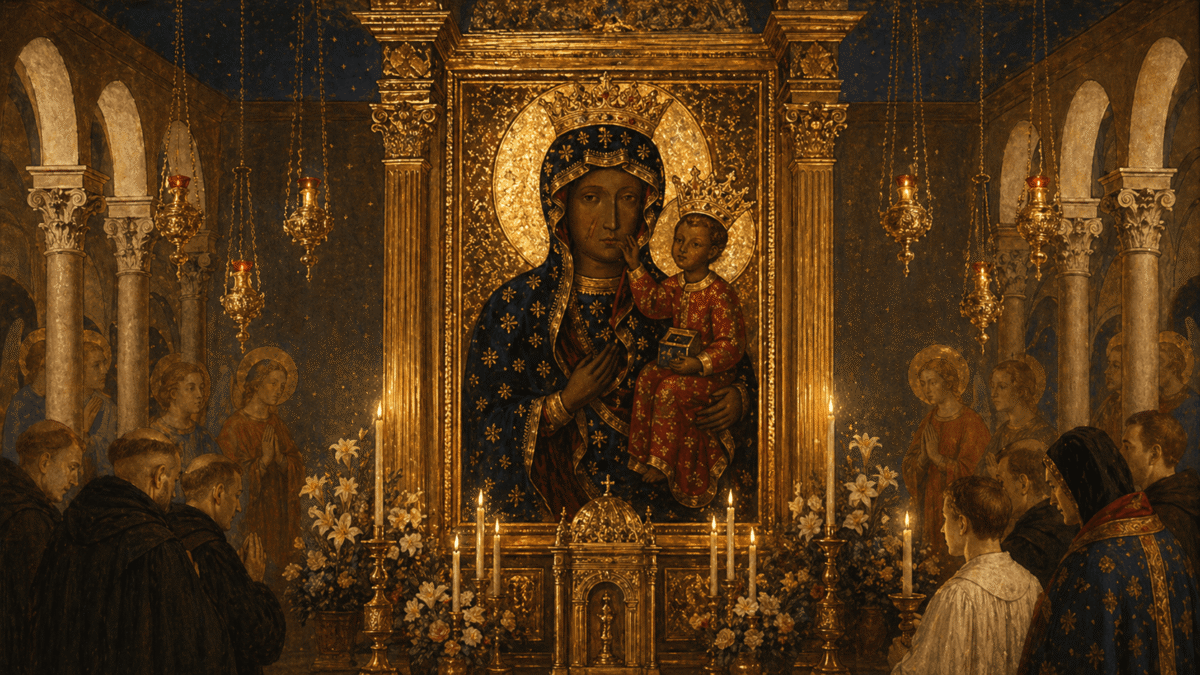
Our Lady of Częstochowa, the Black Queen of Poland
Our Lady of Częstochowa, venerated at the shrine of Jasna Góra (“Luminous Mount”) in Częstochowa, Poland, is the greatest Polish Marian shrine and one of the most important in the world. The seat of the Pauline Order, it receives each year about four million pilgrims from more than forty countries. John Paul II, when he visited the shrine in June 1979, described it as “the spiritual capital of Poland” and “the place where the heart of the nation beats in the heart of the Mother.”
History of the shrine
In 1382, Prince Ladislaus of Opole founded at Jasna Góra a monastery for the Hungarian Paulines and placed there the celebrated painting of the Madonna. The shrine quickly became the most famous Marian center of Poland and of the neighboring nations. In the seventeenth century, the fortress of Jasna Góra played a decisive role in the history of the nation: in 1655, the prior Augustine Kordecki successfully withstood the Swedish siege, at a moment when Poland was being overrun. This episode inspired the vows of King John Casimir, who on April 1, 1656, solemnly proclaimed Mary “Queen of Poland.” The Constitution of the Diet of 1764 confirmed that the nation was “devoted to its Sovereign, the Virgin Mary of the painting of Częstochowa, famous for miracles.” The archive of Jasna Góra preserves eight volumes with about fourteen hundred miracles documented since 1517. In 1946, Cardinal Primate Hlond consecrated the nation to the Immaculate Heart of Mary. In 1956, the text of the national vows, written in prison by Cardinal Stefan Wyszyński, established the pastoral program of the “Great Novena” in preparation for the millennium of the baptism of Poland.
The icon of the Black Madonna
The icon of Jasna Góra (82.2 × 121.7 cm, tempera on linden wood) represents the Virgin Mary with the Child Jesus on her left arm. The face of Mary, of dark complexion, has two parallel marks on the right cheek and one transverse mark: these scars commemorate the profanation of 1430, when invaders slashed the painting with sabers. The origin of the icon is debated: tradition attributes it to Saint Luke. Art historians place the composition in the early Christian and early Byzantine style of the first millennium. The present painting is a recomposition carried out after the attack of 1430, preserving the original design and the features of the Eastern iconographic school. The scars were engraved with a chisel into the tempera, in memory of the original painting. The image was crowned with papal crowns in 1717. Today it is the center of a very direct experience of faith: Polish pilgrims describe the Madonna of Częstochowa as a presence that “understands, feels, and knows everything.”
Ecumenical and papal dimension
The icon of Częstochowa unites the traditions of the Churches of the East and of the West, giving the cult of Jasna Góra a recognized ecumenical dimension. John Paul II, who grew up in devotion to the Black Madonna and always returned to her throughout his pontificate, personally consecrated himself at the shrine during his first visit to Poland (June 4, 1979). After the attempt on his life in May 1981, the Pope renewed his consecration to Mary of Fatima and of Częstochowa. After the election of John Paul II, the image of the Madonna of Częstochowa was popularly called “the Pope’s Madonna.” Each year the shrine welcomes pilgrimages from every profession, national congresses, spiritual exercises for bishops and major superiors, and the walking pilgrimage from Warsaw (243 km in nine days, with more than 50,000 participants).
Deepen your studies: explore Mariology, Marian apparitions, Marian Theology, and the Postgraduate Program in Mariology.
Magisterium of the Church
Regina Poloniae, sub cuius tutela natio polonica semper vixit et revixit, hodie quoque materna sua intercessione nos protegit et ad Filium suum ducit.
St. John Paul II, Homily at Jasna Góra (June 4, 1979)
📚. Literal translation: The Queen of Poland, under whose protection the Polish nation has always lived and lived again, today also protects us with her maternal intercession and leads us to her Son.
Postgraduate Program in Mariology
Would you like to deepen your formation in Mariology? Discover the Postgraduate Program in Mariology of Locus Mariologicus — an academic formation that unites theological rigor, spiritual life, and the living tradition of the Church.
See also: Complete Guide to the Marian Apparitions Approved by the Church
Would you like to study Mariology seriously?
This article grows out of the works in the Locus Mariologicus library. The Postgraduate Program in Mariology takes you to the same source, with academic guidance: Scripture, the Fathers of the Church, and the Magisterium, from the first dogma to contemporary questions.





Responses