Dedit illis potestatem: The Twelve Sent Forth and Mary, Mater Ecclesiae
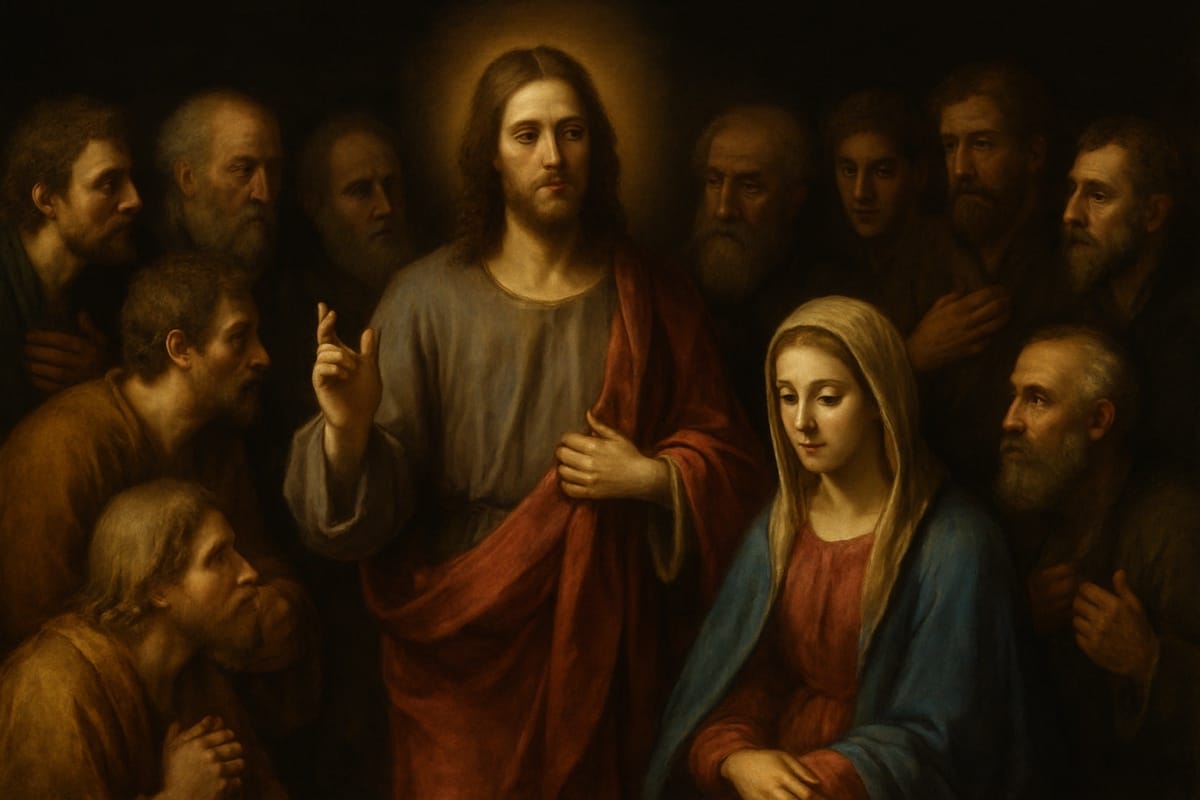
Et convocatis duodecim discipulis suis, dedit illis potestatem spirituum immundorum, ut eicerent eos, et curarent omnem languorem et omnem infirmitatem.
Mt 10:1
Chapter 10 of Matthew is the second of the Gospel’s five great discourses, the missionary discourse, and it opens with the founding gesture of the apostolate: Jesus gathers the twelve disciples, gives them authority, lists their names, and sends them out on mission. The structure is threefold: the gift of authority (Mt 10:1), the list of names (Mt 10:2-4), and the mission instructions (Mt 10:5-42). This episode is one of the most structurally significant in all of Matthew’s ecclesiology: it is the first time Matthew uses the word “apostle” (Mt 10:2), the first time the Twelve are sent out as a group, and the moment when others begin to share in Jesus’ mission.
The number twelve is no accident: it corresponds to the twelve tribes of Israel, which reveals Jesus’ intention to reconstitute the people of God, not as a political nation but as a community of mission. The twelve apostles are the pillars of the new Israel that Jesus is founding, the eschatological sign that God’s promise to the people of the twelve tribes is now being fulfilled in a new way. In Mt 19:28, Jesus will say explicitly that the Twelve will sit on twelve thrones to judge the twelve tribes of Israel; the apostolate has an eschatological dimension that goes beyond the immediate mission of traveling through the villages of Galilee.
I. “He Gave Them Power”: Delegated Authority
“He gave them power over unclean spirits, to cast them out, and to heal every disease and every infirmity” (Mt 10:1): the authority Jesus gives the Twelve is exactly the authority He Himself exercised in chapters 8-9: healing diseases and casting out demons. The mission of the Twelve is not an imitation of Jesus’ mission; it is a participation in the same mission, with the same authority. Jesus is not creating substitutes for when He is absent: He is multiplying His effective presence through the mediation of others.
The delegation of authority that Jesus carries out in Mt 10:1 is the theological foundation of the sacrament of Holy Orders. Bishops, as successors of the Apostles, and priests and deacons, as collaborators of the bishops, exercise an authority that was delegated by Jesus to the Twelve and handed on through apostolic succession. The “dedit illis potestatem” (he gave them power) of Mt 10:1 is the first formal act in this chain of delegation that reaches down to the present day: the authority to preach, heal, absolve, and consecrate has its source in the same gesture by which Jesus gave power to the Twelve.
The logic of delegated authority is important for understanding the nature of the Christian mission: the apostles do not act on their own authority but by the authority they received from Jesus. The missionary is not the owner of the message he proclaims; he is the bearer of a message he has received. He does not heal by his own power; he acts by the power of Christ entrusted to him. This distinction between the apostle’s personal authority and the authority of Christ, which he exercises in the name of another, is what the early Church called “ex opere operato” in the sacraments: the efficacy of the sacrament depends not on the personal holiness of the minister but on the authority of Christ, who acts in him and through him.
Mary received a unique form of participation in Jesus’ mission: not the apostolic delegation of public preaching, but the maternal and intercessory mission that is inseparable from the mission of the Son. Mary’s divine motherhood, being the Mother of God, is itself a form of “potestatem” received: not the authority to preach or to heal, but the authority to present the Savior to the world, to intercede with the Son, and to be for the Church the Mother whom Jesus Himself gave her on Calvary (“Behold, your mother,” Jn 19:27).
II. The List of the Twelve: The Diversity of the Apostolate
“The names of the twelve apostles are these: first, Simon, who is called Peter, and his brother Andrew; James, the son of Zebedee, and his brother John; Philip and Bartholomew; Thomas and Matthew, the tax collector; James, the son of Alphaeus, and Thaddaeus; Simon the Zealot, and Judas Iscariot, who betrayed Him” (Mt 10:2-4): the list includes a fisherman who will become the rock (Peter), a tax collector (Matthew), a Zealot (Simon, a member of a political-religious movement of resistance to Rome), and a traitor (Judas). The diversity is radical: the Twelve encompass social classes, temperaments, and, tragically, the future traitor.
The presence of Judas on the list is a fact that Matthew does not soften: “Judas Iscariot, who betrayed Him.” The traitor is named as an apostle and receives the same sending, the same authority, the same instructions. Judas’s betrayal does not invalidate the apostolate; it confirms the freedom with which Jesus chose His apostles: He included the one He knew would betray Him, without on that account excluding him from the list of those sent. The human frailty of the apostolate, which includes a traitor among the Twelve, is part of the mystery of the Church that the Lord founded.
The diversity of the Twelve anticipates the diversity of the universal Church: the apostolate is not the property of any social, ethnic, or cultural group. Peter and Andrew were fishermen from Galilee. Matthew was a tax collector for the Roman administration. Simon the Zealot was a political activist in the resistance to Rome. That these two, the collaborator with Roman power and the resister, should belong to the same apostolic group was in itself an eschatological sign: in Christ, political and social divisions are overcome by the common mission.
Matthew’s list of the Twelve ends with the name of Judas, “who betrayed Him,” the only apostle identified by his betrayal rather than by his origin or profession. This detail is pastorally important: the Church that Jesus founded is not a community of the perfect but a community of those who are sent, which includes the weak and the unfaithful. Judas’s betrayal is neither hidden nor minimized in the apostolic tradition: it is part of the honesty with which the Church recounts her own origin, founded on the free choice of Jesus, who included human frailty in the apostolic college itself.
III. “Go Rather to the Lost Sheep of Israel”: The Sequence of the Mission
“These twelve Jesus sent out, giving them the following instructions: Do not go into pagan lands, nor enter any town of the Samaritans. Go rather, by preference, to the lost sheep of the house of Israel” (Mt 10:5-6): the instruction to restrict the mission to Israel clashes with the universal mandate of Mt 28:19. The tension is real and has been much discussed: here Jesus limits the immediate mission of the Twelve to Israel, but at the resurrection He promises a mission to all nations. The most coherent explanation is that the order of salvation is “first for the Jew, then for the Greek” (Rom 1:16): Israel has priority at the time of Jesus’ historical mission, but the universal mission is already on the horizon from the beginning.
“Lost sheep of the house of Israel”: the same vocabulary of Jesus’ compassion in Mt 9:36 (“sheep without a shepherd”) now becomes the vocabulary of the mission of the Twelve. Jesus sends the Twelve precisely to what His heart looked upon with compassion: the lost sheep. The mission does not arise from a strategy of religious expansion but from concrete compassion for those who are lost. Those who are sent go where the compassionate heart of Jesus sends them, and that heart is always turned toward those who are “afflicted and downcast.”
Mary, “Mater Ecclesiae,” Mother of the Church, is the title that Paul VI proclaimed at the close of the third session of the Second Vatican Council (1964). This proclamation is not a doctrinal novelty but the making explicit of a reality already present in Jn 19:26-27: “Behold, your mother.” Jesus gives Mary as mother to the beloved disciple and, by extension, to the Church he represents. The Church that the Twelve inaugurate with their sending in Mt 10 has in Mary her Mother: not the institutional founder (that role belongs to Peter and the apostles), but the Mother who accompanies, intercedes, and sustains.
IV. Mary and the Twelve in the Upper Room: The Church Is Born in Prayer
After the Ascension, “the apostles returned to Jerusalem […] and went into the Upper Room […] All of them persevered with one accord in prayer, with some women, with Mary, the mother of Jesus, and with his brothers” (Acts 1:12-14). This image of the Twelve (minus Judas, plus Matthias, who was about to be chosen) gathered with Mary in prayer before Pentecost is one of the most theologically dense images in the New Testament for the relationship between Mary and the apostolate.
Mary in the Upper Room is not in a position of apostolic authority: she does not preach, she does not preside, she is not one of the Twelve. She is in the position that corresponds to her specific mission: the mother who gathers her children, who prays with them, who sustains by intercessory silence what the apostles sustain by the word of preaching. The “unanimity” of the prayer in the Upper Room, “homothumadón,” with one heart, includes Mary as an element of cohesion: the maternal presence that unites those who might have scattered because of their differences in temperament and background.
The Pentecost that follows this unanimous prayer is the equivalent of the “dedit illis potestatem” of Mt 10:1, but amplified: the Holy Spirit given at Pentecost is not merely authority over demons and diseases. He is the power of the universal mission that goes from Jerusalem to the ends of the earth (Acts 1:8). Mary, who was in the Upper Room when the Spirit descended upon the Twelve, was part of the founding event of the universal mission, and she continues, through her intercession, to accompany the mission that Pentecost inaugurated.
Postgraduate Program in Mariology
Would you like to deepen your formation in Mariology? Discover the Postgraduate Program in Mariology of Locus Mariologicus, an academic formation that unites theological rigor, spiritual life, and the living tradition of the Church.
Would you like to study Mariology seriously?
This article grows out of the works in the Locus Mariologicus library. The Postgraduate Program in Mariology takes you to the same source, with academic guidance: Scripture, the Fathers of the Church, and the Magisterium, from the first dogma to contemporary questions.




Responses