Filiam meam modo defuncta est: Jairus, the Woman with the Hemorrhage, and Mary, Gate of Life
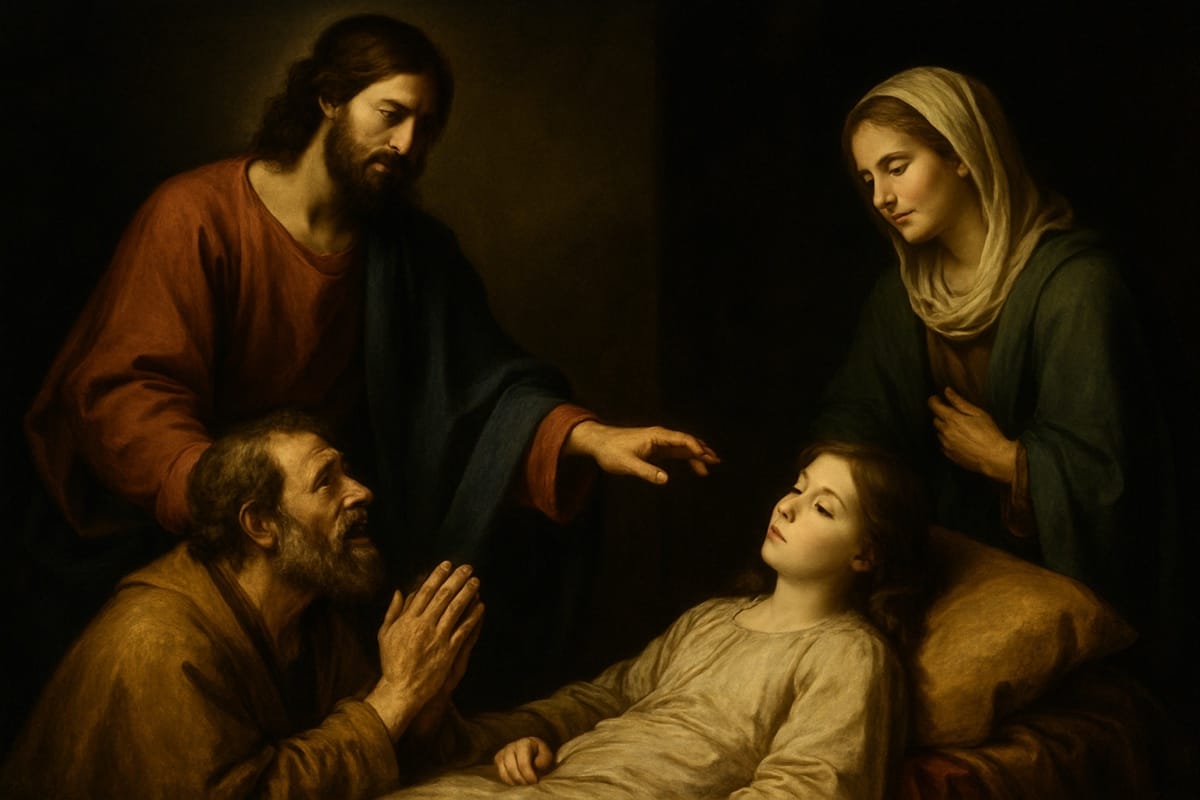
Et ecce princeps unus accessit et adorabat eum, dicens: Domine, filia mea modo defuncta est. Sed veni, impone manum tuam super eam, et vivet.
Mt 9:18
The episode of Mt 9:18-26 is one of the most ingenious in Matthew’s narrative: two miracles interwoven, one inside the other, as if the urgency of one case shed light on the discretion of the other. Jairus, the ruler of the synagogue, comes to ask Jesus to raise his daughter, and on the way to Jairus’s house the woman who had suffered from a hemorrhage for twelve years touches the fringe of Jesus’ garment and is healed. Jairus’s daughter, who had been dead for twelve years (no, she was alive when Jairus asked, but died in the meantime), is raised. The two miracles are chronologically consecutive but narratively simultaneous, and the juxtaposition is theologically deliberate.
Matthew is the briefest of the three evangelists who narrate this episode (see Mk 5:21-43 and Lk 8:40-56): he omits the twelve-year hemorrhage, omits the details about the crowd, and omits the servants who come to say, “your daughter is dead; why trouble the Teacher any further?” In Matthew, Jairus says from the very beginning, “she has just died” (Mt 9:18), which heightens the urgency: there is no progression from bad to worse, only death presented at once to the Healer. This concentration is characteristic of Matthew’s method: he focuses on what is theologically essential, not on narrative drama.
I. “Lay Your Hand, and She Will Live”: Jairus’s Faith in Urgency
“Lord, my daughter has just died. But come, lay your hand on her, and she will live” (Mt 9:18): Jairus’s petition is one of the most complete models of intercessory prayer in the Gospels. It has three elements: the acknowledgment of reality (“has just died”), the specific request (“come, lay your hand”), and faith in the efficacy of Jesus’ action (“she will live”). Jairus does not ask, “if you can do anything”; he asks with the certainty that Jesus can do the impossible. Death is presented not as the limit of the petition but as its object: precisely because she has died, Jairus comes to ask.
Jairus’s posture, “he prostrated himself before Him” (Mt 9:18, “prosekynei”), is the posture of adoration. The same verb is used of the Magi, who prostrated themselves before the Child (Mt 2:11), and of the disciples, who prostrated themselves before the Risen One (Mt 28:17). Jairus, the ruler of the synagogue, a representative of Jewish religious authority, prostrates himself before Jesus as before God. Faith in his daughter’s resurrection is inseparable from the recognition of Jesus’ divine identity: only God can raise the dead. Jairus asks Jesus to raise his daughter. Therefore Jairus is implicitly recognizing in Jesus more than a prophet.
Jairus’s urgency finds an echo in Christian intercessory prayer in extreme moments. When a situation seems beyond human hope (terminal illness, unexpected death, irreversible crisis), Jairus’s prayer is the model: not fatalistic resignation (“God will do whatever He wants”), nor anxious bargaining (“I will make vows if You do it”), but direct petition grounded in faith: “come, lay your hand, and she will live.” Jairus’s faith does not depend on the likelihood of a cure; it depends on the identity of the Healer.
Mary, Mother of God, lived Jairus’s experience on Calvary: the Son dead, the faith that did not die, the implicit certainty that what God had promised (“of his kingdom there will be no end,” Lk 1:33) could not be annulled by the cross. Like Jairus, who prostrated himself before Jesus asking for life for his dead daughter, Mary remained near her dead Son with the faith that awaited the life God would give. The Resurrection was the divine answer to Mary’s silent faith on Holy Saturday, the equivalent of the “little girl, arise” that Jesus spoke to Jairus’s daughter.
II. “If I Touch His Garment, I Shall Be Healed”: The Discreet Faith of the Woman with the Hemorrhage
“A woman who had suffered from a hemorrhage for twelve years came up behind him and touched the fringe of his garment” (Mt 9:20): the woman’s approach is the opposite of Jairus’s. Jairus came directly, identified himself, and asked in public. The woman came from behind, did not identify herself, and touched without asking. Her faith is “if I only touch his garment, I shall be healed” (Mt 9:21), a minimal faith, a faith that does not dare to ask but believes that Jesus’ mere nearness is enough for healing.
Jesus “turned, saw her, and said: Take heart, daughter, your faith has saved you” (Mt 9:22). The same “take heart” (tharsei) addressed to the paralytic in Mt 9:2 is now addressed to the woman. Jesus does not rebuke her discreet approach; He answers it with the same word of encouragement and with recognition of the faith that prompted the gesture. The woman’s faith, which she considered almost insufficient (so much so that she did not dare to ask aloud), was recognized as saving faith. “Your faith has saved you” is the phrase Matthew uses for healings associated with personal faith: faith that acts, even if it is timid and discreet faith.
The contrast between Jairus’s public faith and the discreet faith of the woman with the hemorrhage reveals that Jesus welcomes both ways of approaching Him. There are those who come face to face with Him, identify themselves, and ask aloud with urgency, like Jairus, like the mothers who bring their children, like the blind men who cry out, “Son of David, have mercy on us.” And there are those who draw near in silence, without words, through a discreet touch that knows Jesus’ nearness is enough. Jesus responds to both with the same efficacy: the paralytic who was carried by his friends, Jairus’s daughter, for whom her father pleaded, the woman with the hemorrhage who touched in silence; all were healed.
The woman who “had suffered for twelve years” and was healed the moment she touched the fringe of the garment theologically anticipates the experience of sacramental confession: the penitent who approaches Christ not directly but through priestly mediation, who “touches” Christ’s grace by way of the sacraments, who receives healing without seeing it physically but experiences its effect: “the hemorrhage ceased immediately” (Mk 5:29). Restored health is the sign of grace received, just as the paralytic who walked was the sign of forgiveness received.
III. Mary, Gate of Life: Between Jairus and the Woman with the Hemorrhage
Marian tradition has seen in Mary a synthesis of the two figures in this episode. Like Jairus, Mary intercedes with urgency and confidence when the situation seems hopeless: “They have no wine” (Jn 2:3) is the formula of direct, public intercession, grounded in the certainty that the Son can do what seems impossible. Like the woman with the hemorrhage, Mary often acts discreetly: she does not ask for herself, does not put herself forward, touches the Son’s heart without speeches, and the effect is immediate: “Do whatever He tells you” (Jn 2:5).
“Gate of Life,” “Ianua Vitae,” is one of the Marian titles that tradition developed from the image of Mary as the one who gives passage to the Son, who is Life. The Son who raised Jairus’s daughter and healed the woman with the hemorrhage entered the world through the gate that is Mary. Mary’s divine motherhood is not merely a biological fact: it is the affirmation that the Life that heals and raises the dead passed through the mediation of her humanity; the Word became flesh in Mary’s womb, and it was through Mary’s womb that Life entered time.
Devotion to the graces obtained through Mary’s intercession (sanatoriums, votive churches, collections of ex-votos that document healings and deliverances) has a solid Christological foundation in this episode: if Jesus healed Jairus’s daughter through her father’s intercession, and healed the woman with the hemorrhage through the discreet faith of her touch, then the structure of divine action includes the mediation of the faith of others. Mary as “Gate of Life” is the one who opens access to the Son for those who, like Jairus, come with urgency, and for those who, like the woman with the hemorrhage, draw near in silence.
IV. “The Girl Is Not Dead but Sleeping”: Faith in the Resurrection
“Depart, for the girl is not dead but sleeping” (Mt 9:24): Jesus uses the euphemism of “sleep” for the death of a child in front of those who are weeping. The crowd “laughed at Him” (Mt 9:24); the disbelief at the claim that death is “sleep” is the disbelief of those who do not recognize who is in the house. Jesus “put the crowd outside” and went in with only the parents; the resurrection takes place in silence, far from the scrutiny of those who do not believe.
“And the girl arose” (Mt 9:25): the Greek verb “egeírō” is the same one used for the Resurrection of Jesus throughout the New Testament writings. The resurrection of Jairus’s daughter is an anticipatory sign of Christ’s Resurrection: what happened to the girl in the closed room, far from those who laughed, is the sign of what will happen to the Son in the closed tomb, far from those who doubted. The structure is the same: death, the disbelief of those who laughed, Jesus’ silent intervention, resurrection.
“The fame of this spread throughout all that land” (Mt 9:26): the girl’s resurrection did not remain secret, despite the atmosphere of silence in which it took place. The charge Jesus gave to those He healed not to spread the news (in other episodes) is not mentioned here: the resurrection of a dead child is too visible to be contained. The spreading fame is the natural echo of a sign that goes beyond the healing of diseases: raising the dead is the highest sign of divine authority, which places Jesus in the line of Elijah and Elisha but above both; they raised the dead through prayer, whereas Jesus raises them by His own power.
Mary witnessed her Son’s fame spread, from the adoration of the Magi, through the healings in Galilee, to Calvary, where that fame was turned into scandal. But on Holy Saturday, when the fame had fallen silent and the girl seemed definitively dead, Mary kept her faith in the resurrection that the Son would accomplish. “Not dead, but sleeping”: Mary had known, since the Annunciation, that the Son who was to be born was the Son of the Most High, whose kingdom would have no end. Death was the sleep from which the Father would awaken Him. Mary’s faith on Holy Saturday is the faith that awaits the awakening and that, on the third day, was confirmed.
Postgraduate Program in Mariology
Would you like to deepen your formation in Mariology? Discover the Postgraduate Program in Mariology of Locus Mariologicus, an academic formation that unites theological rigor, spiritual life, and the living tradition of the Church.
Would you like to study Mariology seriously?
This article grows out of the works in the Locus Mariologicus library. The Postgraduate Program in Mariology takes you to the same source, with academic guidance: Scripture, the Fathers of the Church, and the Magisterium, from the first dogma to contemporary questions.



Responses