Pope Leo XIV and the Supplication of Pompeii
A pontificate dedicated to Mary from the first day
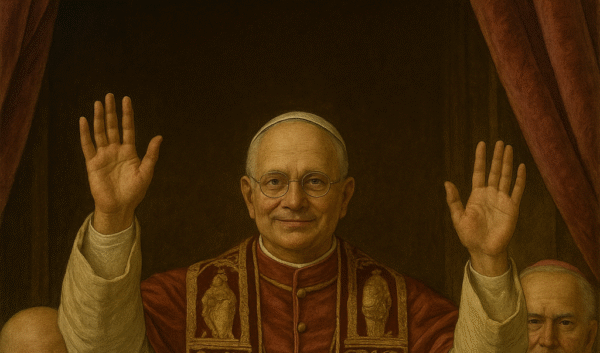
Elected Pope on May 8, 2025, Leo XIV keeps his Marian devotion alive in his initial gestures of his pontificate. Upon appearing for the first time on the loggia of St. Peter’s Basilica for the Habemus Papam and the Urbi et Orbi blessing, Pope Leo XIV included Mary in his message. After greeting the people and thanking his predecessors, the new Pope led the Ave Maria with the crowd in St. Peter’s Square. This act of concluding his first public appearance with the Ave Maria, invoking the protection of the Most Holy Virgin, highlighted Leo XIV’s filial confidence in Our Lady and dedicated from the start his petrine ministry to Mary’s care. Furthermore, he cited the Prayer of Pompeii, which we will delve into throughout the article.
Supplication to the Queen of the Most Holy Rosary of Pompeii: Origin, Content, and Magisterial Value
Why do millions of faithful, twice a year on May 8th and the first Sunday in October, raise their voices in a single prayer titled “Supplication to the Queen of the Most Holy Rosary of Pompeii”? The answer lies in three central figures: Blessed Bartolo Longo, the Rosary prayer, and the ecclesial vision that integrates popular devotion, charity, and spiritual formation.
There are prayers that traverse centuries like underground rivers, emerging whenever the People of God need comfort. The Supplication to the Queen of the Most Holy Rosary of Pompeii is one of these living watercourses. To understand it, one must follow the path of Blessed Bartolo Longo, who transitioned from the shadows of anticlericalism to the lights of the Rosary. In 1872, on a scorching afternoon, he vowed never to leave the nearly deserted valley of Pompeii until he had spread the Marian crown there. From that decision, the landscape changed: popular festivals, confraternities, missions, the arrival of a simple painting that became an icon, and later the construction of a grand sanctuary that still points to the sky like a finger of hope. Among bricks and Ave Marias, Longo also established schools, orphanages, and homes for prisoners’ children, convinced that contemplating Christ with Mary expands the heart to embrace all the marginalized.
At the heart of this project lies the Supplication, composed in 1883, taken from the booklet I Quindici Sabati and multiplied in countless pamphlets that traveled around the world. The text opens with almost liturgical praises, calling Mary “august,” “blessed,” and “all-powerful by grace.” But it soon shifts to a passionate confession of misery, offering a mirror in which the sinner recognizes and rises up. The prayer then progresses in a growing crescendo of intercessions, asking from the Mother’s throne what only the Father can grant: peace in times of war, forgiveness where hatred prevails, justice where inequalities reign, and light for those who have lost faith. Each invocation seems to pulse in the rhythm of the Rosary, evoking Christological mysteries that become concrete balm for present wounds.
The strength of the Supplication lies not only in its rhetorical beauty. It was approved by the Pope as early as 1887, gained widespread radio broadcast, and traverses the sanctuary’s borders twice a year like a planetary choir. When John Paul II beatified Bartolo Longo, he called him “the Apostle of the Rosary” and recognized that this prayer had transformed a barren valley into a laboratory of Christian charity. Those who pray it today realize that its words unite the unequal: peasants and cardinals, children and the elderly, all align themselves in a single line of supplications that ascend to the Heart of the Son. It is doctrine cast in poetic form, theology translated into compassion, and ecclesiality lived as brotherhood. The secret of the Supplication lies precisely in this swinging motion between contemplation and action. Longo wrote that “two friends, living daily together, end up sharing even their habits.” Conversing with Christ and the Virgin, repeating the mysteries, transforms the one who prays. The Supplication makes this encounter almost tangible, moving from the memory of divine wonders to the urgent needs of our days. There, the Virgin is not a distant muse but “Mother of sinners” who scrutinizes every pain and presents it, like perfume, before the divine throne. Praying it involves taking on a commitment, just as its author did. The same is true for the ruined one who saw churches built, also saw orphanages and schools, legal defenses for the condemned, and lines of poor people fed.
In a time that exalts speed and consumes news like sparks, the Supplication offers a deeper breath. It reminds us that the Gospel flourishes when someone dares to believe that the smallest space can become an epiphany of grace. Praying these lines is to join the stream of millions who, on May 8th and the first Sunday of October, pronounce the same words, whether in Gothic cathedrals, slum shanties, or digital broadcasts. The echo circles the globe but always returns to the valley of Pompeii as a wave of gratitude.
The Marian prayer retains its theological richness when we return to it as a source of evangelical creativity. What makes the Supplication relevant is the affection it pours out and the promise it holds: “Whoever trusts in Mary discovers Christ and, discovering Christ, finds the next person.” Thus, with each final invocation, “Queen of the Rosary of Pompeii, pray for us,” the praying one, even silently, feels called to continue the story begun by that converted lawyer, transforming deserts into gardens of mercy.
The Supplication of Pompeii
I. O August Queen of victories, O Sovereign Virgin of Paradise, your powerful name rejoices in heaven and terrifies the abyss. O glorious Queen of the Most Holy Rosary, we, your happy children, whom your kindness chose in this century to erect a temple in Pompeii, prostrated at your feet on this most solemn day of your new triumphs over the land of idols and demons, pour forth in tears the affections of our hearts and, with the confidence of children, expose our miseries. Oh! from the throne of mercy where you sit as Queen, turn your compassionate gaze upon us, upon all our families, upon Italy, upon Europe, upon the whole Church, and have mercy on our distresses and the labors that afflict our lives.
See, O Mother, how many dangers, to soul and body, surround us and how many calamities and afflictions weigh upon us. O Mother, stay the hand of your Son’s indignant justice and conquer, with mercy, the hearts of sinners: they are also our brothers and your sons, who cost the sweet Jesus blood and sword blows to your most sensitive Heart.
Today show yourselves to all as you are: Queen of peace and forgiveness. Hail, Queen!
II. It is true, it is true that we, first of all, though your children, crucify again in our hearts Jesus and pierce once more your Heart. Yes, we confess it, we deserve the harshest punishments. Remember, however, that on the top of the Cross you gathered the last drops of that divine blood and the last testament of the agonizing Redeemer. That testament of a God, sealed with the blood of a God-Man, declared you our Mother, Mother of sinners. You are therefore, as our Mother, our Advocate, our Hope. And we, groaning, stretch out our supplicant hands to you and cry: Mercy!
Have mercy, O good Mother, on us, on our souls, on our families, on our relatives, on our friends, on our deceased brothers, and above all on our enemies and on so many who call themselves Christians and yet tear the tender heart of your Son. Piety, O piety! Today we beg for the lost nations, for all Europe, for all the world, that they may return repentant to your heart. Mercy for all, O Mother of Mercy. Hail, Queen!III. Oh, Mary, what cost to you to hear our supplications? What cost to you to save us? Did not Jesus place all the treasures of his grace and mercy in your hands? You are enthroned, crowned Queen, at the right hand of your Son, surrounded by immortal glory above all the choirs of Angels. You extend your dominion over all the width of Heaven, and to you is subject the earth and all creatures that dwell therein. Your power reaches even to Hell, and only you can deliver us from Satan’s grasp, Mary. You are Almighty by grace, therefore you can save us. If you say that you do not wish to help us because we are ungrateful and unworthy children of your protection, tell us at least to whom else can we turn to be freed from so many plagues.
Ah, no! Your Mother’s heart will not endure to see us, your children, lost. The Child we see on your knees and the mystical crown we behold in your hand inspire us with the confidence that we will be heard. We fully trust in you, we cast ourselves at your feet, we abandon ourselves as unworthy children in the arms of the tenderest of mothers, and today, yes, today, we expect from you the graces we have longed for. Hail, Queen!
We now ask you one last grace, O Queen, which you cannot refuse on this most solemn day. Grant to all of us your constant love and, in a special way, your maternal blessing. No, we will not rise from your feet, we will not turn away from your knees until you have blessed us.
Bless, O Mary, at this moment, the Supreme Pontiff. To the ancient laurels of your crown, to the old triumphs of your Rosary, by which you are called Queen of Victories, add this one, O Mother: grant victory to the Church and peace to human society. Bless our Bishop, the Priests, and in a special way, all those who honor your Sanctuary.
Bless, finally, all those associated with your new Temple in Pompeii and all who cultivate and promote devotion to your Holy Rosary.
Blessed Rosary of Mary, sweet chain that binds us to God, bond of love that unites us to the Angels, tower of salvation in the assaults of Hell, safe harbor in common shipwreck, we will never leave you. You will be our comfort in the hour of agony. To you we will give the last kiss of life that fades. And the last accent of our pale lips will be your gentle name, Queen of the Rosary of the Valley of Pompeii, our beloved Mother, unique refuge of sinners, sovereign consolator of the sad. Blessed be you everywhere, now and forever, on earth and in Heaven. So be it. Hail, Queen!Greetings from the community Locus Mariologicus to Pope Leo XIV
May the Blessed Virgin Mary, Mother of the Church and Star of the New Evangelization, illuminate your petrine ministry with the clarity of her “fiat,” act of faith and love that brought into the world its own Light. United to the whole Church, we turn to her with the words of the oldest Marian prayer: “Under thy protection we flee, holy Mother of God” (Under thy protection we flee, Saint Mother of God). We therefore entrust ourselves to her maternal tenderness, certain that, under her gaze, Peter’s ship will sail steadfastly in hope, unity, and charity.
Mary, Salus Populi Romani and Mater Spei, pray for us and guide the Pontificate of Leo XIV “ad multos annos” (for many years), to the glory of the Most Holy Trinity and the joy of all the faithful.
The Prayer of Pompeii and the devotion to the Rosary, so dear to Leo XIV, find their theological foundation in the Apostolic Letter Rosarium Virginis Mariae (Rosary of the Virgin Mary) by Pope John Paul II, an essential reference for contemporary Marian spirituality.
Deepen your studies: explore Mariology, Marian Theology, Marian Apparitions, and the Postgraduate Program in Mariology.
Mariology Formation: The Locus Mariologicus Institute offers the Postgraduate Program in Mariology, articles, and academic resources on Mariology, Marian Apparitions, and Marian Theology.
To deepen your Marian devotion through the Rosary, consult the Apostolic Exhortation Marialis Cultus (On the Rosary) by Pope Paul VI.





Responses