Mary at the Foot of the Cross (Jn 19:25-27): “Woman, Behold Your Son”
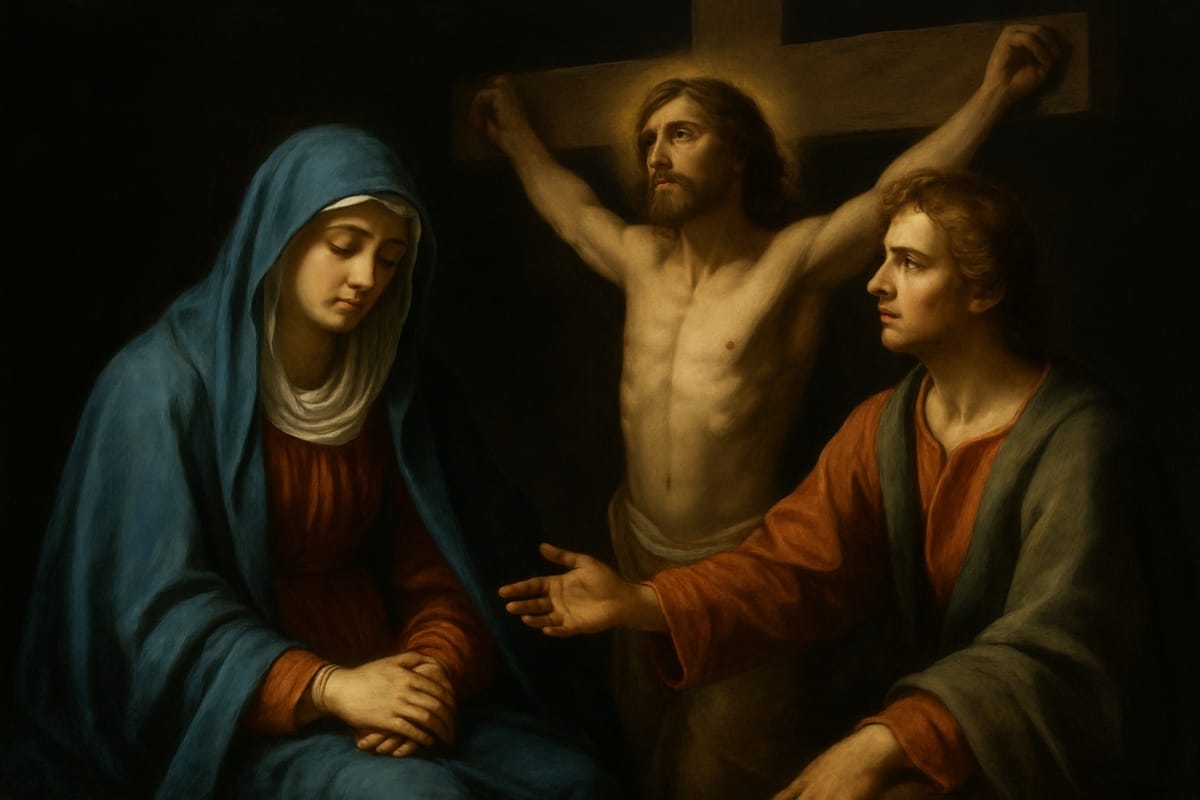
Mary at the Foot of the Cross (Jn 19:25-27) is one of the densest scenes in the Gospel of Saint John: in the last moments of His life, Jesus entrusts His Mother to the beloved disciple and the disciple to her – “Woman, behold your son… Behold your mother.” Far from being a simple gesture of filial piety, it is, in the evangelist’s intention, a true testamentary disposition that reveals Mary’s spiritual motherhood over the Church. This guide explains the text and its meaning.
The text (Jn 19:25-27)
“Standing by the cross of Jesus were his mother, and the sister of his mother, Mary the wife of Clopas, and Mary Magdalene. Jesus, seeing his mother and, beside her, the disciple whom he loved, said to his mother: ‘Woman, behold your son.’ Then he said to the disciple: ‘Behold your mother.’ And from that hour the disciple received her as his own.”
“Woman”: the link with Cana
Jesus addresses Mary by calling her “Woman” – exactly as at the Wedding at Cana (Jn 2:4), the only other place where Mary appears in the Fourth Gospel. This deliberate repetition creates an inclusio: the figure of Mary opens (Cana) and closes (the Cross) the public life of Jesus. At Cana, Mary is the one who asks for the gift of Jesus for others; at the Cross, in the “hour” toward which everything was moving, she receives the lasting fulfillment of that request.
The Mariological core: a testamentary disposition
The twofold saying has the value of a testament pronounced from the cross, reinforced by the “from that hour.” It is not merely a matter of Jesus providing human support for His Mother: the text “must reveal something important for the future.” The meaning lies in the bond between the two persons entrusted to each other:
- Mary is to receive the beloved disciple as a son and to remain with him.
- The disciple “received her as his own” – and she will pass on to him what Jesus had said.
Mary, Mother of the Church
The beloved disciple is not only John: he represents every disciple, the whole community of believers. For this reason the tradition of the Church reads in this scene the birth of Mary’s spiritual motherhood over the Church. As exegesis notes, the detail that the disciple too is entrusted to Mary “as his mother” evokes “the maternal womb that gave birth to Jesus and to the Church.” Mary also represents the part of Israel open to the Messiah – the Daughter of Zion who welcomes the King. It is the Johannine root of the title Mater Ecclesiae, and it prolongs her sharing in the sorrows of the Son.
Frequently Asked Questions
Why does Jesus call Mary “Woman” and not “Mother”?
It is an intentional title that links the scene to Cana (Jn 2:4) and, in the reading of tradition, evokes the “woman” of Genesis (3:15) and of Revelation (12) – Mary as the New Eve.
Who is the “beloved disciple”?
He is identified with Saint John, but the evangelist presents him as a figure of every disciple of Christ – which is why the Mother is given to him, and to the whole Church.
What does “received her as his own” mean?
That the disciple welcomed Mary into his own home and into his life of faith – the model of every Christian’s relationship with the Mother of the Lord.
See also
Would you like to study Mariology seriously?
This article grows out of the works in the Locus Mariologicus library. The Postgraduate Program in Mariology takes you to the same source, with academic guidance: Scripture, the Fathers of the Church, and the Magisterium, from the first dogma to contemporary questions.





Responses