Mary, Mother of the Church: The Title, the Feast, and the Theology
Mary, Mother of the Church: the title and its history
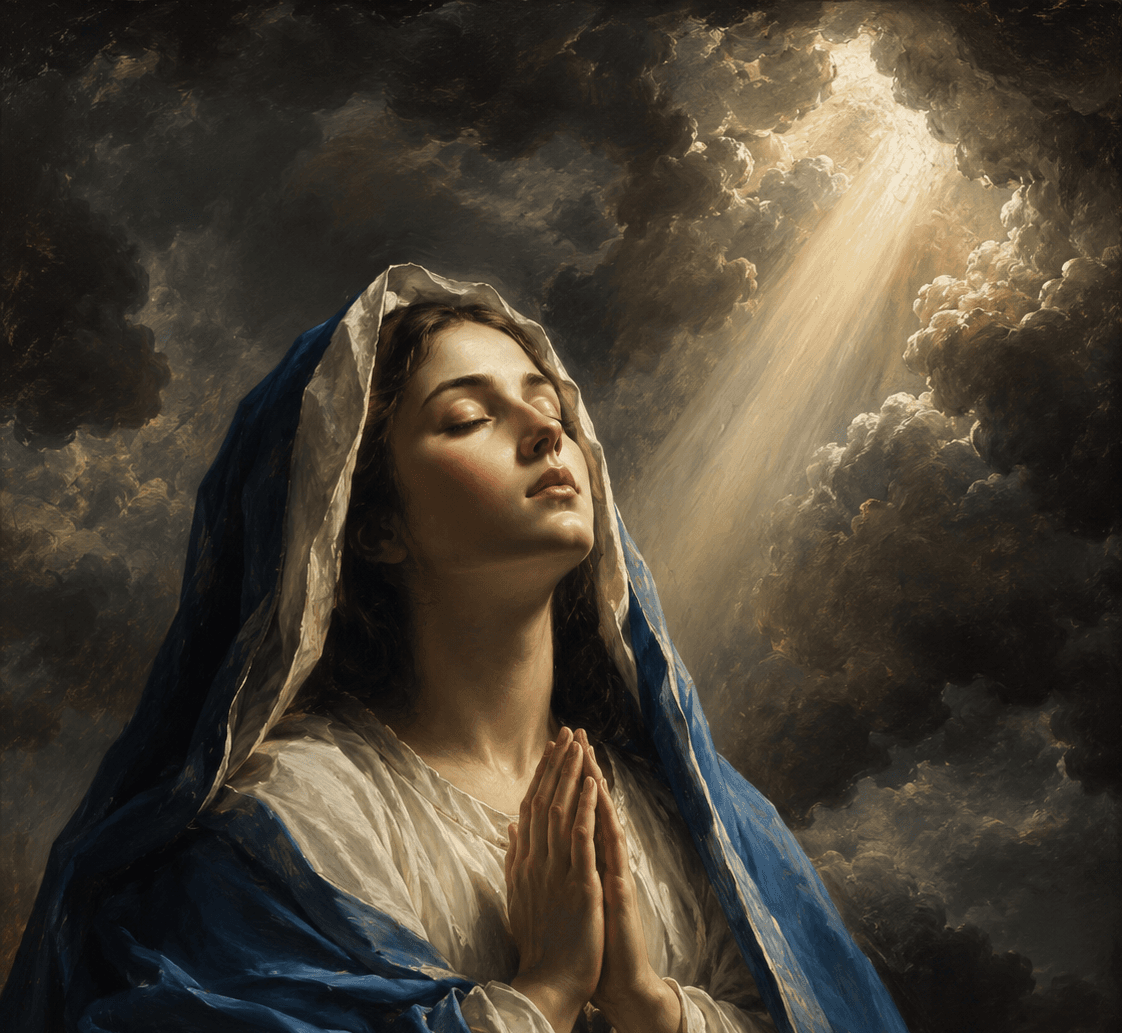
Mary, Mother of the Church is one of the most beautiful and richest titles of the Marian tradition. Solemnly proclaimed by Pope Paul VI at the close of the third session of the Second Vatican Council (November 21, 1964), this title sums up the whole relationship between Mary and the community of the faithful, the Church born of the Holy Spirit in the Upper Room, of which Mary is Mother, Type, and Model.
In 2018, Pope Francis instituted the liturgical feast of Mary, Mother of the Church, setting it on the Monday after Pentecost. This decision, announced by the Decree of the Congregation for Divine Worship, underlines the intimate connection between the gift of the Holy Spirit and Mary’s motherhood over the Church.
Biblical foundation: John 19:25-27
The classic biblical foundation of Mary’s motherhood over the Church is the text of John 19:25-27: at the foot of the Cross, Jesus says to the beloved disciple, a figure of all Christians: Behold, your Mother. And from that hour the disciple took her into his own home.
Patristic and medieval exegesis read this text as a universal gift: in entrusting Mary to the beloved disciple, Jesus entrusts Mary to all His disciples, to the whole Church. Mary is not only the Mother of Jesus: she is Mother of the Church, Mother of all who believe. This reading is confirmed by the great commentators on the Gospel of John, from Origen to Saint Bernard, from Rupert of Deutz to Saint Louis de Montfort.
Lumen gentium: the great Magna Carta of conciliar Mariology
Chapter VIII of the Dogmatic Constitution Lumen Gentium (1964) is the most important magisterial document on Mary in the twentieth century. In it, the Second Vatican Council deliberately integrates Mariology within ecclesiology: Mary is not studied in isolation, but in relation to Christ and to the Church.
LG 54 states: “The Sacred Synod, in expounding the doctrine on the Church, in which the Redeemer works salvation, intends to set forth diligently both the role of the Blessed Virgin in the mystery of the Incarnate Word and of the Mystical Body, and the duties of redeemed mankind toward the Mother of God, Mother of Christ and Mother of men.”
It is in this context that Paul VI, at the conclusion of the conciliar session, proclaims Mary “Mother of the Church,” not as a dogmatic definition, but as a liturgical and spiritual proclamation of universal scope.
Mary, type of the Church: Virgin and Mother
Besides being Mother of the Church, Mary is also its Type, the most perfect model of what the Church is called to be. LG 63 states: “For in the mystery of the Church, which is herself also rightly called mother and virgin, the Blessed Virgin Mary precedes her in an eminent and singular manner, presenting herself as the model both of virgin and of mother.”
The Church, like Mary, is at once Virgin (faithful to Christ, without compromise with the world) and Mother (begetting children of God through faith and the sacraments). Mary is not merely an external model: she is the perfect realization of what the Church aspires to be, the fullness of grace in a human being wholly given to God.
Mary, Mother of the Church, in the Marian apparitions
In the great Marian apparitions, Mary’s motherhood over the Church is manifested concretely. At Lourdes she appears as the Mother who heals, consoles, and calls to conversion, revealing herself to Bernadette with the words: “I am the Immaculate Conception.” At Fatima she presents herself as the Mother who intercedes, who asks for prayer for the Pope and for the Church, who reveals the eschatological dimension of history.
The message of each apparition is always ecclesiological: Mary calls people to the Church, leads them to the Church, protects the Church. She does not appear for her own sake, but for Christ and for His Church.
Studying the relationship between Mary and the Church
The relationship between Mary and the Church, Mary as Type and Mother of the Church, Marian ecclesiology, pneumatology and Mary, is one of the central axes of contemporary Marian Theology. Post-conciliar Mariology has increasingly deepened this articulation, integrating the study of Mary into the study of the Church and vice versa.
The Postgraduate Program in Mariology of Locus Mariologicus studies Marian ecclesiology in depth, from Lumen Gentium to the most recent documents, forming theologians and pastoral workers capable of articulating Marian faith with the concrete life of the Church today.
The title and the theology of Mary, Mother of the Church, are explored in depth in John Paul II’s encyclical Redemptoris Mater, which examines the presence of Mary in the life of the pilgrim Church.
Deepen your studies: explore Mariology, Marian Theology, Marian apparitions, and the Postgraduate Program in Mariology, Angelology, and the Frequently Asked Questions.
Postgraduate Program in Mariology
Would you like to deepen your formation in Mariology? Discover the Postgraduate Program in Mariology of Locus Mariologicus — an academic formation that unites theological rigor, spiritual life, and the living tradition of the Church.
Would you like to study Mariology seriously?
This article grows out of the works in the Locus Mariologicus library. The Postgraduate Program in Mariology takes you to the same source, with academic guidance: Scripture, the Fathers of the Church, and the Magisterium, from the first dogma to contemporary questions.

Responses