Mary Mediatrix of All Graces: What the Church Teaches
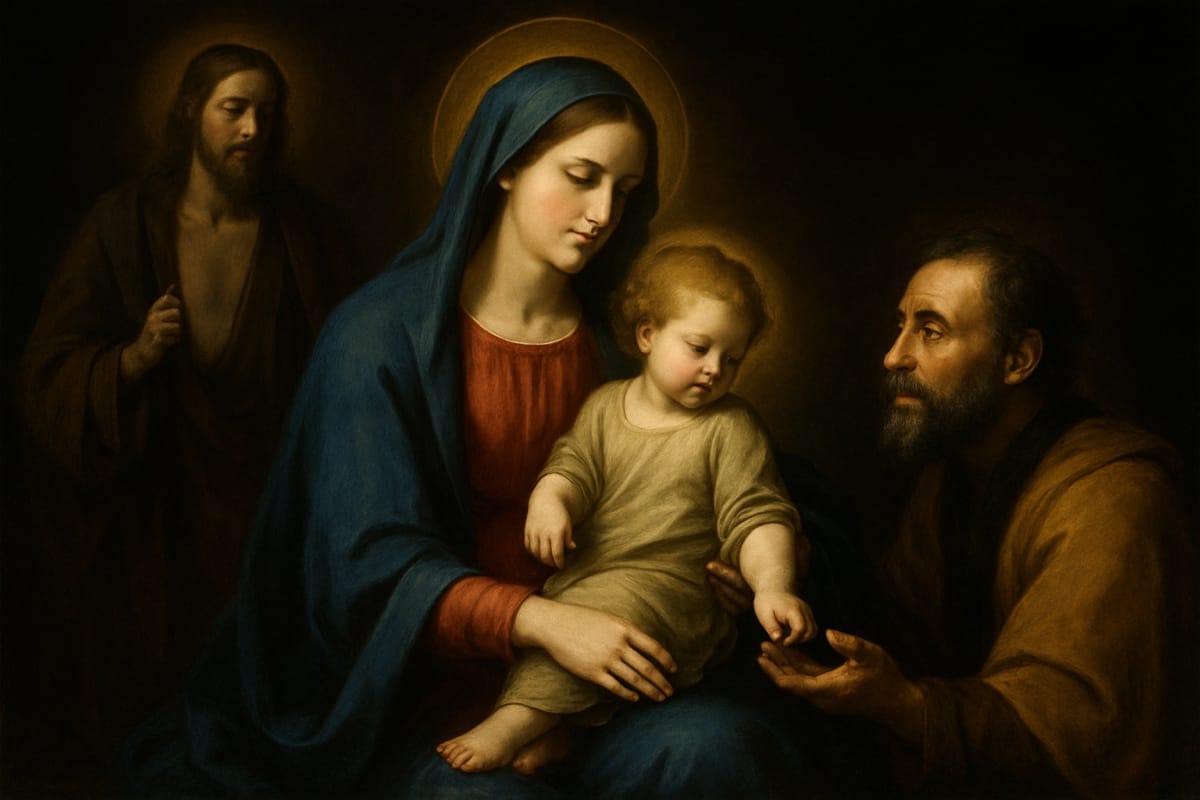
The title of Mary Mediatrix of All Graces expresses Mary’s maternal role in the history of salvation – both in her cooperation with the redemptive work of Christ and in her intercession and distribution of graces to men. It is one of the richest and, at the same time, most delicate Marian themes, above all in ecumenical dialogue. This guide explains what the Catholic Church teaches, with the precision needed so as not to obscure the one mediation of Christ.
Christ, the one Mediator
The starting point is Saint Paul: “there is one God, and there is one mediator between God and men, the man Christ Jesus” (1 Tim 2:5). All reflection on Mary’s mediation begins here and is subordinate to it. Classical theology, following Saint Thomas Aquinas, distinguishes:
- Christ is mediator as a principal, independent, self-sufficient, and necessary cause – the source of grace.
- Mary is mediatrix in a secondary, dependent, non-self-sufficient way – participating in the one mediation of Christ and receiving from it all her value.
For this reason the Second Vatican Council cautions that the Marian titles are to be understood “in such a way that they take nothing away from, nor add anything to, the dignity and efficacy of Christ, the one Mediator” (Lumen Gentium 62).
What Mary’s mediation means
The title of mediatrix embraces two moments of Mary’s spiritual motherhood:
- In the acquisition of grace – her singular cooperation with the objective redemption of Christ, from the Annunciation to Calvary.
- In the impetration and distribution of grace – her present maternal intercession before God for all men.
This cooperation has a single theological root: Mary’s motherhood, which unites her to the Son in human generation, in the historical work of salvation, and in the glory of the Assumption.
The doctrine of the Second Vatican Council
In the Council’s preparatory phase, about three hundred responses that reached the Holy See asked for the solemn definition of Mary’s universal mediation. Vatican II did not accept the request for a dogmatic definition, but it formulated a clear and balanced doctrine. Lumen Gentium (nn. 60-62) teaches that:
- Mary’s maternal role toward men “in no way obscures or diminishes this one mediation of Christ, but rather shows its efficacy.”
- The Church invokes Mary under the titles of Advocate, Auxiliatrix, Adjutrix, and Mediatrix.
- This saving influence of Mary “flows from the superabundance of the merits of Christ, rests on His mediation, and depends entirely on it.”
Why the theme is sensitive in ecumenism
Historically, a great development of Mariology between 1920 and 1960 led at times to a disproportionate emphasis – a “Marian verticalism” that, in popular piety, reached exaggerated expressions and provoked opposition among separated Christians. A balanced theology corrects this by always anchoring Mary’s mediation in the one mediation of Christ and by respecting the proper role of the Holy Spirit as source and gift of grace. Rightly understood, Mary’s mediation does not compete with Christ’s: it depends on it and leads to it.
Frequently Asked Questions
Is Mary Mediatrix a dogma?
No. It is doctrine taught by the Magisterium (notably in Lumen Gentium), but the Church has not defined a specific dogma of “Mary Mediatrix of All Graces.”
Does this not contradict 1 Timothy 2:5?
No. Mary’s mediation is participated and subordinate: it exists within the one mediation of Christ, like the light that reflects the sun, not like a second source.
What is the difference between Mediatrix and Co-redemptrix?
“Co-redemptrix” refers above all to Mary’s cooperation in the historical acquisition of redemption; “Mediatrix” also embraces the present distribution of graces. Both titles have the same root: Mary’s spiritual motherhood.
See also
Would you like to study Mariology seriously?
This article grows out of the works in the Locus Mariologicus library. The Postgraduate Program in Mariology takes you to the same source, with academic guidance: Scripture, the Fathers of the Church, and the Magisterium, from the first dogma to contemporary questions.





Responses