Mary, the New Eve: the patristic typology that founded Mariology
“Quae alligavit Eva per incredulitatem, haec absolvit Maria per fidem” (Saint Irenaeus, Adversus Haereses III, 22, 4), “What Eve bound by unbelief, Mary loosed by faith”
I. The Fall and the protoevangelium: the first promise of Redemption
The third chapter of the book of Genesis narrates at once the tragedy of the original fall and the redeeming promise that illumines all subsequent history. After the disobedience of Eve and Adam, God pronounces a sentence that is, at the same time, judgment and hope. To the serpent, first: “I will put enmity between you and the woman, between your offspring and hers: she will crush your head and you will strike her heel” (Gen 3:15). This passage, which the Christian tradition calls the protoevangelium or “first good news,” is the inaugural prophetic announcement of the redemption that would be fulfilled millennia later in Christ. But the text contains something more that often escapes an immediate reading: a feminine figure is singled out as the privileged antagonist of evil. The “woman” whose offspring will crush the serpent’s head is, in the ancient Christian reading, at once Eve (mother of all humanity, who will produce the Redeemer) and Mary (the direct mother of that Redeemer). This twofold reference founded, in the first centuries of Christianity, the oldest and most influential typology in all of Marian theology: the Eve-Mary typology. And upon this typology, more than upon any other category, was built the patristic Mariology that still today sustains contemporary theological reflection on Mary.
II. The Eve-Mary typology in the Fathers: Justin, Irenaeus, Tertullian
The first to articulate the Eve-Mary parallel explicitly was Saint Justin Martyr, in the Dialogue with Trypho, written around the year 160 A.D. Justin observed that Eve, a virgin and uncorrupted, received from the serpent the word that produced disobedience and death. Mary, a virgin and uncorrupted, received from the angel the word that produced obedience and life. This brilliant insight was developed systematically by Saint Irenaeus of Lyons in his books against the Gnostic heretics, especially in Book III, chapter 22, of the Adversus Haereses, written around the year 180. Irenaeus turned the parallel into a structuring doctrinal category: Christ is the new Adam who undoes what Adam did, and Mary is the New Eve who undoes what Eve did. “What Eve bound by unbelief, Mary loosed by faith” became one of the most cited Mariological formulas in all of the Christian tradition, crossing the centuries without losing its theological efficacy. Tertullian, in the work De Carne Christi, written shortly afterward, articulated the same insight with the juridical sobriety that characterized him. And the Fathers of the fourth and fifth centuries (Cyril of Jerusalem, Ambrose, Jerome, Augustine) definitively consolidated the typology as well established in the apostolic faith. The New Eve became a category belonging to the patrimony of the universal Church.
III. The Fiat that undoes the non serviam: the Annunciation as founding act
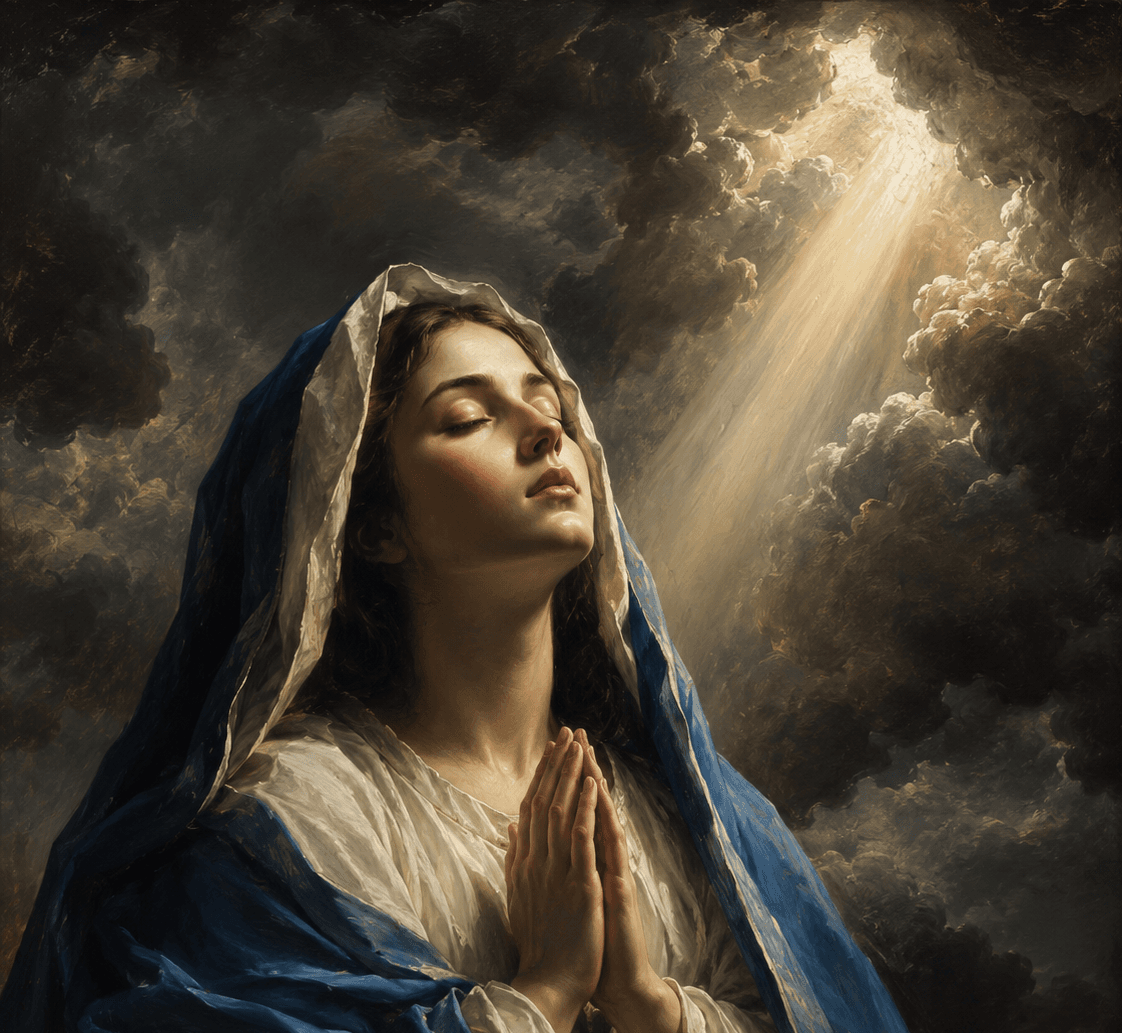
The Gospel of Luke that accompanies this meditation is the account of the Annunciation. “The angel Gabriel was sent by God to a town of Galilee called Nazareth, to a virgin betrothed to a man named Joseph” (Lk 1:26-27). And the culminating point of the angelic dialogue is Mary’s response: “Behold the handmaid of the Lord: let it be done to me according to your word” (Lk 1:38). This yes of Mary is theologically the exact opposite of the non serviam pronounced, according to the patristic tradition, first by Lucifer at the beginning of creation and then by Eve in the garden of Eden. Where Eve chose her autonomy against the divine will, Mary chose her total dependence on that same divine will. Where Eve received the word of the tempter, Mary received the word of the messenger. Where Eve produced the disobedience that sealed humanity in the fall, Mary produced the obedience that opened for humanity the door of redemption. This symmetrical correspondence is not narrative coincidence: it is, according to the Fathers, providential intentionality. God willed to recapitulate salvation in the exact inverse of the fall, and He willed that there be, at the beginning of the history of redemption, a woman who would answer in exactly the opposite way to the woman at the beginning of the history of the fall. The New Eve is in Nazareth because the first Eve was in Eden, and God does not tolerate asymmetries in His work.
IV. The New Eve as the founding category of universal Mariology
The Mariological category of the New Eve is, in the proper sense, the foundation of all Catholic theology about Mary. Before the definition of the divine motherhood at Ephesus (431), before the definition of perpetual virginity at the Lateran (649), before the definition of the Immaculate Conception (1854) and of the Assumption (1950), the Fathers of the Church already contemplated Mary as the New Eve. This antiquity is not merely a curious historical datum: it is proof that Mariology is not a late development of the Christian faith; it is an integral part of theological reflection from the first centuries. The Second Vatican Council gathered up this patristic tradition faithfully in Lumen Gentium: “The holy Fathers rightly see in Mary not a mere passive instrument in the hands of God, but one who cooperated in human salvation with free faith and obedience. For she, as Saint Irenaeus says, by her obedience became the cause of salvation for herself and for the whole human race” (LG 56). The New Eve remains, in the twenty-first century, one of the most luminous categories for understanding the mission and the meaning of Mary in the economy of grace. Her entire spiritual motherhood over the Church, all her recognized historical apparitions, all her liturgical titles and all her popular devotions find their ultimate foundation in this fundamental patristic datum: Mary is the woman whose loving obedience undid the knot of the ancestral disobedience, and whose motherhood bore the Son who restored to us what we had lost through the mother who bore us unto death. The New Eve does not replace the first: she redeems her from within, fulfilling what the first could not accomplish.
Postgraduate Program in Mariology
Would you like to deepen your formation in Mariology? Discover the Postgraduate Program in Mariology of Locus Mariologicus — an academic formation that unites theological rigor, spiritual life, and the living tradition of the Church.
Would you like to study Mariology seriously?
This article grows out of the works in the Locus Mariologicus library. The Postgraduate Program in Mariology takes you to the same source, with academic guidance: Scripture, the Fathers of the Church, and the Magisterium, from the first dogma to contemporary questions.


Responses