Nisi natus fuerit denuo: Mary and the Birth from Above
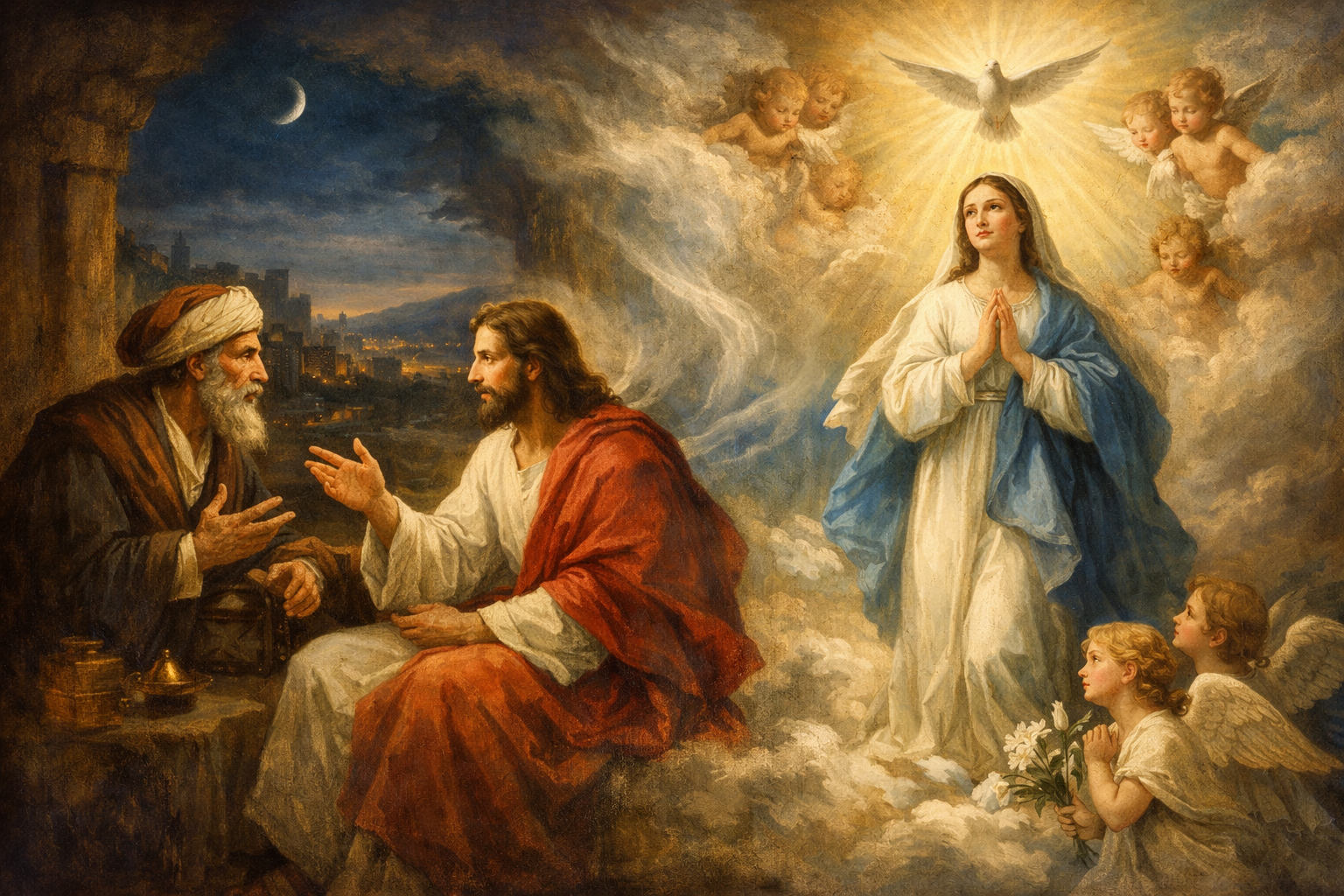
Nisi quis natus fuerit denuo, non potest videre regnum Dei.
Jn 3:3, Gospel for Monday after the Second Sunday of Easter
A Mariological meditation drawing on the readings for Monday after the Second Sunday of Easter (Jn 3:1-8)
“Truly, truly, I say to you, unless one is born anew, he cannot see the Kingdom of God” (Jn 3:3). Nicodemus comes from the night, from ignorance, from fear, from calculated prudence. He is a teacher of Israel who needs to learn all over again. And Jesus sets before him the most radical problem: it is not a question of gradual improvement, but of an entirely new birth. Nisi natus fuerit denuo: the condition is absolute.
Here Mariology finds one of its most fruitful and least explored connections: Mary is the first person in history to have been born from above. Not in the sense of the Annunciation, but in the sense of the Immaculate Conception: from the first instant of her existence, she was preserved from the sinful condition and established in the fullness of grace. The Father’s fiat over Mary is, ontologically, the birth from above that Jesus announces to Nicodemus as the condition for access to the Kingdom.
I. The paradox of Nicodemus
Nicodemus is intelligent, honest, and sincere. He recognizes that Jesus comes from God because of the signs He performs (Jn 3:2). But natural intelligence cannot reach the mystery of the Kingdom: he would need to be born anew. His question, How can a man be born when he is old? Can he enter a second time into his mother’s womb? (Jn 3:4), reveals that he imagines the new birth as a biological repetition of the old one.
Jesus corrects him: “Unless one is born of water and the Spirit, he cannot enter the Kingdom of God” (Jn 3:5). The new birth is pneumatological; it comes from above (anōthen), from the Holy Spirit. It is not a second human childbirth but a divine generation.
Here Mariology identifies the principle that governs the whole relationship between the Holy Spirit and Mary. Lk 1:35: “The Holy Spirit will come upon you, and the power of the Most High will overshadow you”. This overshadowing (episkiazein) is the language of the divine presence, the same presence that covered the Tabernacle in the wilderness (Ex 40:35). Mary is the Tabernacle of the Spirit, the one upon whom the Spirit came in a unique and singular way.
II. The Immaculate Conception as an anticipated birth from above
The doctrine of the Immaculate Conception, defined by Pius IX in Ineffabilis Deus (1854), affirms that Mary was “preserved immune from all stain of original sin, by a singular grace and privilege of almighty God, in view of the merits of Jesus Christ”. This anticipated preservation is, theologically, a birth from above avant la lettre.
Duns Scotus formulated the decisive argument: Potuit, decuit, ergo fecit. God was able to do it (omnipotence), it was fitting to do it (the dignity of the Mother of the Son), therefore He did it. Scotus’s argument is the argument of perfect mediation: a redeemer who preserves in advance is more perfect than a redeemer who heals a posteriori. Mary is the extreme and perfect case of the Redemption, the first in the kingdom of the redeemed, the ripe fruit of Christ’s Pasch before Christ.
Ratzinger, in his Collected Works, observes that the Immaculate Conception is not an exception to the plan of Redemption; it is its starting point. Mary is redeemed in a more excellent way (excellentiori modo redempta, DH 2803). Her birth from above anticipates what Baptism will accomplish for all the faithful.
III. “The Spirit blows where He wills”: Mary and the freedom of the Spirit
“The wind blows where it wills, and you hear its sound, but you do not know where it comes from or where it goes; so it is with everyone who is born of the Spirit” (Jn 3:8). The birth from above bears the mark of the sovereign freedom of the Spirit. It cannot be controlled, predicted, or programmed; it is the pneuma that goes wherever it wills.
In the Marian tradition, this freedom of the Spirit is associated with the virginity of Mary. The Virginity of Mary means precisely that the Incarnation did not follow the laws of biological generation, but the sovereign freedom of the Spirit. Mary did not conceive by natural power, but by the exclusive action of the Spirit who came upon her.
Mary’s virginity is by no means peripheral; it stands in intimate connection with the central core of the faith. Virginity is the visible sign that the birth of Jesus, and by extension the birth from above of every believer, is the work of the Spirit, not of human desire.
IV. “Do not marvel”: the faith that does not demand immediate understanding
“Do not marvel that I said to you: you must be born anew” (Jn 3:7). Jesus does not explain the how exhaustively; He points to the sign of the wind and extends an invitation to faith. Nicodemus cannot understand yet. He still has further to go (Jn 7:50; Jn 19:39-40: it is Nicodemus who brings the myrrh for the burial).
Mary never asked, how can I be redeemed without having been conceived? She simply was redeemed, by grace. The fiat was not a response to understanding; it was a response of trust. The Spirit blows where He wills. Mary opened the window.
Redemptoris Mater (John Paul II, 1987, no. 14) describes Mary’s “pilgrimage of faith” as a path that goes “beyond all understanding”: Mary moves forward without seeing the complete destination, sustained by the Spirit who guides her. This is the model for Nicodemus and for all of us.
We invite you, on this Paschal day, to contemplate the mystery of the birth from above, not as a mystical metaphor but as an ontological reality that begins in Mary. She is the first citizen of the Kingdom to be born from above. And in every Baptism, the Church repeats in history what God did for Mary in the first instant of her existence.
What does “Nisi natus fuerit denuo” mean for Mariology?
The Latin expression from Jn 3:3, “unless one is born anew,” sheds light on Mary’s role in the spiritual birth of Christians. Mariology understands Mary as the spiritual Mother of all who, through Baptism, are born from above in Christ.
What is Mary’s role in spiritual birth according to theology?
Mary, Mother of the Incarnate Word, is also the spiritual Mother of the faithful. At the foot of the Cross (Jn 19:26-27), Jesus entrusted all the disciples to her. Thus her motherhood extends to every Christian who is born from above by grace.
How does Mariology interpret the relationship between Jn 3 and Mary’s motherhood?
Mariological exegesis of Jn 3 relates birth from the Spirit to Mary’s maternal mediation: just as she brought forth the Son of God in history, she intercedes for and accompanies the spiritual birth of each child of God in faith.
Deepen your studies: explore Mariology, Marian Theology, Marian apparitions, and the Postgraduate Program in Mariology.
To explore more deeply the Marian theology of spiritual birth in Christ, consult Pope John Paul II’s Encyclical Redemptoris Mater.
Prof. Daniel Afonso
Rome, April 13, 2026
Postgraduate Program in Mariology
Would you like to deepen your formation in Mariology? Discover the Postgraduate Program in Mariology of Locus Mariologicus, an academic formation that unites theological rigor, spiritual life, and the living tradition of the Church.
Would you like to study Mariology seriously?
This article grows out of the works in the Locus Mariologicus library. The Postgraduate Program in Mariology takes you to the same source, with academic guidance: Scripture, the Fathers of the Church, and the Magisterium, from the first dogma to contemporary questions.



Responses