The secret of Padre Pio’s holiness: “the sweet Lady.”

By Prof. Dr. Daniel C. Afonso · Updated
Introduction: Padre Pio and the secret of his love for Mary
Padre Pio, one of the most venerated saints of the twentieth century, is a figure who transcends devotion to become an icon of faith and spirituality. But what many may not know is the profound Mariological bond he had. How could a man marked by the wounds of Christ not also be such a profound devotee of Mary, the Mother of God? This article seeks to explore this often forgotten, yet central, dimension of Padre Pio’s spirituality.
Who was Padre Pio?
Before addressing the Mariological question, it is worth understanding who Padre Pio was. He was born on May 25, 1887, in the town of Pietrelcina, Italy, and baptized Francesco Forgione. Padre Pio was an Italian Capuchin friar who became famous during his lifetime for the mysticism that surrounded him and, most notably, for the stigmata he bore on his body from 1910, similar to the wounds of the crucified Christ. It was the early morning of September 23, 1968. In his room in the friary, with the rosary between his fingers, repeating the names of Jesus and Mary, the man who had embraced the cross of Christ rests in peace.


The secret of his holiness: Mary
The source of his intense and mystical spirituality was deeply rooted in his devotion to the Virgin Mary, whom he affectionately called the “Sweet Lady”. Padre Pio himself described Mary as the “matrix” of his outpouring of graces. He was Marianized and Christified so profoundly that he became, in the words of Saint Paul VI, a “representative stamped with the stigmata of Jesus Christ”.
But why Mary? The centrality of Mary in the life of Padre Pio
The central place that Mary held in the life and spirituality of Padre Pio shows the intimate relationship between Marian devotion and the Christian life.
The Mariological dimension of Padre Pio
Padre Pio did not merely venerate Mary. She was fully present in his theology and daily practices. His devotion to Mary was not superficial. It was theological, rooted in the tradition of the Church, and deeply personal. He saw Mary as the one who cooperated in the Redemption, the Mother who suffers beside her Son for the salvation of humanity.
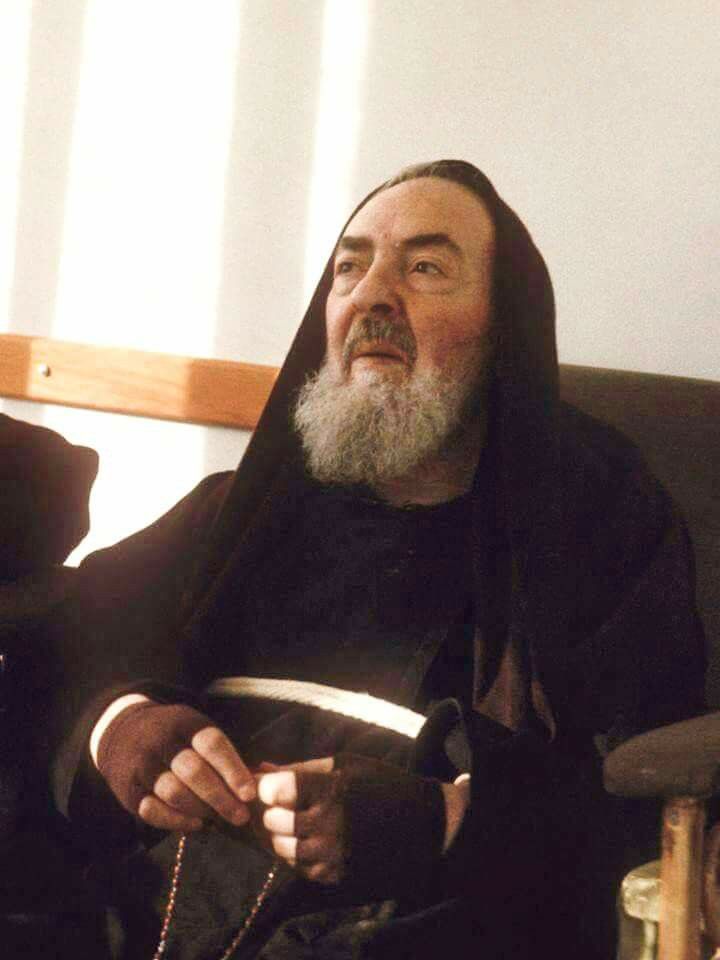
Mary’s Rosary: a continual prayer of Padre Pio
One of the most notable aspects of Padre Pio’s devotion to Mary was his constant recitation of the Rosary. For him, the Rosary was not merely a form of prayer. It was a way of living in constant communion with Mary and, through her, with Christ. And he did not pray alone, but led everyone around him to pray as well. A devotee of Padre Pio is always Marian.
The Marian legacy of Padre Pio and Mary, the Sweet Lady
The life and spirituality of Padre Pio are a witness for our modern times to devotion to the Virgin Mary, so ancient and so new. He shows that true Marian devotion is not a detour from the Christian faith, but rather a path that leads more deeply into the heart of Christ. Thus, perhaps we can begin to understand the Mariological mystery of Padre Pio: to know Mary better is, in fact, a way to love her Son, Jesus Christ, more deeply.
Saint Padre Pio, pray for us!
Padre Pio’s devotion to Mary finds theological grounding in the encyclical Redemptoris Mater (John Paul II), which contemplates Mary as Mother in faith and model of holiness for all Christians.
Deepen your studies: explore Mariology, Marian Theology, Marian apparitions, and the Postgraduate Program in Mariology.
Postgraduate Program in Mariology
Would you like to deepen your formation in Mariology? Discover the Postgraduate Program in Mariology of Locus Mariologicus, an academic formation that unites theological rigor, spiritual life, and the living tradition of the Church.
Learn to pray the Rosary with our guide: How to Pray the Rosary, step by step.
Would you like to study Mariology seriously?
This article grows out of the works in the Locus Mariologicus library. The Postgraduate Program in Mariology takes you to the same source, with academic guidance: Scripture, the Fathers of the Church, and the Magisterium, from the first dogma to contemporary questions.
Responses