Paraclitus docebit vos omnia: Mary and the Spirit who will teach all things
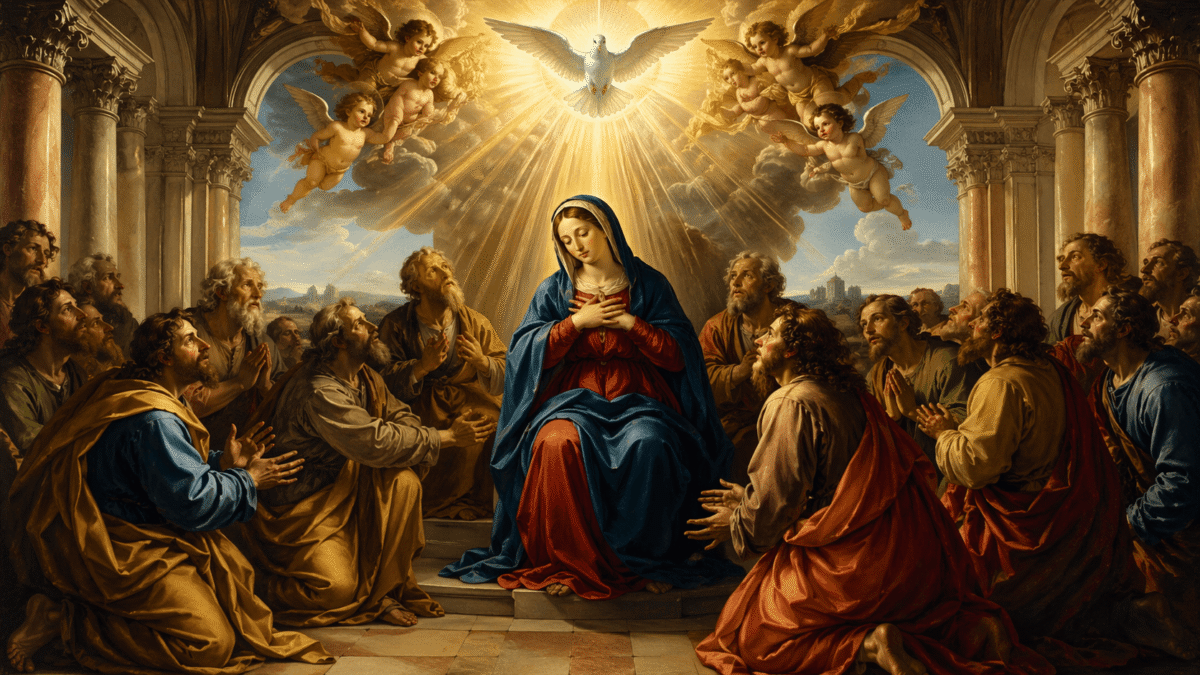
The Paraclete, the Holy Spirit (…) docebit vos omnia et suggeret vobis omnia quaecumque dixero vobis.
Jn 14:26
“The Paraclete, the Holy Spirit (…) will teach you all things and will remind you of everything I have said to you”. Jn 14:26 promises a permanent presence of the Spirit as the “interior master” who not only illumines minds but also makes them “remember” (anamnesis) the words of Jesus. This promise lies at the heart of Johannine pneumatology and has a direct Mariological dimension: Mary, who was overshadowed by the Holy Spirit at the Annunciation and was present in the Upper Room when the Spirit descended at Pentecost, is the figure par excellence of the fruitful relationship between the Spirit and the human creature.
I. The Paraclete: teacher, consoler and living memory of Jesus
The Johannine title “Paraclete” (Parakletos) cannot be translated by a single word: it means at once “the one called alongside” (advocate, defender), “the consoler” and “the intercessor”. John uses it four times in the farewell discourses (Jn 14:16, 26; 15:26; 16:7-15) to describe the mission of the Spirit after Jesus’ departure. The central function of the Paraclete in these texts is to “replace” Jesus among the disciples, not so that Jesus is absent, but so that His presence becomes interior, deeper than physical presence.
Jn 14:26 specifies two functions of the Paraclete: “He will teach” and “He will bring to remembrance”. The teaching of the Spirit is not a new revelation that supplants Jesus; it is the progressive illumination of the one revelation that is Jesus. “He will bring to remembrance” points to anamnesis: the Spirit does not bring novelties, but deepens and clarifies what Jesus said and did. This function is structural for the living tradition of the Church: dogmatic development is not a betrayal of the Gospel; it is its explicitation through the action of the Paraclete.
The theology of the sensus fidei, the “sense of the faith” that the People of God possess collectively, finds its foundation in the Paraclete. The Spirit who “teaches” does not do so only for the intellectual or hierarchical elites; He “teaches” the entire community of the faithful, which thus takes part in the process of the development of faith. This pneumatological dimension of dogmatic development was taken up by the Second Vatican Council (Lumen Gentium 12, Dei Verbum 8) with great emphasis.
The relationship between Spirit and memory has an existential depth that goes beyond the purely intellectual. “He will bring to remembrance” is not merely the evocation of historical facts; it is the living reactualization of a relationship: the Spirit makes Jesus “live again” in the experience of the faithful, making Him contemporary to every generation. The Eucharist, as “anamnesis” par excellence, is the privileged place of this function of the Paraclete: to make present what “Jesus said and did” not as a memory of the past but as a living reality of the present.
II. Mary and the Holy Spirit: a unique relationship
Mary’s relationship with the Holy Spirit is, in Mariology, one of the deepest and least explored themes. The Annunciation (Lk 1:35: “The Holy Spirit will come upon you”) is the inaugural moment of this relationship: the Spirit “overshadows” Mary and thus brings about the Incarnation. This action of the Spirit upon Mary is not an isolated intervention; it inaugurates a relationship that runs through Mary’s entire existence.
Tradition, especially the Franciscan tradition and the Mariological school of the twentieth century (Maximilian Kolbe, René Laurentin, Heribert Mühlen), explored Mary’s relationship with the Spirit under the title “spouse of the Holy Spirit”. This title, correctly understood, is not nuptial in the human sense; it is theological: it expresses Mary’s utmost openness and availability to the Spirit, her full configuration to the Spirit, her unreserved docility to the Spirit’s movement. Mary is the “most spiritual” creature in the most literal sense: the one most filled with the Spirit, the one most moved by the Spirit.
Maximilian Kolbe developed the thesis, controversial but fruitful, that Mary is the “quasi-incarnatio” of the Holy Spirit: just as the Son became incarnate in Jesus of Nazareth, so the Spirit “became incarnate” in an analogous way in Mary. This thesis, technically imprecise (for the Spirit did not assume Mary’s humanity as the Son assumed humanity in Jesus), points to something real: Mary’s utmost transparency to the Spirit, her “docility” which made possible the Spirit’s “saying-everything” through her.
The practical consequence of this relationship is that Mary can be described as the “place” where the Spirit acts most visibly in the history of salvation. Every key moment of her life is associated with an action of the Spirit: the Annunciation (Lk 1:35), the Magnificat (Lk 1:46, “I rejoiced in the Spirit”), the Visitation (Lk 1:41, Elizabeth is “filled with the Holy Spirit”), and of course Pentecost (Acts 2). Mary is, in the history of salvation, the one who most profoundly “received” the Spirit who “teaches all things” and “brings to remembrance”.
III. “He will bring all things to remembrance”: Mary and the living tradition
Jn 14:26 promises that the Spirit will make us “remember” everything Jesus said. This promise is the theological foundation of the Church’s Tradition: not as a dead archive of texts from the past, but as a living memory, animated by the Spirit, which continually actualizes the mystery of Christ for every generation. Tradition is not the weight of the past upon the present; it is the present of the past, made contemporary by the action of the Paraclete.
Mary is, in the Mariological tradition, the figure of the “living memory” of the Church. She who “kept and pondered” (Lk 2:19, 51) the words and the gestures of Jesus was the first “living tradition”: the one who handed on to the Apostles what she knew of the hidden life of Jesus, what she had received from Jesus Himself, what she had lived in the moments that she alone shared with Him. The source of the infancy narratives in Luke (Lk 1-2) is frequently identified as Mary: only she could have known what Luke recounts.
This function of “living memory” that Mary exercised in the first community has a permanent ecclesial dimension. The Church that “keeps” the mysteries of Christ, the liturgy, the sacraments, the Magisterium, the spiritual life, repeats, in a certain way, the gesture of Mary who “pondered them in her heart”. The Church is the “memory of Jesus” in the world, animated by the Spirit who “brings to remembrance”, and Mary is the model of this memory.
The recitation of the Rosary, a meditation on the mysteries of the life of Jesus through Mary’s eyes, is the most popular devotional expression of this Marian “memory”. To pray the Rosary with Mary is not merely to recall historical events; it is to “relive” the mysteries with the help of the one who lived them most intimately. The Spirit who “brings to remembrance” acts in a particular way through this prayer, which is at once Marian memory and Christological contemplation.
IV. Pentecost: Mary and the birth of the Church in the Spirit
Acts 1:14: “All these devoted themselves with one accord to prayer, together with some women and with Mary, the Mother of Jesus, and with His brethren”. Mary was in the Upper Room when the Spirit descended at Pentecost. Her presence is not accidental; it is constitutive: she who was “overshadowed” by the Spirit at the Annunciation is present when the Spirit “overshadows” the nascent Church. The Upper Room is the womb of the Church. The Spirit is the principle of her life. And Mary, with her praying presence, is the maternal figure who accompanies her at her birth.
John Paul II, in Redemptoris Mater (n. 26), drew attention to the continuity between the Annunciation and Pentecost: in both cases, the Spirit “overshadows” a human subject and makes that subject fruitful for the divine mission. In Mary, the Spirit begot the incarnate Son. In the community of the Upper Room, the Spirit begot the Church, the Body of Christ. Mary is present at both moments: she is the figure of the continuity between the Incarnation and Pentecost, between the Son and the Church, between the historical mission of Jesus and the permanent mission of the Spirit.
Pneumatological Mariology, which places Mary’s relationship with the Spirit at the center of reflection on her identity and function, has been gaining increasing importance in contemporary theology. This perspective overcomes the impasses of a Mariology excessively centered on Mary’s personal privileges and opens it to her ecclesial and missionary dimension: Mary is not only the figure of the past (the Annunciation, Calvary, the Upper Room); she is the figure of the present of the Church, animated by the Paraclete who “teaches all things and brings to remembrance” the words of Jesus.
Mary, “temple of the Holy Spirit” and figure of Pentecost, is the model of the human creature who allows herself to be “taught” and “reminded” by the Paraclete, thus becoming a living and fruitful memory of Jesus in the world.
References
- John Paul II, Redemptoris Mater, n. 26-27 (1987).
- Second Vatican Council, Lumen Gentium, n. 53-59 (1964).
- H. Mühlen, Una Mystica Persona (1964).
- M. Kolbe, Scritti di Massimiliano Kolbe, vol. II.
- R. Laurentin, L’Esprit Saint et Marie (1975).
Postgraduate Program in Mariology
Would you like to deepen your formation in Mariology? Discover the Postgraduate Program in Mariology of Locus Mariologicus – an academic formation that unites theological rigor, spiritual life and the living tradition of the Church.
Would you like to study Mariology seriously?
This article is born of the works in the library of Locus Mariologicus. The Postgraduate Program in Mariology takes you to the same source, with academic guidance: Scripture, the Fathers of the Church and the Magisterium, from the first dogma to contemporary questions.





Responses