Feed my sheep: Mary and the Church that are born of the Risen One.
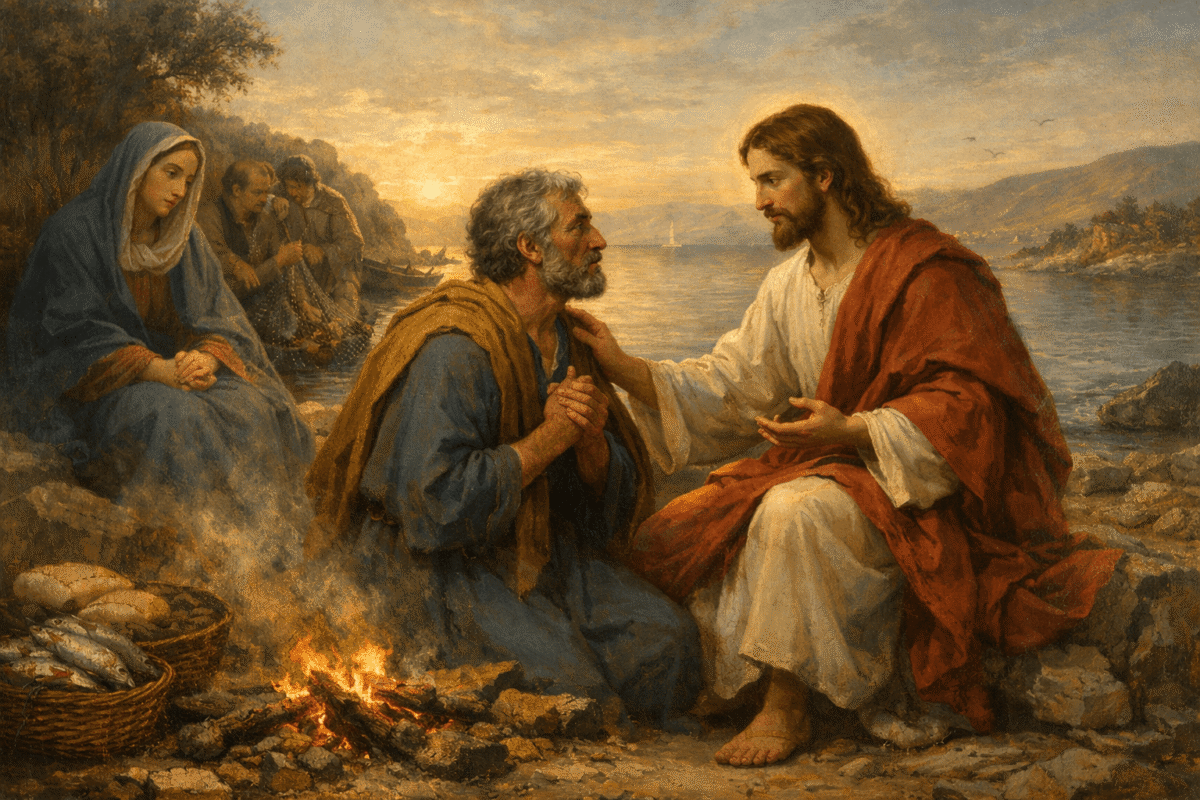
Dixit ei tertio: Simon Ioannis, amas me? Et dixit ei: Domine, tu omnia nosti, tu scis quia amo te. Dixit ei Iesus: Pasce oves meas.
Jn 21:17
The Third Sunday of Easter in Year C offers us the conclusion of the Gospel of John: the apparition of the Risen One on the shore of the Sea of Tiberias, the miraculous catch of fish, the breakfast beside the fire, and, above all, the rehabilitation of Peter and his mission. “Feed my sheep”: here, in visible fashion, the pastoral structure of the Church is born. And Mary, Mother of the Church, is not absent from this birth: her spiritual motherhood, entrusted on the Cross (Jn 19:26-27), is the affective and contemplative dimension without which the Petrine structure risks being reduced to pure administration.
I. The Dawn of the Risen One
“When day was now breaking” (Jn 21:4), the dawn is, in John, the time of the paschal apparitions. Mary Magdalene found the empty tomb at dawn (Jn 20:1). The disciples on the sea encounter the Risen One at dawn. The paschal dawn is the time of the encounter with the Living Lord, the moment in which the night of the tomb is resolved into the light that no death can extinguish. The recurrence of this motif in the fourth Gospel is not accidental: the dawn is the symbol of the Resurrection both in nature and in faith, and John is careful to situate the encounters with the Risen One at this liminal moment between night and day.
Marian tradition sees in Mary the dawn par excellence, she who precedes the Sun and announces it. This image, coming from the Holy Fathers (Jerome, Ambrose), was taken up by Benedict XVI in Verbum Domini (n. 88): “Mary is the perfect model of how the Word of God transforms human life”. At the dawn of Easter, Mary is the creature who first, in total faith, even without any sensible vision, welcomed the Resurrection. Her faith on Holy Saturday, the darkest day, was the dawn that preceded the public manifestation of the Risen One. In that sense, Mary is the deepest “paschal dawn”: not the one who first sees the Risen One with her eyes, but the one who awaits Him with the most faithful faith in the darkest night.
“But the disciples did not know that it was Jesus” (Jn 21:4): the Risen One is the same and is different. The glorified body that appears on the shore of the lake is the same body that Mary conceived in Bethlehem and that was crucified on Calvary, but transfigured, glorified, not immediately recognizable in the morning light. This initial “non-recognition” that precedes recognition is a pattern in the apparitions of the Risen One: the disciples of Emmaus did not recognize Him on the road (Lk 24:16). Mary Magdalene took Him for the gardener (Jn 20:15). The Risen One reveals Himself progressively, to whoever is disposed to recognize Him, and the correct disposition is faith, not sight.
The miraculous catch of fish that precedes the recognition (Jn 21:6-7) has the structure of a new eucharistic sign: the disciples who worked all night without catching anything are directed by the Risen One and obtain a catch they could not achieve by themselves. The “beloved disciple”, figure of contemplation, recognizes the Lord before Peter does (Jn 21:7). This precedence of contemplative love over Petrine action is one of the great themes of Johannine ecclesiology: loving sight precedes pastoral action. The heart that recognizes the Lord directs the hand that steers the boat.
II. “Amas me”?: The Love That Restores
Jesus’ threefold question to Peter, “do you love me”?, corresponds symmetrically to the threefold denial. The structure of the dialogue is of an extraordinary psychological and theological density: the love that restores what fear destroyed. Peter, who had denied three times beside a charcoal fire (Jn 18:18, 25, 27), is invited to confess his love three times beside another charcoal fire (Jn 21:9). The symmetry is not accidental: John deliberately constructs this parallelism in order to show that the Resurrection undoes not only death, but also human denials and betrayals. The love of the Risen One is stronger than sin.
The progression of the verbs of love in the original Greek dialogue is debated by exegetes. Jesus asks with agapas me (love of total self-giving) the first two times, and Peter answers with philō se (love of friendship). The third time, Jesus descends to Peter’s level and asks also with phileis me, and Peter “was grieved” (Jn 21:17). Jesus’ “descent” to Peter’s level is not a capitulation: it is the pastoral kenosis of the love that always begins where the other is, and not where we would like him to be. Jesus does not ask of Peter a love that he does not yet have. He accepts the love Peter has and builds the mission upon it.
Mariology finds here a mirror of its own existence. Mary never denied Him. She never abandoned Him. But the love she represents, the love that remains, that does not flee, that stands beside the Cross, is the model to which Peter, after the Resurrection, is called to be configured. Love constituted in the Petrine mode, the love of the shepherd who becomes responsible for the sheep, needs to be nourished by Marian love, the contemplative love that never leaves the Son’s side. The structure of the Church is, in that sense, the articulation between the actively Petrine principle and the contemplatively Marian principle.
Hans Urs von Balthasar, in Der antirömische Affekt, distinguished systematically between the “Petrine principle” and the “Johannine-Marian principle” in the Church. The first organizes, governs, decides. The second contemplates, loves, bears witness. Neither of the two is dispensable: without the Petrine principle, the Church dissolves into devotional sentimentalism. Without the Johannine-Marian principle, the Petrine principle degenerates into pure bureaucracy or an exercise of power. The balance between the two is the permanent challenge of ecclesiology and of the concrete life of the Church in every historical epoch.
III. “Pasce oves meas”: The Pastoral Mission and the Maternal Model
The mission entrusted to Peter, “feed my sheep”, is not a self-reference: he feeds the sheep of Christ, not his own. Peter does not receive a flock of his own. He receives the responsibility of caring for the flock of another. This structure of service, the pastoral office as service in the name of another, defines the essence of the hierarchical ministry in the Church. The shepherd is always a vicar, not an owner. He always acts in the name and with the authority of Christ, not by his own right.
The nascent Church, as it appears in the first chapters of the Acts of the Apostles, has a fundamentally maternal structure: it welcomes, it feeds, it cares, it brings forth to life. The supreme model of this ecclesial motherhood is Mary. Paul VI, in closing the third session of the Second Vatican Council (November 21, 1964), proclaimed Mary “Mother of the Church”. This proclamation was not an arbitrary decision: it synthesized a tradition that runs through the Fathers, the Liturgy, and the great medieval theologians. The Church that “feeds” the sheep of Christ learns from Mary how one feeds them: with maternal love, with patience, with the readiness to offer its own being as food.
John Paul II, in Redemptoris Mater (n. 24), developed the ecclesiological dimension of this motherhood: Mary is the Mother of Christ and, in Christ, the mother of all the members of His Body. This motherhood is not merely metaphorical: it is a spiritual reality that has concrete effects in the life of the Church. Mary who intercedes for the Church, who accompanies the shepherds in their mission, who presents to the Son the needs of the flock, this active and intercessory Mary is the ultimate foundation of all ecclesial pastoral work, prior and superior to any juridical or canonical structure.
The Acts of the Apostles (1:14) describe the period between the Ascension and Pentecost: the apostles, including Peter, gathered in the Upper Room, persevering in prayer “with Mary, the mother of Jesus”. The beginning of the apostolic ministry takes place under Mary’s maternal gaze. This conjunction, Mary and Peter, motherhood and primacy, love and structure, is one of the most fruitful themes of contemporary ecclesiology. The Church that “feeds the sheep” of Christ does so better when it does so with Mary’s disposition, with a love that keeps no accounts, with a patience that does not grow weary, with an intercession that does not resign itself.
IV. The Prophecy of Martyrdom and the Freedom of Love
Jn 21:18-19 contains a raw and direct prophecy: “when you are old, you will stretch out your hands and another will gird you and carry you where you do not wish to go”. For Peter, the following of Christ will culminate in martyrdom, in a death that repeats, in mirrored form, the death of the Master. And immediately: “He said this to indicate by what death he was to glorify God. And having said this, He added: Follow me” (Jn 21:19). The final “follow me” is not a reassuring invitation. It is a radical invitation that involves the totality of life, including its loss.
Mary lived the most radical “follow me” before Peter: she followed the Son from the Annunciation to Calvary, without choosing the terms of that following. Simeon’s “sword” (Lk 2:35) was her prophecy of martyrdom, not physical martyrdom, but the martyrdom of the heart that suffers with and through the Son. The Christian spiritual tradition identified Mary as the first “spiritual martyr”, not because she had shed her blood, but because the love that united her to the Son made her a participant in His suffering in a way so profound that no other human being can compare.
The freedom of love that Peter is called to exercise in the “follow me” has in Mary its most perfect model. She did not follow the Son because she was compelled or because she had no alternative: she followed Him with a total freedom that was renewed at every step of the way. Mary’s freedom is particularly visible in the moments when the following was most difficult: when Simeon prophesied the sword (Lk 2:35), when Jesus remained in the Temple without warning (Lk 2:49-50), when the public ministry drew her away from immediate closeness to the Son, when Calvary became the reality she had to accept. In each of these moments, Mary freely chose to go on following, and that freedom makes her following a model of inestimable value for all who are called to the “follow me” of the Risen One.
The closing of the Gospel of John, “there are still many other things that Jesus did” (Jn 21:25), suggests that the story narrated is only the beginning of a longer story that continues in the Church and in every generation. Mary, who keeps in her heart what the Gospels could not record, is the guardian of this unwritten memory, the mediator of the living tradition that the Spirit continues to activate in the community of the faithful throughout history. The “feed my sheep” of Jn 21 was not exhausted with Peter: it continues in every shepherd who, loving Christ, cares for His flock with the maternal love he has learned from Mary.
The Risen One who asks “amas me”? and who sends forth to feed the sheep brings to birth a Church that has Mary as its model of faithful love. May this Third Sunday of Easter deepen in us faith in her who is, at one and the same time, Mother of Christ and Mother of the Church.
Postgraduate Program in Mariology
Would you like to deepen your formation in Mariology? Discover the Postgraduate Program in Mariology of Locus Mariologicus – an academic formation that unites theological rigor, spiritual life, and the living tradition of the Church.
Would you like to study Mariology seriously?
This article is born of the works in the library of Locus Mariologicus. The Postgraduate Program in Mariology takes you to the same source, with academic guidance: Scripture, the Fathers of the Church, and the Magisterium, from the first dogma to contemporary questions.




Responses