Pilgrimages and the Scholar of Mariology

Pilgrimage
The pilgrim needs the shrine, and the shrine needs the pilgrim.
Pilgrimage reminds us that on earth we have no lasting dwelling, but are on our way to the heavenly city (cf. Heb 13:14).
Pilgrimage expresses the desire to visit a place where an event of salvation history took place, or where God or the Virgin became manifest, or where a holy man bore heroic witness with his life, or where his mortal remains are kept.
Pilgrimage shows a purpose of detachment from temporal things, even if this detachment materially lasts only a short time. Through the inevitable privations and renunciations it entails, it manifests the need for penance and expiation.
Pilgrimage makes room for bearing witness to one’s readiness for the gift of self in humble and hidden service to brethren who are needy or sick.
Pilgrimage affirms that all pilgrims, of whatever nation or social class, belong to the one family of God. These are the authentic values that pilgrimage expresses, even though they are sometimes obscured by the presence of tourist or commercial elements.
Pilgrimage is a manifestation of worship closely linked to the life of the shrine. In its most authentic forms it constitutes a lofty expression of piety, because of the reasons that lie at its origin, the spirituality that animates it, and the prayer that marks its fundamental moments: the departure, the journey, the arrival, and the return.
From Hebrew Pilgrimage to the Pilgrimage of Mary
Jerusalem, which had become the seat of the temple and of the ark, became the shrine-city of the Hebrews, the destination par excellence of the longed-for holy journey (Ps 84:6), in which the pilgrim advances amid songs of joy of a multitude keeping festival (Ps 42:5) to the house of God, to appear in His presence (cf. Ps 84:6-8).
Three times a year the men of Israel were to appear before the Lord (cf. Ex 23:17), that is, to go to the temple in Jerusalem: this gave rise to three pilgrimages on the occasion of the feasts of Unleavened Bread (Passover), of Weeks (Pentecost), and of Tabernacles. And all devout Israelite families, like the family of Jesus (cf. Lk 2:41), went to the holy city for the annual celebration of the Passover.
During His public life, Jesus too would go as a pilgrim to Jerusalem (cf. Jn 11:55-56). It is also well known that the evangelist Luke presents the saving action of Jesus as a mysterious pilgrimage (cf. Lk 9:51-19:45), whose intended destination is Jerusalem, the messianic city, the place of His paschal sacrifice and of His exodus to the Father: I came from the Father and have come into the world. Now I am leaving the world again and going to the Father (Jn 16:28).
And it is precisely during a gathering of pilgrims in Jerusalem, of observant Jews from every nation under heaven (Acts 2:5), to celebrate Pentecost, that the Church begins her missionary journey.
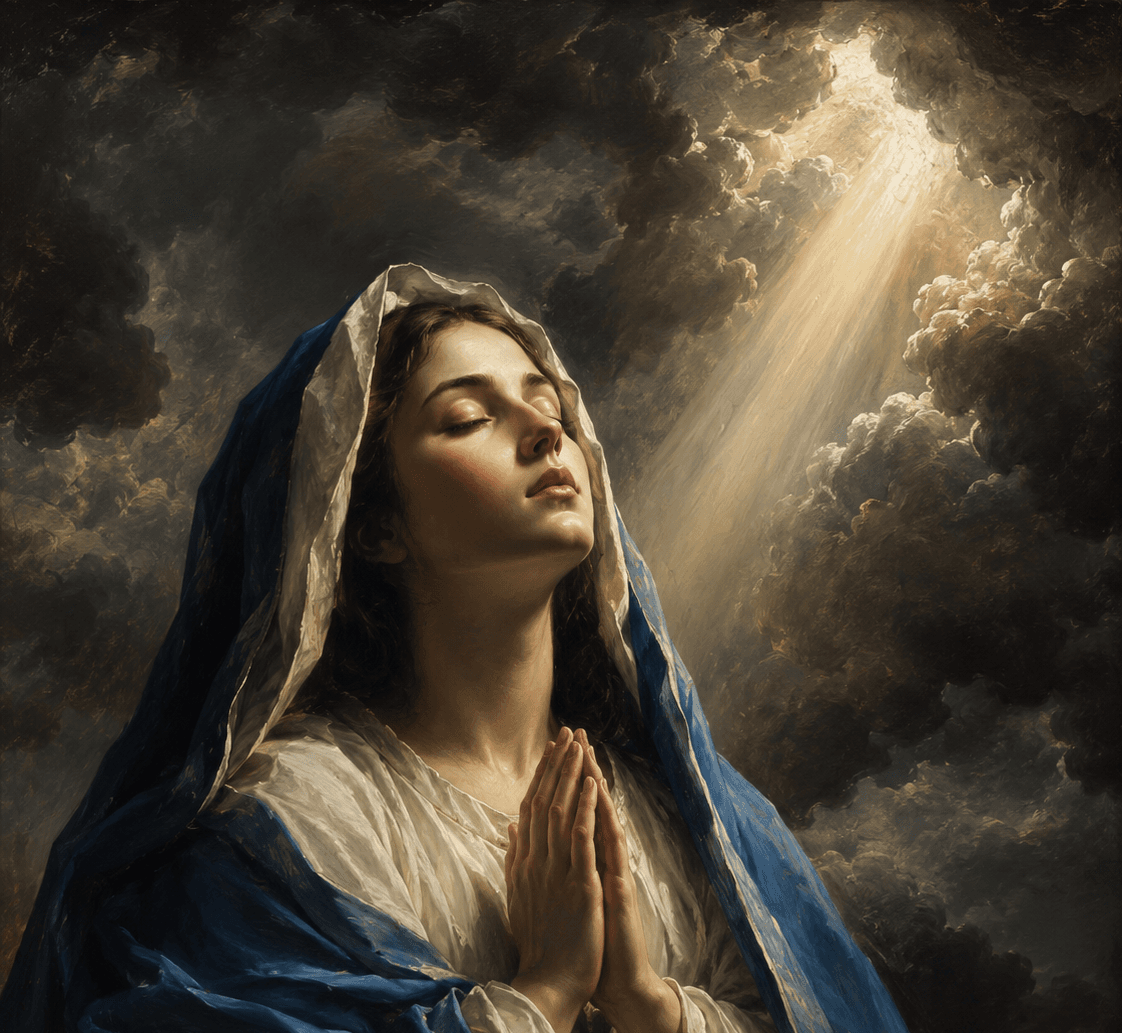
Considering the life and mission of the Virgin, it is not difficult to understand the Mariology of the spirituality of pilgrimage. Faithful to the tradition of her people, Mary of Nazareth was a devout pilgrim:
- The parents of Jesus went to Jerusalem every year for the feast of the Passover. When he was twelve years old, they went up again according to custom (Lk 2:41-42).
- Mary was once again a pilgrim to Jerusalem with her Son when He, the true Lamb of God (cf. Jn 1:36), by offering the sacrifice of His life, instituted the new and definitive Passover, the memorial of our liberation from sin and of His exodus from this world to the Father (cf. Jn 13:1).
- Mary’s interior life was a pilgrimage of faith.
The Magisterium and the liturgy, considering earthly life as a pilgrimage, repeatedly portray the Virgin’s intercession on behalf of her children as assistance to pilgrims on their way to the heavenly sanctuary.
Therefore, the Mariology of a pilgrimage derives not only from the fact that it is directed to a shrine dedicated to the Virgin, but also and above all from the attitude with which it is carried out:
- fidelity to tradition,
- motivation of faith,
- orientation toward Easter.
The success of a pilgrimage as a manifestation of worship, and the spiritual fruits hoped for from it, are ensured by the orderly unfolding of the celebrations and by due emphasis on its various stages, along the lines that tradition indicates to us. Thus, for example:
- The departure of the pilgrimage will fittingly be marked by a moment of prayer, held in the parish church or in another more suitable one, consisting of the celebration of the Eucharist, or part of the Liturgy of the Hours, or a special blessing of the pilgrims.
- The last part of the journey will be animated by more intense prayer. It is advisable that this final stretch, when the shrine is already in sight, be covered on foot, in procession, praying, singing, and stopping at the stands that may appear along the way.
- The welcoming of the pilgrims can give rise to a kind of liturgy of welcome, which places the encounter between the pilgrims and the custodians of the shrine on a level eminently grounded in faith. Whenever possible, the latter will go out to meet the pilgrims, in order to walk the last part of the way with them. This is where the Scholar of Mariology comes in.
- The stay at the shrine should obviously be the most intense moment of the pilgrimage and will be marked by a commitment to conversion, duly ratified by the sacrament of reconciliation; by particular expressions of prayer, such as thanksgiving, supplication, or requests for intercession, in keeping with the characteristics of the shrine and the purposes of the pilgrimage; and by the celebration of the Eucharist, the summit of the pilgrimage.
- The conclusion of the pilgrimage will fittingly be marked by a moment of prayer, at the shrine itself or in the church from which the pilgrimage set out. The faithful will thank God for the gift of the pilgrimage and will ask the Lord for the help they need to live their Christian vocation with more generous commitment when they return to their homes.
Just as the shrine is a place of prayer, pilgrimage is a journey of prayer. At each of its stages, prayer should animate the pilgrimage, and the Word of God should be its light and guide, its nourishment and support.
Since ancient times, the pilgrim has wanted to take home mementos of the shrine he has visited. Care will be taken that objects, images, and books convey the authentic spirit of the holy place. On this point, the production, above all, of books concerning the Mariology of the shrine and of pilgrimage should be the responsibility of the Scholars of Mariology, so as to adapt, create, expand, and teach how to use these contributions to the spiritual life, which are usually replicated in the ecclesial communities from which the pilgrims come.
To deepen your reflection on Marian pilgrimages and the cult of Mary, consult Paul VI’s Apostolic Exhortation Marialis Cultus, which provides the theological foundation for authentic Marian devotion.
Deepen your studies: explore Mariology, Marian Theology, Marian apparitions, and the Postgraduate Program in Mariology.
Postgraduate Program in Mariology
Would you like to deepen your formation in Mariology? Discover the Postgraduate Program in Mariology of Locus Mariologicus – an academic formation that unites theological rigor, spiritual life, and the living tradition of the Church.
Would you like to study Mariology seriously?
This article grows out of the works in the Locus Mariologicus library. The Postgraduate Program in Mariology takes you to the same source, with academic guidance: Scripture, the Fathers of the Church, and the Magisterium, from the first dogma to contemporary questions.


Responses