The Miraculous Medal: Origin and Spread

The second apparition of the Virgin
As the Revolution of 1830 was breaking out, between July 27 and 29, the Three Glorious Days were being celebrated. The king had been deposed, and all the bloody wars that had been foretold were underway. Even the Archbishop of Paris became the object of popular fury. People thought they were seeing the evil days of 1793 return. But the protection of the Lazarists and the Daughters of Charity came to pass, as had been prophesied. The threats of the young rioters stopped at the door of the house of the Communities of Saint Vincent de Paul.
The Miraculous Medal
Is it all over? No. Four months later, she was the bearer of a precise command: to have a medal struck with the image of the Immaculate Conception, whom she saw radiant with the gifts of God. On December 27 she was seized with a great desire to see the Holy Virgin.
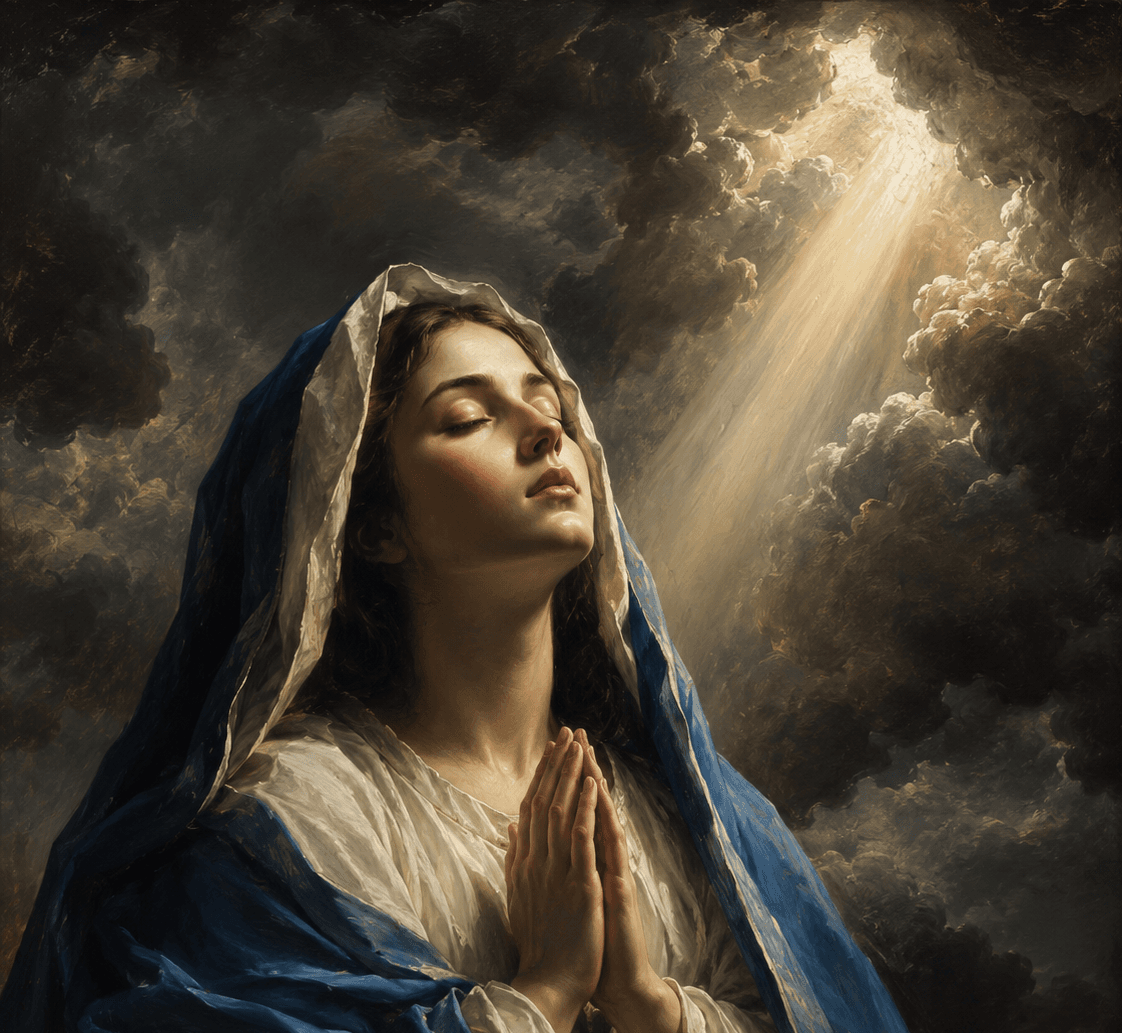
“A desire so strong that it convinced me I would see her as beautiful as on her most beautiful day. I saw the Most Holy Virgin at the same height as the picture of Saint Joseph […]. Standing, dressed in white, of medium height, with an appearance so beautiful that it would be impossible for me to describe her beauty. She wore a dress of white silk the color of the dawn” (Life, 90-91). It was half past five in the afternoon, during prayer, “in deep silence”. Her confessor, Father Aladel, received this account very badly and wrote nothing about what had happened; there remains only the following record of what Catherine confided to him: “During prayer the novice saw a picture representing the Most Holy Virgin as she is usually represented under the title of the Immaculate Conception, standing, with her arms outstretched. [She was] dressed in a white dress and a silvery-blue mantle, with a dawn-colored veil. From her hands came rays, as if in bands, whose light was enrapturing. [The nun heard] at the same time a voice saying: ‘These rays are the symbol of the graces that Mary obtains for men’. Around the picture she had read, in letters of gold, the following invocation: ‘O Mary conceived without sin! Pray for us who have recourse to thee’” (Life, 91).
Catherine’s memoirs specify her feelings at that moment:
“In this regard, I cannot express what I felt and what I saw: the beauty and the sparkling light, the rays […]. ‘I distribute [these graces] to the people who ask for them’ [Catherine heard it said]. She made me understand how generous she is to the people who pray to her. How many graces she grants to the people who ask her for them, and how much joy she feels in granting them. At that moment, whether I was there or not, I rejoiced; I do not know” (Life, 91-92). Father Aladel continues his account briefly, following Catherine’s lines: “A few moments later this picture turns around, and on the reverse she makes out the letter ‘M’ with a small cross above it, and below, the Sacred Hearts of Jesus and Mary. After the sister had carefully reflected on all this, the voice said to her: ‘A medal must be made on this model, and the people who wear it and say this short prayer with piety will receive a very special protection from the Mother of God.’”
Subsequent history
At the time, Father Aladel gives her a poor reception. This return of the visions is a bad sign:
“Pure illusion!” he replies to such things. “If you want to honor Our Lady, imitate her virtues and keep away from imagination!” Catherine withdraws, apparently calm, without becoming any more agitated, the confessor observes (n. 52, CLM 1, p. 220). But this is due mainly to her self-control and to the promised grace, for the shock was severe. Relieved at having dared to speak, she now tries to obey.
Third and last apparition (December 1830).
In December she sees the picture again: as on November 27, at “half past five”, after meditation. The Virgin wears the same high-necked dress, the color of dawn, and the same blue veil. The “hair held back by a band trimmed with lace the length of two fingers,” Catherine meticulously explains. The rays that came from her hands “filled the whole lower part, so that the feet of the Most Holy Virgin could no longer be seen”. And once again “a voice” is heard in the depths of her heart: “These rays are the symbol of the graces that the Most Holy Virgin obtains for the people who ask her for them.” The apparition has the character of a farewell. Catherine receives this notice:
“You will see me no more, but you will hear my voice during your prayers.”
In the service of the poor
On January 30, 1831, Catherine took the habit and left the novitiate. She was assigned to the house at Reuilly, quite close by, so that she could be seen: she was a nun, so she would not create any inconvenience. She served with the most perfect discretion throughout her life, but the Medal had not yet been made.
In March 1832, a terrible cholera epidemic struck the people of Paris within a few hours. Twenty thousand died of dehydration. It is a national tragedy, a time of condolence and mutual aid, but also of prayer. It is at this moment that M. Aladel persuades Monsignor Quélen, who was also shaken by the drama of the Revolution, on account of which he had lost his archbishop’s palace on January 15, 1831, to combat this tragedy. He came back to visit the sick. In May the epidemic abated, but it started again in the second half of June. And all this speeds up the production of the medal. On June 30, 1832, the first 1,500 copies were distributed. The archbishop wears one and has a picture made bearing its likeness. Catherine receives one at the beginning of July. And miracle after miracle, cure after cure, begin to take place, in a lasting way. There is nothing to report about Catherine’s life. She remained unfailingly an efficient and discreet servant in the service of the poor. At Reuilly she soon became a countrywoman in charge of the garden and the animals, always ready for the task, even before the elderly who were at times gloomy and authoritarian. She gives the true measure of her discreet authority and of her adaptability when it comes to the days of the Commune of 1871. She no longer has apparitions, but she sometimes receives communications and messages that she is charged with passing on. In such cases she insists until obedience reduces her to silence.
The cross of 1848
On the threshold of the Revolution of 1848, Catherine sends M. Aladel a new request: a great cross to be erected in Paris as a spiritual lightning rod:
“This cross will be called the Cross of Victory. It will be greatly revered. From all over France and from the most distant countries, even from abroad, people will go there, some out of devotion, others on pilgrimage, and still others out of curiosity. Finally, there will be very special protections that will have to do with the miracle. No one will come to Paris without coming to see and visit this cross as if it were a work of art.” And the sublime ends in the commonplace: Father Aladel finds reason to laugh at what the sister says. She continues: “At the foot of the cross this whole revolution will be depicted exactly as it happened. The base of the cross seems to me to measure 10 to 12 feet, in the shape of a square, and the cross itself to be 15 to 20 feet high. Once erected, it seemed to me to be about 30 feet high” (Life, 191).
Once again Catherine was not heeded. Father Aladel orders her not to speak of it again. All that remains for her is to write one last time:
“My Father, this is the third time I have asked you for this cross, after consulting the good God, the Holy Virgin, and our good father Saint Vincent. […] Instead of feeling relieved, I felt more and more compelled to send you everything in writing. So, out of obedience, I submit. I think I will no longer worry about it. I am, with the deepest respect, your daughter, devoted to the Sacred Hearts of Jesus and of Mary” (Life, 190-191).
The cross was very popular in 1848. Some demonstrators carried in triumph a cross they had saved from the attack on the Tuileries, but Aladel did not seize the opportunity.
Lourdes, 1858
When Catherine heard of the apparition, she said at once:
“It is the same [Lady]” (Life, 197). “The most extraordinary thing,” writes Sister Dufès, her superior, “is that, without having read any of the published works, Sister Catherine knew about everything that had happened, even more than the people who had gone there on pilgrimage.” According to her, the Virgin had to appear so far away because the nuns’ community chapel, essential to the community, was not open to the public. Three nuns wrote down their reflections on the matter: “And to think that these miracles could have taken place in our chapel!” (Testimony of Sister Tranchemer). “If the colleges had been willing, the Most Holy Virgin would have chosen our chapel” (Sister Millon). “My Good Mother, no one here wants to do what you want; show yourself somewhere else!”
she would write this, according to Sister Pineau. In this way she expressed her displeasure that the chapel on the rue de Bac was not open to the public, which stood in the way of the congregation’s prosperity, since the chapel was too small for the many nuns and 500 novices. It was on April 25, 1865, that M. Aladel died. He had been Catherine’s confessor until his death.
The Virgin with the globe
Catherine was tormented because the Miraculous Medal, by then numbering a million copies, did not represent what she had seen in 1830: the Virgin with a globe in her hands, radiant with light. Sister Dufès begins:
“They will say you are mad!” “Oh! It will not be the first time! M. Aladel often treated me like a nasty wasp when I insisted on these things!” Then she told her about it. “But what became of this globe?” “All I could see were the rays coming down from her hands,” Catherine replies. “But what will become of the Medal if all this is made public?” “Oh! You must not touch the Miraculous Medal.” “But if M. Aladel refused, that means he had his reasons.” “It is the martyrdom of my life,” Catherine replies. “But the globe of the earth is already under her feet; so will there be a second globe between her hands?”
Neither Catherine nor Sister Dufès ever explained how the seer reconciled the two images.
Sister Dufès is all the more perplexed by the fact that Catherine was not infallible in her intuitions. She had the ground dug up at Reuilly, beyond the town hall, to uncover, at a depth of 1.50 meters, “a flat stone, similar to a tombstone,” with which one was to “build a chapel,” “or rather,” “a church.” They searched thoroughly, but found nothing: “You are mistaken,” concluded Sister Dufès. Catherine had yielded to the evidence: “Well, my sister, I was mistaken. I thought I was telling the truth. I am glad that you know the truth.”
From all this one can gauge how difficult discernment is in the matter of apparitions. Did Aladel discern well in rejecting the cross of 1848, which could have had considerable influence at the time? Was he right to reject the Virgin with the globe, a project that Sister Dufès finally supported despite an initial categorical refusal from her superior? There was no way around it: two images of the Virgin would have raised many difficulties in high places because of the revolutions. But he had allowed a “private” execution of this model for the Reuilly house. The model, made according to Catherine’s indications while always preserving her anonymity, was finally placed in the chapel on the rue de Bac, without anyone grasping what all this could add to the Virgin with open, radiant hands already placed on the central altar.
In short, at the beginning of the apparition, the Virgin was holding a radiant globe (the earth) in her hands. The light became dazzling. At that point Catherine no longer saw the first globe, but only the rays that lit up the globe beneath the Virgin’s feet (which also represented the earth). What was the position of the hands at that moment? The inquiries do not specify it. In any case, Catherine explained to Sister Dufès:
“Nothing must be changed on the medal!” This makes the following likely: Aladel was right to retain the final phase represented on the medal, because it is not the globe that radiates the light, but the Virgin’s hands. The medal could only represent this final phase, whatever the variants of each of the three apparitions.
Catherine, approaching seventy, was beginning to feel the weight of her years. Her secret began to leak out furtively, and so she received a discreet visit from Marshal Mac Mahon (Life, 286), at a time when families were not permitted to go up to the infirmary. During her fervent agony she still showed that intuitive side, like a second sight, which had discreetly accompanied her regular, everyday work, perfectly integrated into the most varied social situations. For her death, she asked that sixty-three children recite each invocation of the litanies of Our Lady around her bed. “She is losing her mind,” they began to think. “There are only thirty-seven invocations in the litany of the Immaculate used by the Daughters of Charity. And even fewer in the Litanies of Loreto.” “Yes, there are,” Catherine protested. “You will find them in the Office of the Immaculate Conception in our prayer book.”
Sister Dufès does the count. It is correct. Catherine, who had been so good at counting on her fingers before she learned to read and add, knew how to count, as the impeccable accounts she kept for her farm at Reuilly, for the cows, rabbits, and pigs, bear witness. She got her way on this last question, which had nothing to do with clairvoyance, but with the precision of her bookkeeper’s mind, plus a pinch of poetry and something symbolic.
She saw in the number sixty-three the illustration of an oral tradition that attributes sixty-three years to the Virgin: fifteen years before the birth of the Son, and then another fifteen after the thirty-three years of Christ’s life. Thus Catherine dedicated to Our Lady her seventy years of laborious life, which made her Our Lady’s elder sister. Into all this she put her poetry, her familiarity, and her humor, but also her joy at being closer to heaven.
“Why be afraid to go and see Our Lord, His Mother, and Saint Vincent?”
These were among Catherine’s last words before she closed her blue eyes.
To understand the Marian devotion connected with the Miraculous Medal, consult Paul VI’s Apostolic Exhortation Marialis Cultus, on popular piety and the cult of Mary.
Further your studies: explore Mariology, Marian Theology, Marian apparitions, and the Postgraduate Program in Mariology.
Postgraduate Program in Mariology
Would you like to deepen your formation in Mariology? Discover the Postgraduate Program in Mariology of Locus Mariologicus, an academic formation that unites theological rigor, spiritual life, and the living tradition of the Church.
See the complete list of Marian apparitions recognized by the Church.
Responses