Remittuntur ei peccata multa: The Sinful Woman and the Women Disciples of the Lord
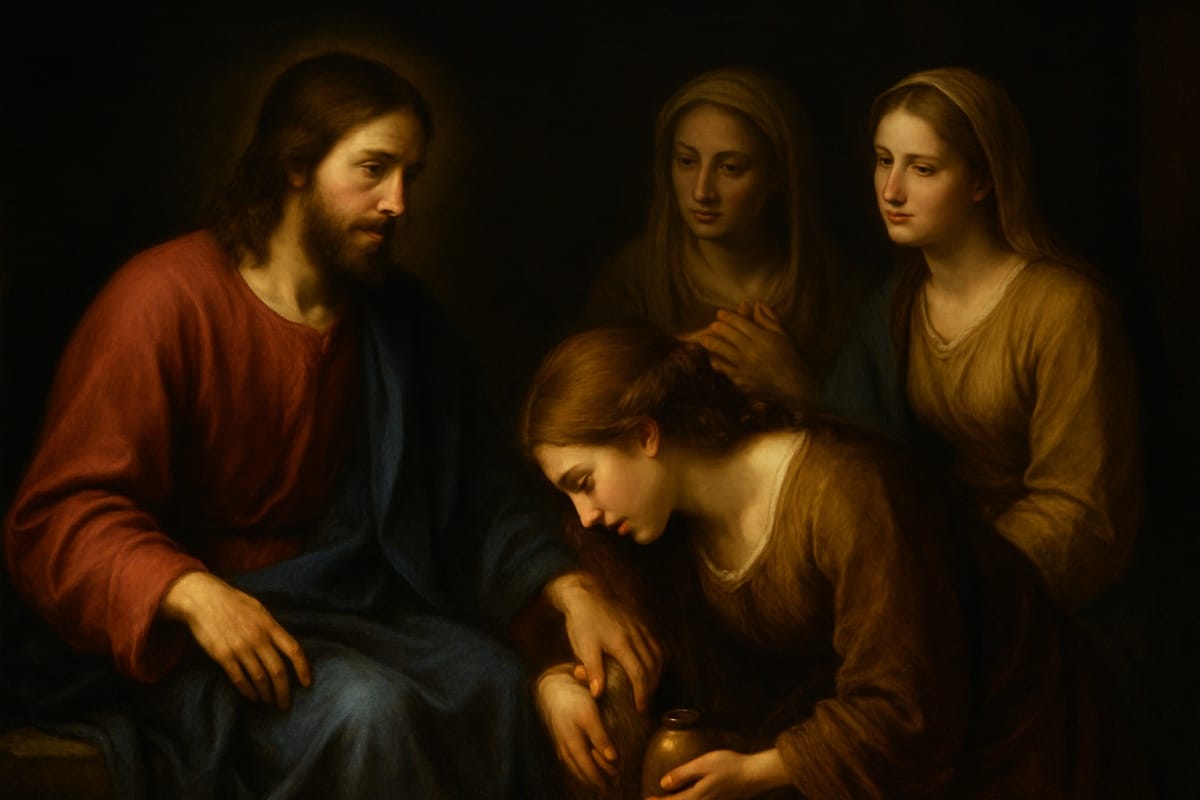
Remittuntur ei peccata multa, quoniam dilexit multum. Cui autem minus dimittitur, minus diligit.
Lk 7:47
The Eleventh Sunday in Ordinary Time, Year C, offers one of the richest and most literarily elaborate pericopes in the Gospel of Luke: Lk 7:36-8:3. The episode of the banquet in the house of Simon the Pharisee, with the sudden entrance of a “sinful” woman who anoints Jesus’ feet with tears, hair, and precious perfume, is followed immediately (Lk 8:1-3) by the list of the women who accompanied Jesus in His itinerant mission, among them Mary Magdalene, Joanna, and Susanna, “and many others.” The first reading (2 Sam 12:7-10, 13), the prophet Nathan before David after the adultery with Bathsheba, and the second reading (Gal 2:16, 19-21), Paul on justification by faith, set the Gospel within a broader context: the grace that forgives, that sets free, and that calls to discipleship.
The identity of the “sinful woman” of Lk 7 was one of the greatest exegetical debates in biblical history. Gregory the Great (†604) identified her with Mary Magdalene and with Mary of Bethany, creating the “composite Magdalene” that dominated Western iconography and devotion for fifteen centuries. Modern exegesis rejects this identification: Luke does not name the woman of Lk 7, and nothing in the text links her to Mary Magdalene or to Mary of Bethany. Mary Magdalene, as Luke describes her in 8:2, is a disciple healed “of seven demons,” not necessarily of moral sins, but of a condition of suffering or of psychological/spiritual disturbance. The distinction matters: the “sinful Magdalene” of the Western tradition is a later theological construction, not a biblical datum.
I. Simon’s Banquet: The Irruption of Love
The setting of the episode, a Pharisaic banquet, is theologically essential. The Pharisees were the representatives of the rigor of the Law and of ritual purity. The presence of a woman who was a “public sinner” in this setting was a grave violation of the purity norms. What Luke narrates is the collision between two logics: the logic of purity (which keeps the sinner at a distance so as not to contaminate the righteous) and the logic of Jesus’ merciful love (which lets itself be touched by the repentant sinner and transforms the sinner through that contact). This collision is not merely a dispute about ritual norms; it is a question about the nature of God: does God keep the impure at a distance, or does He go out to meet the lost?
The woman’s gesture is extraordinarily complex on the symbolic level. She comes in “with an alabaster flask of perfume,” an object of great value, probably her working capital. She weeps over Jesus’ feet, wipes them with her hair (a gesture of extreme submission and intimacy; for a woman to let down her hair in public was itself socially transgressive), kisses them again and again, and anoints them with the perfume. This sequence is a silent liturgy of love: the broken flask, the poured-out perfume, the tears as baptismal water, the hair as a towel of ministry. It is the language of a love that has gone beyond words.
Simon’s reaction, “If this man were a prophet, he would know who and what sort of woman this is who is touching him, for she is a sinner” (Lk 7:39), reveals his logic: holiness is incompatible with contact with sin. Jesus answers with the parable of the two debtors (Lk 7:41-43): two debtors, one who owed five hundred denarii and the other fifty, both freely forgiven. The one to whom more is forgiven loves more. Jesus’ logic overturns Simon’s: it is not contact with sin that defiles the holy one, but the love born of forgiveness that transforms the sinner. Holiness is not separation from the impure; it is love that reaches out to the impure and transforms them.
II. “Remittuntur ei peccata multa”: A Theology of Forgiveness
The formula of forgiveness, “her many sins are forgiven, because she loved much” (Lk 7:47), is theologically delicate and calls for precise exegesis. Misread, it suggests that love is the condition of forgiveness: the woman loved so much, and therefore she was forgiven. Such a reading would be a soteriology of merit, human love obtaining divine favor. But the parable of the two debtors that precedes the formula says the opposite: the debtors were freely forgiven by the creditor, and for that reason they loved. Love is the fruit of forgiveness, not the condition for obtaining it.
The Greek syntax of verse 47 allows this interpretation: the hoti (“because” or “since”) can be causal (she is forgiven because she loved) or evidential (her love is evidence that she has been forgiven). The parable that precedes it makes clear that the evidential reading is the correct one: she loves much because she has already been forgiven much. This theological distinction is fundamental: God’s grace precedes and gives rise to human love. Love does not precede and give rise to grace. The woman who poured out the perfume did not “merit” forgiveness; she responded with love to a forgiveness already received in her encounter with Jesus.
This theology of forgiveness that gives rise to love has enormous spiritual and pastoral richness. A spirituality that starts from awareness of one’s own sin and of the greatness of God’s love, what Bernard of Clairvaux called cognitio sui et Dei, the knowledge of oneself and of God, is more fruitful than a spirituality that starts from the presumption of merit. Thérèse of Lisieux expressed this insight in an unsurpassable way: the awareness of being “the littlest” was not an obstacle to love, but its foundation. Whoever has been forgiven much loves much, and whoever loves much bears much fruit.
III. The Women Disciples: Lk 8:1-3
The section that immediately follows, Lk 8:1-3, is one of the most important texts of the New Testament for the history of the place of women in the early Church, and it is often underestimated in catechesis. Luke states explicitly that Jesus traveled accompanied not only by the Twelve but by a group of women who “served him out of their own means”: Mary Magdalene, Joanna (the wife of Chuza, Herod’s steward), Susanna, “and many others.” This group of women is a historical fact that Luke mentions explicitly in the pre-Easter period, not only at the Passion and the Resurrection, as the other Synoptics do.
The presence of these women in Jesus’ itinerant company is sociologically revolutionary in the context of first-century Judaism, where women were not disciples of rabbis. Luke uses the verb diakoneo (to serve, to minister) to describe their activity, the same verb that describes apostolic and diaconal service in the early Church. The expression “out of their means” (or “with what they had”) indicates that they contributed materially to the support of the missionary company, a form of apostolic patronage without which Jesus’ itinerant mission would not have been possible. They are, in this sense, the first “material supporters” of the Christian mission.
Mary Magdalene, who heads this list, holds first place because she is the most significant: “from whom seven demons had been cast out” (Lk 8:2). The number seven is probably symbolic, signifying the fullness of liberation, rather than literal. Mary Magdalene was healed of a condition of radical suffering and responded by following Jesus completely: she is present beneath the Cross (Jn 19:25) and at the tomb (Mt 28:1; Jn 20:1), and she is the first witness of the Resurrection (Jn 20:11-18). Thomas Aquinas called her “apostle of the apostles” (apostolorum apostola) because she was sent by the Risen One to announce the Good News to the Twelve, which the Roman calendar recognized in 2016 by raising her memorial to a feast.
IV. Mary of Nazareth and the Community of Women Disciples
The relationship between Mary of Nazareth and the women disciples of Lk 8:1-3 is not narrated explicitly in the Gospels, but theological tradition, drawing on Jn 19:25-27 and Acts 1:14, suggests that Mary was part of the wider group of women who followed Jesus and formed the core of the early community. In Jn 19:25, at the foot of the Cross, we find “his mother, his mother’s sister, Mary of Clopas, and Mary Magdalene,” a gathering of the women disciples at the most dramatic moment of the mission. In Acts 1:14, after the Ascension, we find “Mary, the mother of Jesus” in the upper room together with the apostles and other women, persevering in prayer.
This community of women disciples around Mary is the core of the nascent Church as Luke describes it. Mary is not an isolated figure: she is the “mother” of the community in a more than biological sense, the one who had traveled the longest and deepest road, from the Annunciation to Pentecost, and whose presence guided and encouraged the others. The Magdalene, Joanna, Susanna, “and many others” learned from Mary what faithful discipleship is: to stay when others flee, to wait when everything seems over, to recognize the Risen One when He appears early in the morning in the garden.
John Paul II, in Mulieris Dignitatem (1988), reflected at length on the “feminine genius” that these women disciples embody: a way of following Christ marked by personal fidelity, by concrete attention to suffering, and by the capacity to remain present at the moments when human plans collapse. This dimension of feminine discipleship, which is not exclusive to women but was lived by them in a paradigmatic way, has its supreme model in Mary: the “first disciple,” the “woman of the Fiat,” the one who stayed at the foot of the Cross when the Twelve fled, and who in the Upper Room presided in prayer over the community awaiting the Spirit. She who loved much because she had received much is the model of every Christian response to the ineffable gift of grace.
Postgraduate Program in Mariology
Would you like to deepen your formation in Mariology? Discover the Postgraduate Program in Mariology of Locus Mariologicus, an academic formation that unites theological rigor, spiritual life, and the living tradition of the Church.




Responses