Simile est regnum caelorum grano sinapis: The Mustard Seed and Mary, Seed of Salvation
By Prof. Dr. Daniel C. Afonso · Updated
Simile est regnum caelorum grano sinapis, quod accipiens homo seminavit in agro suo. Quod minimum quidem est omnibus seminibus, cum autem creverit, maius est omnibus oleribus et fit arbor.
Mt 13:31-32
Mt 13:31-35 presents two micro-parables that form a diptych: the mustard seed and the leaven. Both share the same logical structure: the least conceals the greatest, the invisible transforms the visible, a contemptible beginning produces a surprising end. The mustard seed (Sinapis nigra) was proverbially the smallest of the seeds cultivated in Palestine. Its capacity to grow to two or three meters made the contrast between origin and destiny particularly striking. The leaven that the woman “hides” in three measures of flour (about 40 liters, enough to feed a hundred people) is an agent of transformation that is invisible but radical.
The two parables implicitly answer an objection that the context of Mt 13 suggests: if the Kingdom of God has come in Jesus, why does it seem so small and so imperceptible? The Pharisees demand a sign (Mt 12:38), the scribes argue about the origin of the miracles (Mt 12:24), the crowd that heard the parables “did not understand” (Mt 13:19). The Kingdom seems to have begun with a failure: seed lost on the path, on the rock, among the thorns. The parables of the mustard seed and of the leaven answer: the criterion of human judgment is not the criterion of the Kingdom. What seems least will become the greatest. What seems hidden will transform everything.
I. “The Smallest of All Seeds”: The Logic of the Least
“The smallest of all seeds” (Mt 13:32). The contrast between the mustard seed and the “greatest of shrubs” is the first great lesson of the parables of the diptych: the Kingdom of God does not begin with human greatness but with what the world considers insignificant. This logic runs through the whole of biblical history: the election of Israel among the peoples (“you are the least of all peoples,” Deut 7:7), the election of David (the youngest and least of the sons of Jesse, 1 Sam 16:11-12), the birth of the Messiah in Bethlehem (“the least of the cities of Judah,” Mic 5:1). The least is the privileged place of God’s intervention.
“Cum autem creverit, maius est omnibus oleribus et fit arbor” (Mt 13:32). The growth of the mustard seed from seed to tree evokes the prophetic language of the “trees of the world” that represent the empires (cf. Ezek 17:22-23; Dan 4:10-12). The image of the “tree in which the birds of the air make their nests” is an image of the universality of the Kingdom: all the nations will find refuge. The small Kingdom inaugurated by Jesus in Galilee will grow until it embraces all humanity, not by force but by the paradoxical logic of the seed that grows.
The theology of the “least that becomes the greatest” has a precise Christological application: Jesus was born on the margins (Galilee, Nazareth, a stable), into a family with no social standing, and was executed as a criminal. It is precisely from this minimal origin that the greatest of the movements of human history is born. The parable of the mustard seed is the self-description of the mystery of the Incarnation: God hid Himself in the least in order to reveal Himself in the greatest.
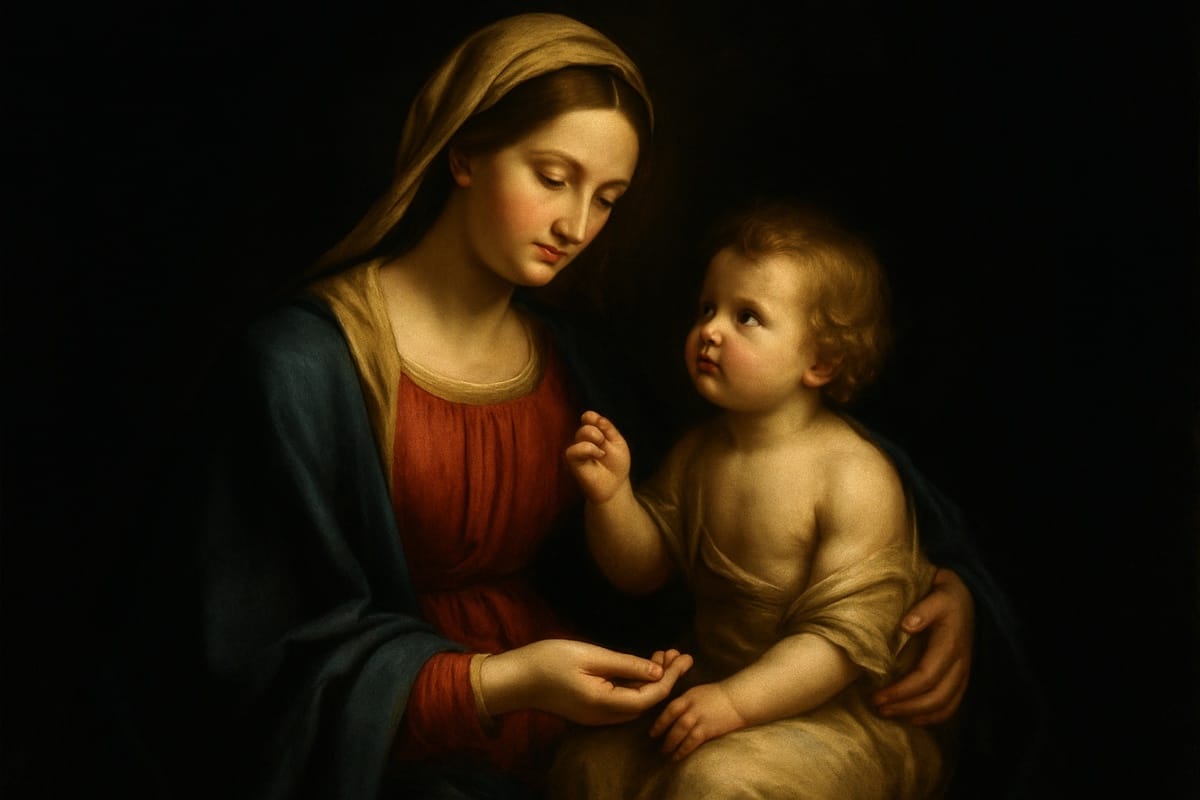
Mary is, in this context, the “earth” in which the mustard seed was planted. The least of seeds (the Child of Bethlehem) found in Mary’s availability the soil that allowed for growth. But Mary is herself also a “mustard seed” in the history of salvation: the young girl of Nazareth without social visibility, without political power, without academic culture. From her was born the Son who would become the greatest of historical realities. The Immaculate One who said “fiat” is the feminine “mustard seed” of the history of salvation.
II. “The Leaven That the Woman Hid”: The Invisible Transformation
“Simile est regnum caelorum fermento, quod acceptum mulier abscondit in farinae satis tribus” (Mt 13:33). Leaven is an agent of transformation that is invisible but radical: it works from within, unseen, until the whole mass is leavened. The figure of leaven as an agent of interior transformation is one of the most fruitful in the spiritual tradition: the Kingdom of God does not act through the instruments of visible power but through the silent transformation of hearts.
The detail of the “woman who hides the leaven” is theologically significant: the agent of the Kingdom’s transformation is a woman. She “hides” the leaven; she does not proclaim, she does not display, but acts silently. The patristic tradition associated this woman with Mary: she who “hid” the eternal Word in her womb so that He might leaven all humanity. The “leaven” that Mary “hid” during the nine months of the Incarnation was the beginning of the radical transformation of human history.
The “three measures of flour,” an extraordinary quantity, suggesting a banquet, evoke the three measures of Gen 18:6 (Abraham’s hospitality) and can be interpreted as a figure of the universality of salvation: all humanity will be transformed by the leaven of the Kingdom. The vision of the eschatological banquet in which everyone takes part has in Mary the “serving woman” who, at Cana, interceded so that the banquet would not fail.
III. Mary as Mustard Seed: The Little One of Nazareth and the Universal Kingdom
The Mary/mustard seed typology has a history in the Marian tradition: Mary is presented as “the least of creatures” who received the greatest of graces. The Magnificat is the expression of this typology: “He has looked upon the lowliness of His handmaid” (Lk 1:48). Mary’s “lowliness” is her objective smallness in the world, the absence of power, visibility, and resources. And precisely from this “smallness” comes the greatest of all fruitfulness: “from now on all generations will call me blessed” (Lk 1:48).
The “greatest of shrubs” that the mustard seed became is a figure of the Church. Mary as “Mother of the Church” (a title given by Paul VI at the Second Vatican Council) is the woman whose “fiat” made possible the growth of the seed into the universal tree. The progression from seed to Church (Pentecost) to parousia (consummation) involves Mary in a different but real way at each stage.
The spirituality of “smallness” that characterizes the Marian tradition, from the devotion to the “spiritual childhood” of Thérèse of Lisieux to the spirituality of the “little ones” of Charles de Foucauld, has its root in the parables of the mustard seed and of the leaven: to learn from Mary not to despise what is small, to trust that the invisible is at work, not to demand the spectacular signs that the Pharisees demanded.
IV. “Eructabo abscondita a constitutione mundi”: The Parables as Revelation of What Is Hidden
“Haec omnia locutus est Iesus in parabolis ad turbas et sine parabola nihil locutus est eis, ut impleretur quod dictum est per prophetam: Aperiam in parabolis os meum, eructabo abscondita a constitutione mundi” (Mt 13:34-35). The quotation of Ps 78:2 that Matthew applies to Jesus’ parabolic ministry reveals the theological depth of the parables: they are not merely pedagogical illustrations but “the revelation of what has been hidden since the foundation of the world.” What the parables reveal is not new information but the internal logic of creation that had been hidden from the beginning.
The “hidden since the foundation of the world” applies in an eminent way to the mystery of Mary: Mary’s divine motherhood was prefigured in the woman of Gen 3:15, in Sarah who conceived the impossible, in Miriam who led the song of the sea, in Hannah who consecrated Samuel. The patristic tradition saw in these figures prefigurations of Mary, not by arbitrary allegorism but because the “hidden since the foundation of the world” that the parables reveal has in Mary its fullest historical realization.
Jesus’ parabolic ministry, revealing the “hidden” in the most everyday signs (seed, leaven, net, treasure), continues in Marian devotion: to contemplate Mary is to contemplate the logic of the Kingdom revealed in a concrete human life. Not the miraculous spectacle but the silent leaven of the “fiat.” Not the power of the world but the tiniest seed that Grace made grow into the universal fruit. The contemplation of Mary is a “parable in the flesh,” the revelation of the hidden that the world does not recognize as power but that leavens the whole history of salvation.
Postgraduate Program in Mariology
Would you like to deepen your formation in Mariology? Discover the Postgraduate Program in Mariology of Locus Mariologicus, an academic formation that unites theological rigor, spiritual life, and the living tradition of the Church.
Would you like to study Mariology seriously?
This article draws on the works in the library of Locus Mariologicus. The Postgraduate Program in Mariology takes you to the same source, with academic guidance: Scripture, the Fathers of the Church, and the Magisterium, from the first dogma to contemporary questions.
Responses