The secret of Padre Pio’s holiness: “the sweet Lady”.

Introduction: Padre Pio and the secret of his love for Mary
Padre Pio, one of the most venerated saints of the twentieth century, is a figure who transcends devotion to become an icon of faith and spirituality. But what many may not know is the profound Mariological bond he had. How could a man, marked by the wounds of Christ, not also be so profound a devotee of Mary, the Mother of God? This article seeks to explore that often forgotten, yet central, dimension of Padre Pio’s spirituality.
Who was Padre Pio?
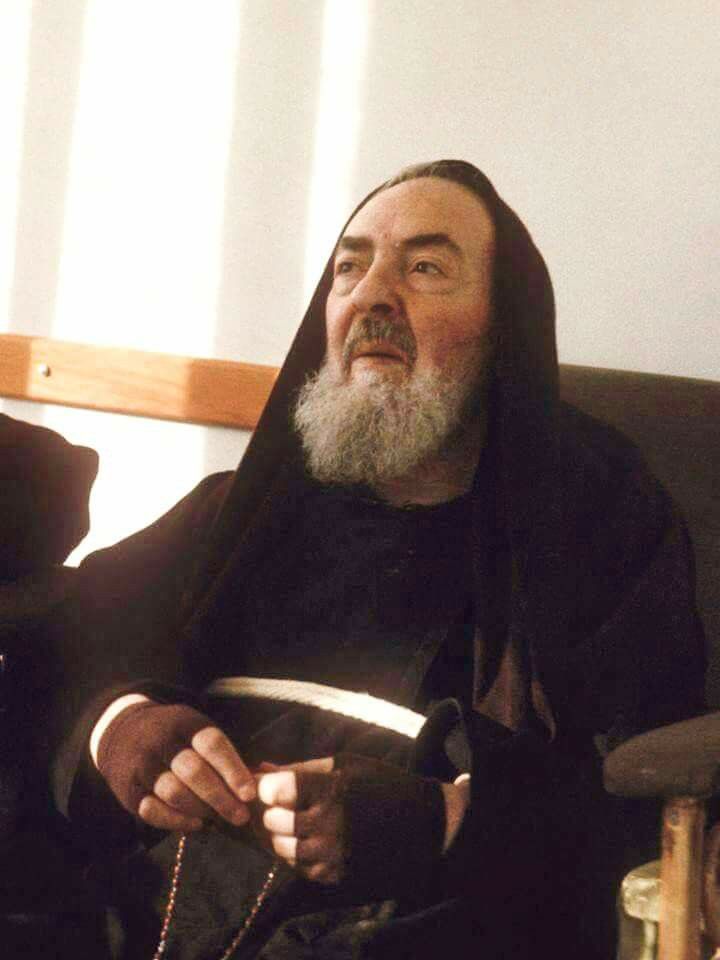
Before taking up the Mariological question, it is helpful to understand who Padre Pio was. He was born on May 25, 1887, in the town of Pietrelcina, in Italy, and was baptized Francesco Forgione. Padre Pio was an Italian Capuchin friar who became famous during his lifetime for the mystical aura that surrounded him and, most notably, for the stigmata he bore on his body from 1910 on, resembling the wounds of the crucified Christ. It was the early morning of September 23, 1968. In his friary cell, with the rosary between his fingers, repeating the name of Jesus and Mary, he who had embraced the cross of Christ rests in peace.

The secret of his holiness: Mary
The source of his intense and mystical spirituality was deeply rooted in his devotion to the Virgin Mary, whom he affectionately called “Sweet Lady”. Padre Pio himself described Mary as the “matrix” of his outpouring of graces. He was Marianized and Christified so profoundly that he became, in the words of Saint Paul VI, a “representative imprinted with the stigmata of Jesus Christ”.
But why Mary? The centrality of Mary in Padre Pio’s life
The central place that Mary occupied in Padre Pio’s life and spirituality shows the intimate relationship between Marian devotion and the Christian life.
The Mariological dimension of Padre Pio
Padre Pio did not merely venerate Mary. She was wholly present in his theology and in his daily practices. His devotion to Mary was not superficial. It was theological, rooted in the tradition of the Church, and deeply personal. He saw Mary as the one who cooperated in the Redemption, the Mother who suffers beside her Son for the salvation of humanity.
The Rosary of Mary: a continual prayer of Padre Pio
One of the most notable aspects of Padre Pio’s devotion to Mary was his constant recitation of the Rosary. For him, the Rosary was not merely a form of prayer. It was a way of living in constant communion with Mary and, through her, with Christ. And he did not pray alone; he led everyone around him to pray as well. A devotee of Padre Pio is always Marian.
The Marian legacy of Padre Pio and Mary, the sweet Lady
The life and spirituality of Padre Pio are a witness for our modern times to devotion to the Virgin Mary, so ancient and so new. He shows that true Marian devotion is not a deviation from the Christian faith, but rather a path that leads more deeply into the heart of Christ. Thus, perhaps we can begin to understand Padre Pio’s Mariological mystery: to know Mary better is, in fact, a way of loving her Son, Jesus Christ, more deeply.
Saint Padre Pio, pray for us!
Padre Pio’s Marian devotion to Mary finds its theological foundation in the encyclical Redemptoris Mater (John Paul II), which contemplates Mary as Mother in faith and a model of holiness for all Christians.
Deepen your studies: explore Mariology, Marian Theology, Marian apparitions, and the Postgraduate Program in Mariology.
Postgraduate Program in Mariology
Would you like to deepen your formation in Mariology? Discover the Postgraduate Program in Mariology of Locus Mariologicus, an academic formation that unites theological rigor, spiritual life, and the living tradition of the Church.
Learn to pray the Rosary in our guide: How to Pray the Rosary, step by step.
Would you like to study Mariology seriously?
This article is born of the works in the library of Locus Mariologicus. The Postgraduate Program in Mariology takes you to that same source, with academic guidance: Scripture, the Fathers of the Church, and the Magisterium, from the first dogma to contemporary questions.




Responses