Bernard of Clairvaux, “Doctor mellifluus”: Vigilance and Marian Devotion
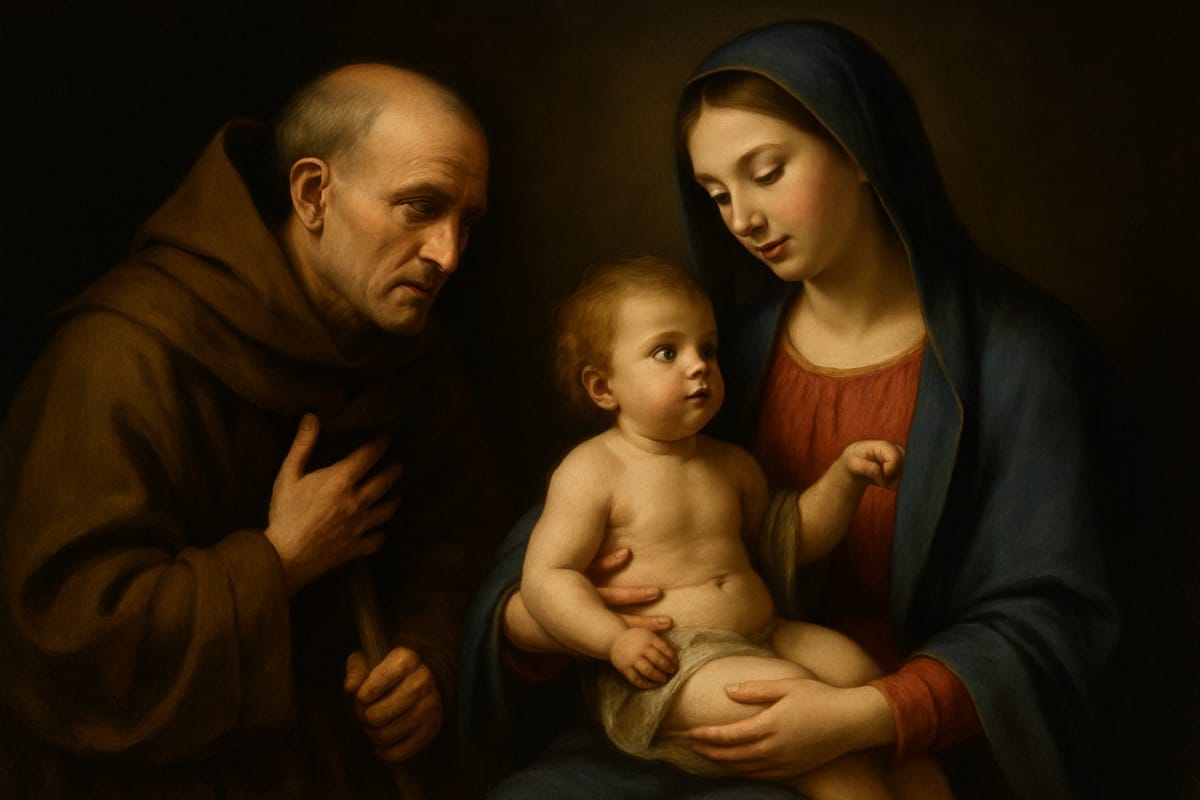
Vigilate ergo, quia nescitis qua die Dominus vester venturus sit. […] Beatus ille servus quem, cum venerit dominus eius, invenerit ita facientem.
Mt 24:42, 46
Mt 24:42-51 closes the eschatological section of Jesus’ discourse with two teachings on vigilance: the parable of the thief in the night (vv. 43-44) and the parable of the two servants (vv. 45-51). Both have the same core: the disciple of Jesus lives in a tension of active waiting, he knows that the Lord is coming, he does not know when, and he must keep his heart always ready. Vigilance (γρηγορεῖτε, to be awake, not to fall asleep) is not anxious passivity but responsible activity: the “faithful and prudent servant” (οἰκονόμος, steward) is the one who goes on working during the Lord’s absence.
On August 20 the Church celebrates the Memorial of Saint Bernard of Clairvaux (1090-1153), a Cistercian monk and Doctor of the Church, called “Doctor Mellifluus” by Pius XII in 1953, the doctor whose doctrine flows like the honey of eloquence and gentleness. Bernard is one of the great Marian theologians in history: his sermons on the Assumption and his homilies on the “Missus est” (Lk 1:26-38) are foundational texts of medieval Mariology. His metaphor of the “aqueduct” and the formula “Monstra te esse Matrem” continue to nourish the Marian devotion of the Church eight centuries after his death.
I. “Vigilate”: Eschatological Vigilance and Its Forms
The vigilance that Jesus asks for (Mt 24:42: γρηγορεῖτε) is a fundamental spiritual attitude in the New Testament: it appears in the eschatological discourses (Mt 24-25), in Gethsemane (“watch and pray that you may not fall into temptation”, Mt 26:41), in the Pauline letters (“the hour has come for us to awake from sleep”, Rom 13:11), in the Book of Revelation (“blessed is he who keeps watch”, Rev 16:15). Christian vigilance is not eschatological paranoia but attention to the present as the place of God’s coming: God comes at every moment, in every encounter, in every demand of conscience.
The parable of the two servants (vv. 45-51) distinguishes the “faithful and prudent” servant from the “wicked” servant. The faithful servant goes on doing what was entrusted to him, feeding his companions, managing the household, working, no matter when the Lord returns. The wicked servant reasons, “my master is delayed”, and uses the presumed postponement to commit injustices (beating his companions, eating and drinking with drunkards). Infidelity begins with the conviction that the Lord is absent, secularization as forgetfulness of the presence of the God who keeps watch and who returns.
Bernard of Clairvaux commented on this eschatological tension in the monastic context: monastic life as a “permanent vigil”, the Opus Dei (the liturgy of the hours) as the structuring of time around the expectation of the Lord’s coming. The seven daily offices (Matins, Lauds, Prime, Terce, Sext, None, Vespers, Compline) are “stations of vigilance” that punctuate the day as a remembrance of the divine presence. Bernard saw in the liturgical rhythm the antidote to the spiritual “falling asleep” that Jesus denounces in the wicked servant.
II. Bernard of Clairvaux: doctor mellifluus and Marian Master
Bernard was born in 1090 at Fontaines-lès-Dijon, in Burgundy, into a noble family. In 1112, at the age of 21, he entered Cîteaux, the austere Cistercian monastery founded in 1098. Three years later he founded Clairvaux (Clara Vallis) as a daughter abbey, which became the center of one of the most remarkable medieval monastic movements: when he died in 1153, he left in his wake 68 monasteries founded or reformed. His influence went beyond monasticism: he preached the Second Crusade (1146-1147), mediated conflicts between kings and popes, and fought the doctrines of Abelard at the Council of Sens (1140).
Bernard’s Mariology is scattered through his sermons but reveals a coherent vision. The four sermons on the “Missus est” (Hom. super Missus est), commentaries on the Annunciation (Lk 1:26-38), are a complete Marian treatise: Bernard describes Mary as the one who “gave the bread of life to the world” and who, when she hesitates before the Fiat, holds the universe in suspense, “answer quickly, O Virgin. Say the word and receive the Word, give your word and conceive the Word of God”. Bernard’s urgency before Mary’s Fiat reveals the weight he gave to human freedom in the Incarnation.
The sermons on the Assumption, written for August 15, join Mary’s greatness to her humility: “Mary was exalted not in spite of her humility but because of it”. This formulation recapitulates the Magnificat (Lk 1:48) and establishes the logic of the Kingdom: the handmaid who lowers herself is the one whom God raises up. The sermon De Aquaeductu (on Mary as the “aqueduct” of grace) is Bernard’s most quoted Marian text: Mary is not the source of grace but the channel through which the grace of Christ reaches the Church, tubus, non fons. Fistula, non origo.
III. “Monstra te esse matrem”: Marian Intercession in Bernard
The antiphon “Monstra te esse Matrem” that Bernard made popular, “Show yourself to be a Mother”, is the most concentrated formula of his doctrine of Marian intercession. Mary “shows” that she is the Mother of Jesus by interceding for sinners before her Son. Bernard describes the chain of trust: the sinner turns to Mary because he is afraid to approach Jesus directly. Mary turns to the Son because she is His Mother. Mary is the “way of trust” for those who feel unworthy of turning directly to Christ, not because Christ is inaccessible but because human frailty needs a maternal face to welcome it first.
This theology of Marian intercession is joined to the unique mediation of Christ: Bernard does not replace Christ with Mary but describes Mary as the one who makes Christ’s mediation more accessible to the sinner. The formulation of the Second Vatican Council (LG 62), “Mary’s maternal function in no way obscures or diminishes the mediation of Christ”, is the balance that Bernard intuitively sought. Bernard’s “vigilance” (Mt 24:42) had in Mary its first model: the Mother who “kept and pondered” (Lk 2:19, 51) all these things in her heart does not fall asleep.
Bernard’s Marian contemplation is a contemplation of vigilance: Mary, who accompanied her Son from the Annunciation to Calvary, who kept the faith burning on Holy Saturday when the disciples deserted, who awaited the coming of the Spirit in the Upper Room, is the model of the “faithful servant” who goes on working during the apparent “absence” of the Lord. The Mary who “kept watch” is the Mary whom Bernard proposes as a model of the spiritual life: not passive waiting but the active fidelity that feeds the companions (the community) and manages the household (the Church) while awaiting the Lord.
IV. Bernard’s “Honey”: The Doctrine That Nourishes
The epithet “Doctor Mellifluus” points to a specific characteristic of Bernard’s theology: not scholastic systematization but the capacity to nourish spiritually, the “honey” that feeds the heart at the same time as it enlightens the mind. Bernard’s doctrine flows “like honey” because it is born of contemplation and aims at contemplation: it is not desk theology but a theology of prayer, brought forth in the Divine Office and in the lectio divina of Cistercian monastic life.
This nourishing character of Bernard’s theology contrasts with the tendency, which he criticized in Abelard, toward a purely rational theology that dissects the mysteries of faith without letting itself be touched by them. Bernard saw in this tendency a risk of intellectual hypocrisy analogous to the ritual hypocrisy of the Pharisees: knowledge about God without knowledge of God, theology without living faith. Bernard’s “mellifluence” is the antidote: a theology that keeps the heart vigilant because it is born of a heart that loves.
In the Mariological tradition, Bernard holds the singular place of the one who joined Mary’s greatness to the primacy of Christ in such a way that the two illuminate each other: Mary is great because she is wholly directed toward Christ. Christ is more accessible through Mary’s “aqueduct”. This articulation, against every tendency to absolutize Mary to the detriment of Christ or to minimize Mary in the name of Christ, is the “honey” that continues to nourish the Mariology of the Church eight centuries after Bernard’s death at Clairvaux on August 20, 1153.
Postgraduate specialisation in Mariology
Would you like to deepen your formation in Mariology? The Locus Mariologicus postgraduate programme is a specialisation that brings together theological rigour, spiritual life and the living tradition of the Church. The next class begins in 2027.
Would you like to study Mariology seriously?
This article grows out of the works in the Locus Mariologicus library. The Postgraduate Program in Mariology takes you to the same source, with academic guidance: Scripture, the Fathers of the Church, and the Magisterium, from the first dogma to contemporary questions.




Responses