“Persevering in prayer with Mary”: the Cenacle, the Rosary, and Mary
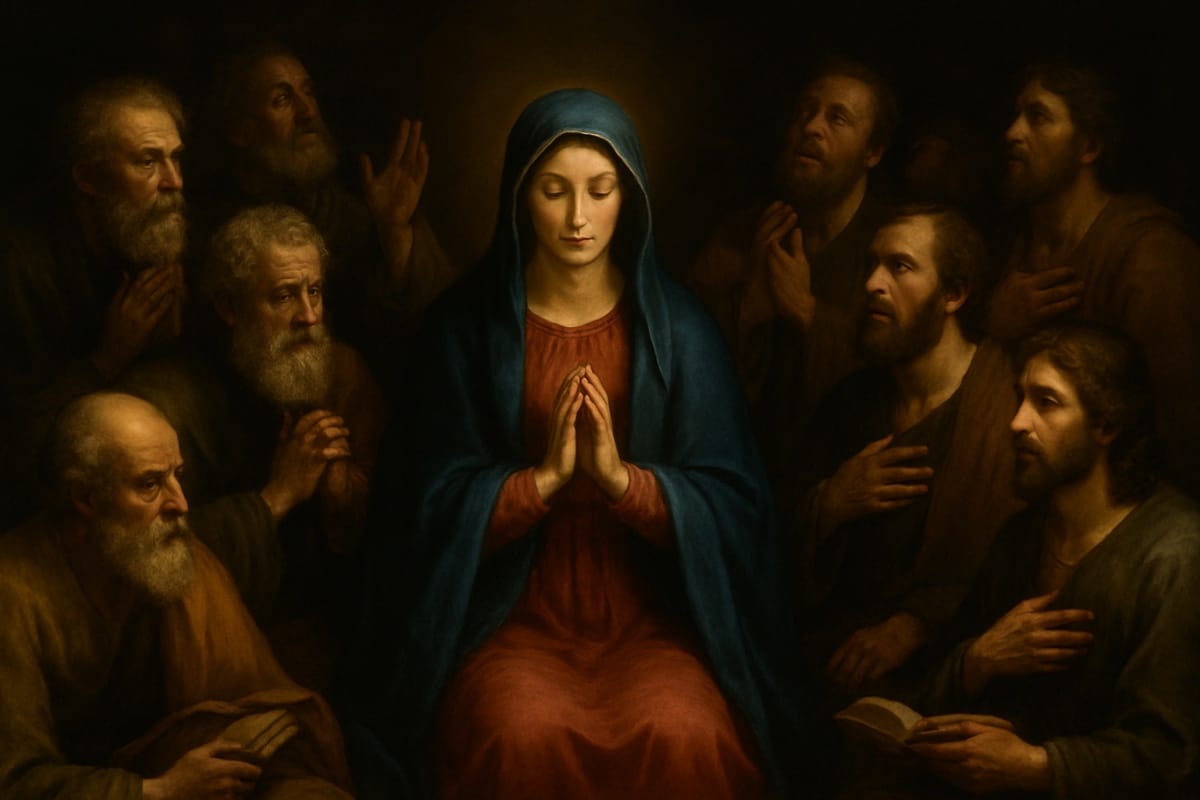
“Hi omnes eram perseverantes uníssomente in oratione cum Maria matre Iesu et fratribus eius.”
>
> (Acts 1:14)
The memory of Our Lady of the Rosary (October 7) connects Acts 1, where Luke describes the apostolic community gathered in the Cenacle, praying perseveringly with Mary, the Mother of Jesus, to Luke 1, where the angel Gabriel greets Mary with the “Hail, full of grace,” repeated incessantly by the Rosary. Both texts depict Mary at the center of prayer: in the Cenacle as a model of the praying community, at the Annunciation as the place where God’s prayer found human response. The Rosary is the school where the Church learns to pray with Mary, as the apostles prayed in the Cenacle.
I. The First Reading: Acts 1:12-14
Luke describes the community of the eleven and those gathered with them in the Cenacle after the Ascension: “all were devoted to prayer, together with the women and with Mary, the Mother of Jesus, and with his brothers” (v.14). Mary appears in the midst of the praying community not as a peripheral figure but as a visible center. She is the only one mentioned by name beyond the apostles. Her presence carries theological significance: the community awaiting the Spirit prays with the woman who the Spirit has already visited.
“Perseverantes uníssomente in oratione”: The prayer in the Cenacle has two characteristics, perseverance and unanimity. Mary is a model for both. In the Magnificat she expressed unanimity with God’s plan. In her thirty years of hidden life she lived perseverance. The community in the Cenacle learned from Mary how to expect the Spirit: not in agitation but in persistent prayer that awaits what God has promised.
II. The Gospel: Luke 1:26-38The Annunciation is the first mystery that the Rosary contemplates, and it is the text that underpins all Marian devotion associated with the Rosary. The “Hail Mary, full of grace” (v.28) of the angel is the greeting that the Rosary repeats—not as a magical formula but as a contemplation of the moment when God visited humanity through Mary. “Full of grace” (kecharitomene) describes a permanent state: Mary is the one who is and remains filled with God’s grace.
“The Holy Spirit will come upon you, and the power of the Most High will overshadow you” (v.35): the Annunciation is the coming of the Spirit upon Mary before the coming of the Spirit upon the community at Pentecost. The Cenacle (Acts 1:14) is the second coming of the Spirit upon the community that prays with Mary. The Rosary invites contemplation of these mysteries as the school of prayer that begins with “Hail Mary” and ends with “Be it done.”
III. The Rosary as a School of Prayer
The Rosary is not a collection of requests but a contemplation. John Paul II, when adding the Luminous Mysteries, described the Rosary as a “compendium of the Gospel”: each group of mysteries contemplates a phase of Christ’s life through Mary’s eyes. The repetition of “Hail Mary” is not monotony but the rhythm of contemplation, as breathing accompanies meditation.
Acts 1:14 and Luke 1:26-38 describe two moments that the Rosary contemplates in different yet complementary ways: the Annunciation as the moment everything began, and the Cenacle as the moment the community learned to wait with Mary. The Rosary brings these together: it begins with the “Hail Mary” of the Annunciation and invites to the perseverance of the Cenacle.
IV. Mary: The Center of the Church’s Prayer
Today’s liturgy presents two complementary images of Mary and prayer. In the Annunciation, Mary receives the visit of God and responds with “Be it done”: it is prayer as total receptivity. At the Cenacle, Mary prays with the community in expectation of the Spirit: it is prayer as solidary perseverance. The Rosary integrates both: each “Hail Mary” is a “Be it done” contemplated in community.
The memory of Our Lady of the Rosary invites the Church to recognize Mary as the center of its prayer life, not because she replaces Christ but because Mary is the model for one who embraces Christ with total faith (Luke 1:38) and perseveres in expectation of the Spirit with the community (Acts 1:14). The Christian who prays the Rosary enters the school of prayer that the apostles attended at the Cenacle.
Postgraduate specialisation in Mariology
Would you like to deepen your formation in Mariology? The Locus Mariologicus postgraduate programme is a specialisation that brings together theological rigour, spiritual life and the living tradition of the Church. The next class begins in 2027.




Responses