The Virgin Mary, chosen lineage of Israel
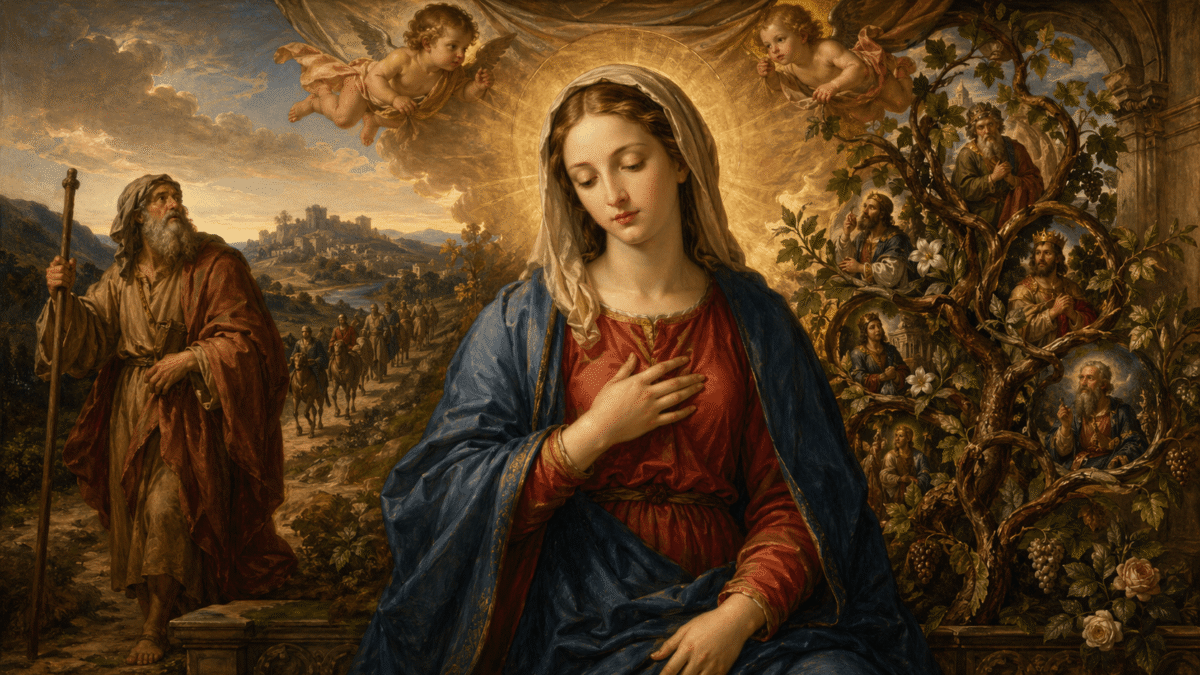
“Sicut locutus est ad patres nostros, Abraham et semini eius in saecula”. “As He had promised to our fathers, to Abraham and to his descendants forever”. (Lk 1:55)
I. The promise that structures the history of salvation
The call of Abram narrated in the twelfth chapter of Genesis is not an isolated episode in the religious history of a people: it is the founding moment of the whole economy of salvation that culminates in the Incarnation of the Word. “Go forth from your land, from your kindred and from your father’s house, to the land that I will show you” (Gen 12:1). The divine word pours out upon Abram with the authority of one who calls from within history, with no prior announcement, with no ritual mediation, establishing from the outset the mode proper to biblical revelation: a word that breaks open the horizon of the predictable and institutes a new beginning. Abram’s response, expressed in the simple act of departing, defines the paradigm of faith that will run through the whole of Scripture, because to believe is to obey before understanding, it is to depart before knowing where one is going.
The promise that accompanies the call has a threefold dimension. Abram is promised numerous descendants, a land in which to dwell, and a blessing that will extend to all the peoples of the earth. This structure of the promise is not accidental: it announces the dimensions of the mystery that will be accomplished in the Virgin of Nazareth. From the descendants promised to Abram the eternal Son is born in the flesh. From the land of Canaan emerges the sacred geography where God will let Himself be found. From the universal blessing that had been promised to the patriarch there radiates the redemption that the Son will accomplish on the cross and that the Mother will sustain beside it. The Virgin Mary is, in this profound sense, the consummation of the Abrahamic promise: in her the election of Israel attains its highest expression, because in her divine grace finds the most perfect receptacle in all of human history.
II. From genealogy to the mystery of election
The genealogy of Jesus Christ with which Matthew opens his Gospel has a theological function that far exceeds the mere enumeration of ancestors. The book of the origin of Jesus Christ, son of David, son of Abraham (Mt 1:1). The sequence is not merely chronological: it is a confession of faith articulated in the form of history. David and Abraham are not merely names on a list, they are the two pillars upon which the Old Testament tradition built its deepest messianic hopes. The mention of Abraham evokes the primordial election, the beginning of everything. The mention of David evokes the promise of an eternal kingdom, the hope of an anointed one who would rule in justice. Between Abraham and David there are fourteen generations. Between David and the deportation to Babylon, another fourteen. Between the deportation and Jesus Christ, fourteen more. The threefold repetition of the number is not a numerical coincidence: it is a catechetical affirmation that history advances according to a divine logic, and that every crisis and every rupture are moments of a pedagogy that leads inexorably to fulfillment.
Mary enters this genealogy at its most decisive and most discreet moment: Jacob begot Joseph, the husband of Mary, of whom was born Jesus, who is called Christ (Mt 1:16). The formula deliberately breaks the pattern that precedes it: instead of Joseph begot Jesus, as the reader accustomed to the cadence of the text would expect, we read Mary, of whom was born Jesus. The grammatical rupture is a theological rupture, announcing that in this final birth another logic intervenes, one that transcends ordinary biological causality. Mary is the point of arrival of the entire genealogy and, at the same time, the point of departure of a new order. The election of Israel, concentrated in the person of Abraham and then in the royal blood of David, finds in the Virgin of Nazareth its purest expression.
III. Of whom was born Jesus, who is called Christ
The reading of the Matthean genealogy in the liturgy of the Masses of Our Lady is not an exercise in historical erudition: it is a meditation on the divine providence that, over the course of forty-two generations, prepared the most worthy human receptacle for the coming of the Son of God. Each name on the list is a stage in a process of progressive election that narrows until it converges on the name of a young woman of Galilee. Tamar, Rahab, Ruth, the wife of Uriah: Matthew includes in the genealogy of Jesus four women whom the rabbinic tradition would not have expected to find in a text of such dignity. This inclusion is deliberate. The four women share a common characteristic: all of them were providential instruments of God in humanly irregular or unforeseen circumstances. Their presence in the genealogy prepares the reader for the most surprising of human irregularities, which is the fruitful virginity of Mary.
Jesus is called “Christ”, that is, the Anointed One, the Messiah. The title is not a later designation: it is the horizon of the whole genealogy. The entire list converges on this name, the whole history of Israel finds in this Anointed One its ultimate meaning. And Mary stands at the center of this convergence, not as a passive figure who merely transmits a genetic code, but as the most chosen Daughter of Zion, the one who concentrates in herself the best of Israel’s faith, the prophetic readiness of Abraham, the loving fidelity of Ruth, the confident boldness of Tamar. In the Virgin, election becomes perfection. In the Virgin, the promise becomes flesh.
IV. Mary, the consummation of the election of Israel
The first of the Masses of the Collection of Our Lady places the Virgin Mary within the broadest and most foundational context of the history of salvation: the election of Abraham. This perspective, far from diluting Marian singularity in a generic past, reveals on the contrary the depth of the roots upon which divine grace worked for millennia in order to prepare the Mother of the Redeemer. Mary is the chosen lineage of Israel not only in the genealogical sense, but in the fullest theological sense: she is the historical perfection of election, the point at which divine grace meets an absolutely perfect human correspondence.
The biblical Mariology developed from this Mass invites the contemplation of Mary as the synthesis of the whole history of salvation. In her there is fulfilled not only the promise made to Abraham, but the entire divine pedagogy that runs through the history of Israel. The Church, in celebrating this Mass, prolongs through the liturgical season the contemplation of the mystery of Mary as the dawn of redemption, as the most luminous face of Israel at the moment in which Israel gives to the world its most precious gift. The Virgin is not merely the means by which the Savior came into the world; she is an essential part of the salvific plan, part of the fulfillment of the promise, part of the blessing that in Abraham had been promised to all the nations. To contemplate Mary as the chosen lineage of Israel is to contemplate human history at its highest point, where human freedom and divine grace meet in a perfection that no other moment of history will equal.
Postgraduate Program in Mariology
Would you like to deepen your formation in Mariology? Discover the Postgraduate Program in Mariology of Locus Mariologicus – an academic formation that unites theological rigor, spiritual life, and the living tradition of the Church.
Would you like to study Mariology seriously?
This article grows out of the works in the Locus Mariologicus library. The Postgraduate Program in Mariology brings you to that same source, with academic guidance: Scripture, the Fathers of the Church, and the Magisterium, from the first dogma to contemporary questions.





Responses