Our Lady of Akita, the Statue That Wept for the Sins of the World
By Prof. Dr. Daniel C. Afonso · Updated
“Quoniam abundavit iniquitas, refrigescet caritas multorum. Qui autem perseveraverit usque in finem, hic salvus erit” (Mt 24:12-13), “Because iniquity has increased, the love of many will grow cold. But whoever perseveres to the end will be saved”
I. The Woman of the Apocalypse: The Great Sign in Heaven and the Struggle of the Church
Chapter eleven of the Book of Revelation ends with a vision that continues into chapter twelve, forming one of the densest theological representations of the relationship between Mary and the Church. “God’s temple in heaven was opened, and the Ark of the Covenant appeared in his temple” (Rev 11:19). And then: “A great sign appeared in heaven: a woman clothed with the sun, with the moon under her feet and on her head a crown of twelve stars. She was with child and cried out in the pains and torment of giving birth” (Rev 12:1-2). Christian exegesis has recognized in this woman a figure at once Mariological and ecclesiological: Mary, who gives birth to the Messiah, and the Church, who gives birth to the children of God in every age. But what matters for Akita is what comes next: the dragon that pursues the woman and her offspring, the flight into the desert, the persistence of the cosmic battle between good and evil throughout all of history. The Church always lives under the sign of the woman and the dragon. And when the woman of the Apocalypse weeps in her labor pains, the Church weeps too, because she is still giving birth to those who will be saved.
II. Akita, 1973-1981: The Lady’s Messages and the Tears Verified by Science
In 1973, in a convent of the Handmaids of the Eucharist in Yuzawadai, near Akita, in northern Japan, Sister Agnes Katsuko Sasagawa, deaf since childhood, began to receive communications from the Mother of God. The central messages were conveyed on three dates: July 6, August 3, and October 13, 1973, the last coinciding with the anniversary of the “miracle of the sun” at Fátima fifty-six years earlier. The content of the messages was sober and grave: an invitation to prayer, penance, and sacrifice for the salvation of sinners, and a warning that if humanity does not convert, it will suffer grave consequences. But what made Akita one of the most scientifically documented apparitions of the twentieth century was a material phenomenon: a wooden statue of the Virgin, carved by the artist Saburo Wakasa, began on January 4, 1975, to shed human tears. Between that date and September 15, 1981, the statue wept one hundred and one times, observed by dozens of witnesses, including medical personnel. Laboratory analyses conducted by Professor Sagisaka of Akita University (not a Catholic) confirmed that it was human blood, human sweat, and human tears, with distinct blood types. Bishop John Shojiro Ito of Niigata officially recognized the apparition on April 22, 1984, after consulting the Congregation for the Doctrine of the Faith, then headed by Cardinal Joseph Ratzinger. The reaffirmation by the Holy See in 2019, under the pontificate of Francis, confirmed Akita as one of the approved Marian apparitions of the second half of the twentieth century.

III. The Iniquity That Increases and the Perseverance That Saves: The Gospel as the Key to Akita
The Gospel of Matthew that accompanies this celebration presents Jesus’ eschatological discourse to the disciples on the Mount of Olives, in which He describes the signs that will precede the end. “You will see wars and hear of wars… Nation will rise against nation, and kingdom against kingdom” (Mt 24:6-7). And the central verse, which illumines the message of Akita: “Because iniquity has increased, the love of many will grow cold. But whoever perseveres to the end will be saved” (Mt 24:12-13). This word of Jesus offers the theological key for interpreting Akita without alarmism or naivety. The messages of Akita are not a sensationalist announcement of imminent catastrophes: they are a reminder of an evangelical constant that the history of the Church has always known. When iniquity increases, love grows cold. When love grows cold, the very meaning of human reality begins to slip away. And when that happens, the only possible Christian response is perseverance to the end, which is not Stoic endurance but loving fidelity to the Lord who comes. The tears of the statue of Akita, shed for more than six years before hundreds of witnesses, are the most extreme form of Mary’s motherhood: to weep, with real human tears, for the children whose perseverance is at risk.
IV. Akita and the Marian Theology of Reparation: Collaboration with the Cross
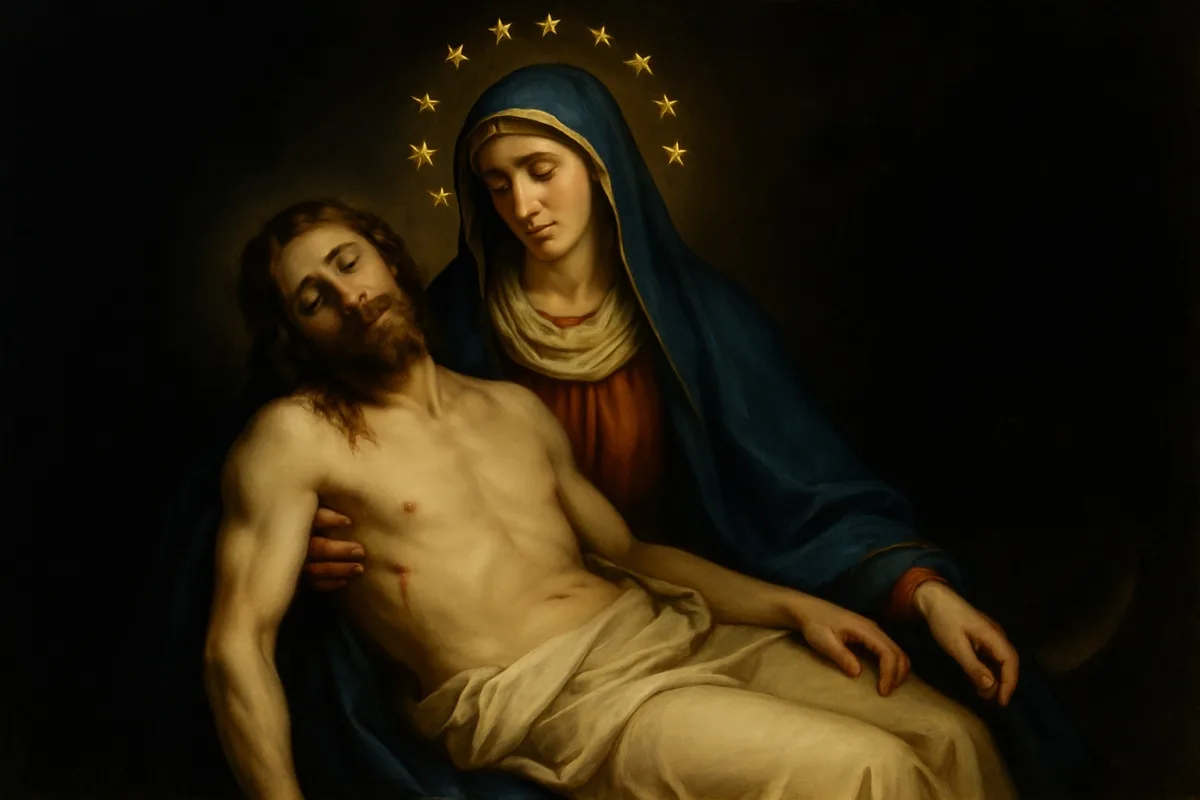
The Marian theology of reparation, which Akita brings to the foreground, has deep patristic and mystical roots. Mary is not only the mother who gives birth: she is the mother who suffers with her Son the work of redemption, who stands at the foot of the Cross as cooperator in the paschal mystery, who offers with Christ her own heart pierced by the sword prophesied by Simeon (cf. Lk 2:35). Devotion to the Immaculate Heart of Mary, which Fátima spread throughout twentieth-century Catholicism, found in Akita a dramatic extension and confirmation: the statue that weeps does not ask for consolation; it asks for reparation. It asks the faithful to join in Mary’s sorrow for the children who stray, offering prayers, sacrifices, whole lives transformed into a reparatory oblation. The Second Vatican Council affirmed that Mary, “with a mother’s heart, associated herself” with the sacrifice of her Son on the Cross (Lumen Gentium, 58). Akita proposes precisely this dimension to contemporary Mariology: Mary continues to associate herself with the paschal mystery through the pilgrim Church, and the faithful are invited to associate themselves with her as she associated herself with her Son. The tears of Akita are not Mary’s final chapter: they are a particularly intense expression of what she has been doing since Calvary, and will continue to do as long as any of her children is in danger of losing the way.
Postgraduate Program in Mariology
Would you like to deepen your formation in Mariology? Discover the Postgraduate Program in Mariology of Locus Mariologicus — an academic formation that unites theological rigor, spiritual life, and the living tradition of the Church.
Responses