Our Lady of the Conception Appeared, patroness of Brazil
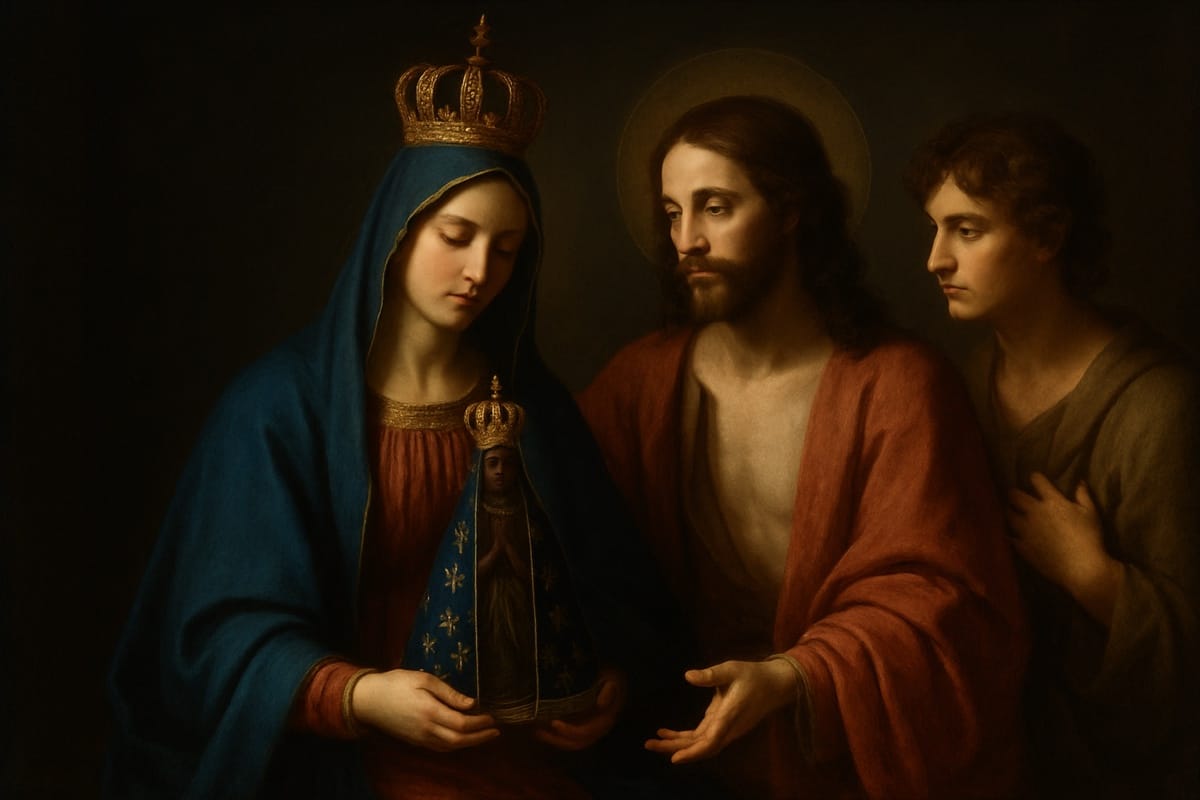
“You are beloved by the Lord your God, and your beauty has pleased him” (Est 5:1b), “You were loved by the Lord your God, and your beauty pleased him”
I. Esther before the King: The Intercessor Who Risks All for Her People
The first reading for this Feast invites us to one of the most dramatic and beautiful scenes in the Deuterocanonical literature. Esther, the Jewish queen at the Persian court, steps before the throne without being summoned, knowing that this audacity could cost her her life. But she does not act out of ambition or caprice; she acts because her people are threatened with extermination, and she is the only one who can intercede with the King, with authority sufficient to be heard. “My life is at stake, I desire it, and the life of my people” (Est 7:3). The depth of this gesture lies not only in her courage, but in the logic of love that places others before herself. Esther intercedes not because she can do so with impunity, but because her love for her people surpasses her fear for her own life. And it is this logic of love that serves as the key to reading the feast that Brazil celebrates every twelve of October: that of a woman who, without sword or army, intercedes with love for her children.
II. The Woman Dressed in the Sun: Mary, Aparecida, and the Apocalypse
The second reading transports us from the Persian palace to the great sign that appeared in the sky: “A woman dressed in the sun, with the moon under her feet and a crown of twelve stars on her head” (Rev 12:1). Exegesis recognizes in this woman a complex figure that simultaneously refers to Israel, the Church, and Mary. But the Brazilian liturgy, by choosing this text for the Feast of Our Lady of Aparecida, makes a hermeneutical choice of great consistency: the woman of the Apocalypse being pursued by the dragon and protected by God is the celestial image of what Brazil encountered in the waters of the Paraíba do Sul river in 1717. The image found by the fishermen was an icon of the Immaculate Conception: Mary without stain, full of grace, dressed in clarity. And the narrative of the Apocalypse, with the dragon seeking to devour her and the earth coming to her aid (cf. Rev 12:16), repeats in prophetic language the logic of Brazilian history: the faith of a people who, in their struggles and fragility, found in Mary the strength that did not come from themselves.
III. Cana: The Mother Who Sees and Intercedes Before the Request
The Gospel reading from the Wedding at Cana completes the biblical arc of this feast with a revelation of style: the style of Mary’s presence and intercession. Mary is in Cana, perceives that the wine has run out, and acts with the discreet urgency of one who loves truly: she goes to her Son, and presents the situation without properly formulating a request, simply with the confidence of one who knows that love is sufficiently intelligent to know what to do. “They have no wine” (John 2:3).Three words that encapsulate the Marian intercessory pedagogy: without rhetoric, without drama, without negotiation. And when Jesus responds in an apparently displeased manner, Mary does not insist nor back down. She turns to the servants and says the words that tradition has fixed as her spiritual testament: “Do whatever he tells you” (John 2:5). Aparecida taught Brazil the same thing that Mary taught at Cana: it won’t solve what we need. It will lead us to the only one who can. “Do whatever he tells you.”
IV. Aparecida: The patroness who emerges from the waters and poverty
The narrative theology of the discovery of the image of Our Lady of Aparecida has been explored by the centuries without reaching a conclusion. In October 1717, three fishermen from the Paraíba do Sul river, after a day without catching any fish, cast their nets one last time and brought up, in two separate pieces, the darkened image of a Our Lady of the Immaculate Conception. They joined the pieces, cast the nets again, and caught so much that they could barely carry it. What popular faith immediately recognized was that there was a language of God here: Mary emerging from the muddy waters, in the darkness, as a sign that God’s grace does not prefer clean places and noble spaces. He prefers the poor fishermen on the riverbanks. He prefers mud. And after her discovery, she multiplied the fish. The feast that Brazil celebrates on October 12 is not the glory of a statue: it is the recognition that God chose this people, this land, this river, to manifest through Mary his preferential love for the little ones. The Second Vatican Council, when it presented Mary as a “sign of certain hope and consolation for the People of God on pilgrimage” (Lumen Gentium 68), was describing, without realizing it, what the image of Aparecida would mean for Brazil: not a symbol of power, but a sign that God does not abandon his children in the turbulent waters of history.
Postgraduate specialisation in Mariology
Would you like to deepen your formation in Mariology? The Locus Mariologicus postgraduate programme is a specialisation that brings together theological rigour, spiritual life and the living tradition of the Church. The next class begins in 2027.





Responses