One Gospel, one neighbor: fidelity that becomes charity
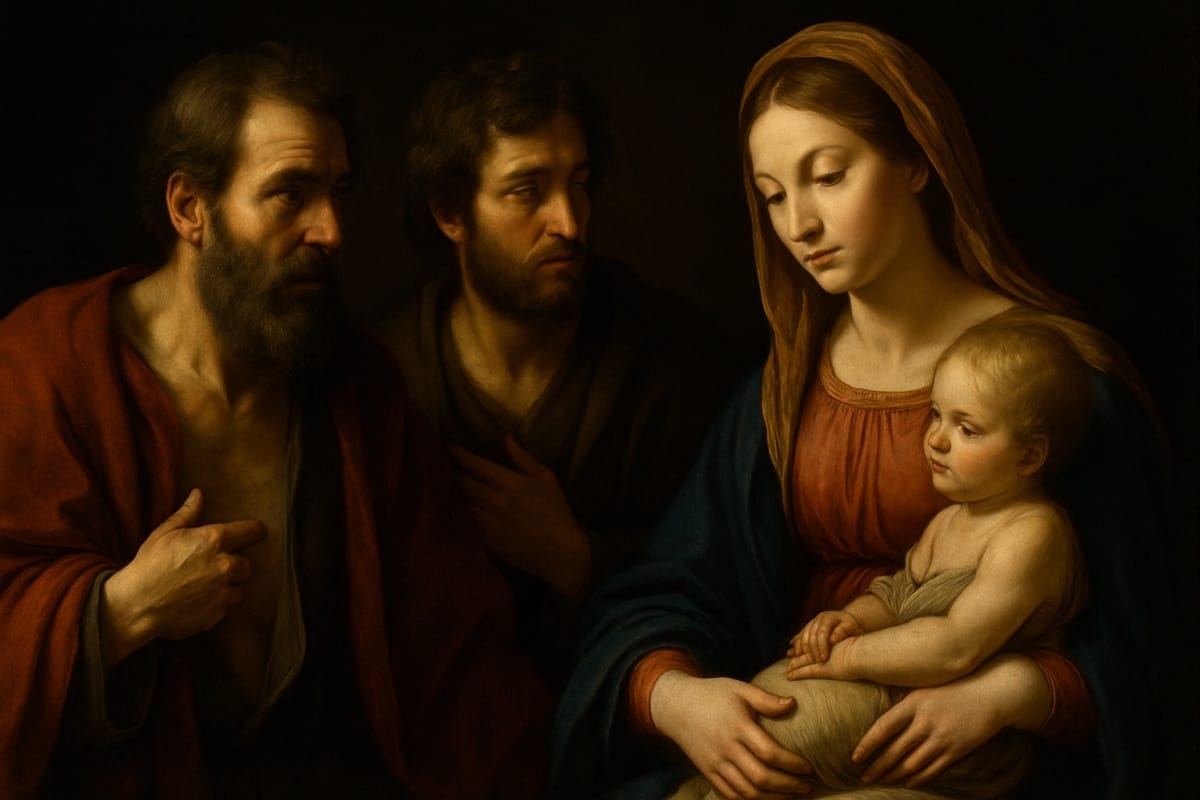
«Miror quod sic tam cito transferimini ab eo qui vos vocavit in gratiam Christi in aliud Evangelium»
Gl 1,6-7
There is one Gospel, and faithfulness to it is the measure of all Christian life. The liturgy of this second Monday of the twenty-seventh week of Ordinary Time presents us with two texts that at first glance seem unrelated: Paul’s indignation before the Galatians who abandon grace, and the Lucan parable of the man who descends from Jerusalem to Jericho. They are united by a common nerve: the demand that the faith received be translated entirely, without doctrine adulterated or charity narrowed. “The Gospel is not preserved by keeping it, but by living it.” Mary, absent from today’s sacred text, remains the face in which this fidelity became flesh.
I. The first reading: Galatians 1:6-12
The Letter to the Galatians arises from a wonder that is already a wounded love. Paul writes. “I marvel that you are transferred thus so quickly”I am amazed that you depart so quickly, and the adverb So quicklyso quickly, it measures the distance between the grace received and its abandonment. The apostle does not reprove a hesitation, he denounces a desertion. The Galatians did not exchange one master for another, they passed Into another GospelFor another gospel, which Paul immediately corrects, because there is no other. There is only the Gospel of Christ and its falsifications, and between one and the others there is no compromise.
The apostle then utters the harshest word in his pen. “But if any angel from heaven should preach to you a gospel other than what you have received, let it be anathema.” “Short title/phrase – translate without context or additional information”“Glory” (1 Cor 15:18), even if we or an angel from heaven were to announce a gospel contrary to what we have announced, let it be anathema. Hardness does not protect Paul, but the truth that does not belong to him. He himself submits to the criterion that he enunciates, because the Gospel that he preaches did not come from men. «Neque enim ego ab homine accepi illud, neque didici, sed per revelationem Iesu Christi» “Short title/phrase – translate without context or commentary.”“Glory” (1 Cor 11:12) I did not receive it from any man, nor was I taught it, but I received it by revelation from Jesus Christ. The authority of the message rests in its origin, the encounter with the Risen One, and not in the eloquence of him who conveys it.
II. The Gospel: Lk 10:25-37
The Lucan narrative leads to the same demand for fidelity in the realm of the suffering flesh. A doctor of the Law rises to test Jesus and asks what to do to inherit eternal life. The response returns him his own knowledge, the double commandment of Deuteronomy 6.5 and Leviticus “Love God with all your heart and your neighbor as yourself.” The doctor knew the Law by heart. What he lacked was to bring it down from knowledge to action. When he sought to justify himself and asked, “Who is my neighbor?”Who is my neighbor? It reveals what I sought, a definition that would permit me to trace the exact limit of obligation, and sleep tranquilly within it.
Jesus answered with a story that deflected the question. A man was descending from Jerusalem to Jericho when he was attacked by robbers. A priest happened to be passing by, and… He has passed byA priest passes by, and he does the same, as do the men of the cult and of the temple who see and do not stop. Last comes a Samaritan, the heretic, the schismatic, one from whom no good was expected, and it is he who… Mercy is the motive.If he is moved with compassion, he draws near, binds up wounds, pours oil and wine, carries the wounded, and pays for his lodging. Jesus does not answer the doctor’s question directly. Instead, he reverses it. He does not ask who deserves to be loved as a neighbor, but who became a neighbor to him who fell. The next one is not who is near, but who approaches.
III. Charity that transcends the Law
Charity does not abolish the Law, but brings it to fulfillment. There is a deep unity between Paul’s reading and the parable, for in both the outer norm is in danger of turning against the grace it was meant to serve. The Galatians make of circumcision a second gospel. The priest and the Levite make of ritual purity a reason to avoid blood and not be defiled. In both cases, observance becomes a wall, and what was meant to open up to the gift is closed off in a formula. Paul will call this elsewhere “the letter that kills,” and today’s Gospel shows it on the road, in the body abandoned by the side of the path.
The Samaritan does not possess the Law, but he keeps it. His compassion is not a fleeting emotion. I am moved with compassion.From the depths of the heart, the same verb that the Gospels almost always reserve for Christ before the hungry crowd and the mourning widow. To love one’s neighbor is to let the mercy of God enter within and to return it in act, without demanding from the wounded credentials of race or belief. True religion is not measured by the distance it keeps from the unclean, but by the nearness it dares with the sufferer. He who loves keeps the whole Law.
IV. Mary, guardian of the Gospel received
Mary embodies the two threads that liturgy today holds in tension: unwavering fidelity to the Gospel and charity that becomes a way of life. Though not named in the readings, no creature has lived more truly what Paul proclaims and the Samaritan incarnates. She preserved the Word received without adding to or subtracting from it.
She kept all these words, meditating on them in her heart. (Luke 2:19) The “fiat” of Nazareth is the exact opposite of the desertion of the Galatians; it is the soul that does not pass to another gospel, because it embraced the one, and embraced it not in formula but in flesh. It is also Mary who first makes the gesture of the Samaritan. As soon as she conceived the Word,
exsurgens abiit in montana cum festinatione
(Lk 1:39), she arose and hastened to the mountain, to serve Elizabeth. She who bore God within her did not stop to contemplate herself, but descended the path of charity. The French school of spirituality saw in her the perfect form of the theological life, where believing and loving are not separated, because the faith that dwelt in her was already a gift of herself. Bérulle contemplated her state of loving servitude to Christ, and Grignion de Montfort taught that through Mary one attains the pure Gospel, free from the adulterations that worldly devotion so often adds to it.
From this arises for us a single and same vigilance. To be faithful to the Gospel of Christ and to draw near to the fallen man are one and the same movement, and he who separates them loses both. The question of the Law’s doctor still resounds among us, and it continues ill-formulated. Let us not ask who is worthy of our nearness, but whom we will make our neighbor today. Mary, Mother of divine grace and guardian of the unique Gospel, teaches us not to exchange the grace received for any substitute, and to descend, as she did, from the mountain of contemplation to the road where someone awaits, wounded, hoping that we will stop.
Postgraduate specialisation in Mariology
Would you like to deepen your formation in Mariology? The Locus Mariologicus postgraduate programme is a specialisation that brings together theological rigour, spiritual life and the living tradition of the Church. The next class begins in 2027.




Responses