Can demons perform miracles? False prodigies and true miracles
By Prof. Dr. Daniel C. Afonso · Updated
In a strict sense, no. A true miracle is that which transcends all the order of created nature, and therefore only God can perform it. Demons can cause wonders that astonish us, either by using forces of nature that we are unaware of, or by deceiving our senses, and Scripture calls these “false signs and wonders” (2 Thessalonians 2:9). St. Thomas Aquinas summarizes the issue thus: “Only God can perform miracles” (Summa Theologica I, q. 110, a. 4).
In summary
- Short answer: Demons do not perform miracles in the proper sense. They do wonders or signs.
- The criterion: A miracle is that which is done “outside the order of all created nature,” and only God can do such (St. Thomas, I, q. 110, a. 4).
- What demons can do: act within the forces of nature or deceive the senses (St. Thomas, I, q. 114, a. 4).
- What they cannot do: transform a human body into an animal body or bring a dead person back to life.
- What Scripture warns: There will be «signs and wonders» that deceive, and no single sign is enough to prove a doctrine (Deuteronomy 13:2-4).
What is a Miracle?
In common language, we call anything that astounds us a miracle. In theology, the term is more demanding. Thomas Aquinas addresses it by asking whether angels, good or evil, can perform miracles (Summa Theologica I, q. 110, a. 4). He begins with a decisive precision:
“It is not enough for a thing to be a miracle because it is done against the order of the nature of some particular being, for thus, when one throws a stone up, one would do a miracle, since this is against the order of the nature of the stone. Therefore, it is said that something is a miracle because it is done against the order of all created nature.” (St. Thomas Aquinas, Summa Theologica I, q. 110, a. 4)
Everything that an angel or any creature does by virtue of itself occurs according to the order of the created nature, and thus is not a miracle. Only God, the author of this order, can act above it. Thomas concludes: “Therefore, only God can perform miracles.” This is the position of Saint Thomas, and not a solemn definition of the Church.

The Magicians of Pharaoh
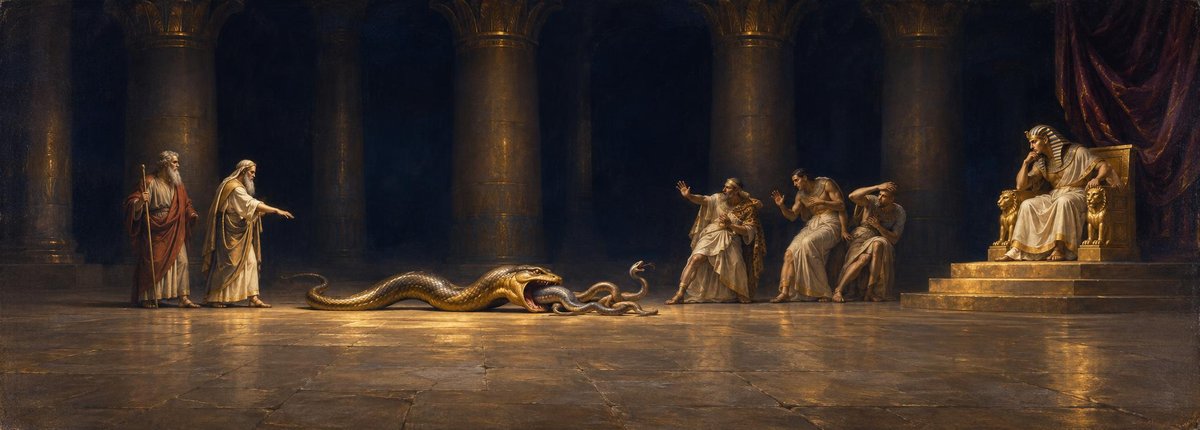
The Bible recounts the most famous case of a wonder that seems to rival God’s work. When Moses and Aaron present the sign before Pharaoh, the text says: “Pharaoh also called the wise men and the sorcerers, and they, too, the magi of Egypt, did the same with their enchantments. They each threw down their rod, and they became snakes. But Aaron’s rod swallowed up their rods” (Ex 7:11-12, translated from the Hebrew).
The magi also repeat the turning of water into blood (Ex 7:22) and the frogs (Ex 8:3). But the narrative has a limit. In the third sign, that of the mosquitoes, it is written: “The magi did the same with their enchantments to bring forth mosquitoes, but they could not” (Ex 8:14). Then they themselves recognize: “It is the finger of God” (Ex 8:15).
How to understand what the magi did? St. Thomas asserts that they made “true serpents and frogs” by the virtue of demons (I, q. 114, a. 4). Explains the manner: the corporal matter does not obey demons with a mere gesture, but they can employ certain “seeds” that exist in the elements of the world, and thus produce what nature also produces, such as frogs that can emerge from putrefaction (I, q. 114, a. 4, ad 2). This is a theological explanation, not a matter of faith. The biblical text does not clarify the manner and merely states that they did “with their enchantments.”
# What Demons Can and Cannot Do
Question 114 asks whether demons can seduce men through true miracles. The answer distinguishes two senses of the word. In its proper sense, “demons cannot perform miracles, nor can any creature, but only God.” In a broader sense, a miracle is that which exceeds human capacity and knowledge, and then “demons can perform miracles,” that is, things that astonish men (I, q. 114, a. 4).
Question 110 states the same thing in another way: when a demon does something with its natural virtue, it is called a miracle “not in a simple sense, but in relation to us,” because we do not know all the virtues of created nature (I, q. 110, a. 4, ad 2).
Thomas is clear about the limit. What nature cannot in any way produce, lies beyond the power of demons: “how to change the human body into a bestial body, or to revive the body of a dead person” (I, q. 114, a. 4, ad 2). If ever something like this appears to happen, “it is not according to the truth of the matter, but only according to appearance.” Appearance occurs in two ways: internally, when the demon alters the imagination and senses of a person, and externally, when it forms a body of air and shows it to view.
The Catechism provides the general framework: Satan “is nothing more than a creature, powerful because he is a pure spirit, but always a creature,” and his action “is permitted by Divine Providence” (no. 395). For more on the biblical adversary, see What is Satan in the Bible?.
“Signs and wonders of falsehood”
The New Testament warns three times of deceptive signs. St. Paul speaks of the adversary of the end times, saying that his coming is “according to the working of Satan, with all power and signs and false wonders” (2 Thessalonians 2:9, translated from the Greek). The Lord says, “False christs and false prophets will arise and give great signs and wonders, to the extent of deceiving, if possible, even the chosen ones” (Matthew 24:24). And the Apocalypse describes the second beast: “It performs great signs, to the point of causing fire to descend from heaven to earth before men” and “it deceives the inhabitants of the earth because of the signs given to it” (Revelation 13:13-14). The signs are “given” to it, and it does not possess them by its own power.
How to understand “de mentira”? St. Thomas offers two readings. The signs of the Antichrist may be false “either because he deceives mortal senses by phantoms, so as to seem to do what he does not do, or because, even if they are true wonders, they lead those who believe into falsehood” (I, q. 114, a. 4, ad 1). In the first case, falsity lies in appearance, in the second, in purpose.
How to Distinguish a Miracle from a False Marvel
If demons do similar things to the saints, how can one discern the difference? Thomas’ answer, citing Saint Augustine, is not in the appearance of the work, but in its end and the right with which it is done:
“When magi do things similar to the saints, they do them for a different purpose and under a different right. Those do it seeking their own glory, these seeking the glory of God. And those do it for certain private dealings, these for public administration and by the order of God, to whom every creature is subject.” (St. Thomas Aquinas, Summa Theologica I, q. 114, a. 4, ad 3)
Scripture provides a criterion that applies to doctrine and not just to works. Deuteronomy foretells a prophet who gives “a sign or wonder,” the sign is fulfilled, but he says: “You shall follow other gods.” The command is: “You shall not listen to the words of that prophet,” “for the Lord your God is testing you to see if you love the Lord your God with all your heart and with all your soul” (Deut 13:2-4, translated from the Hebrew). An extraordinary sign, by itself, never authenticates a doctrine contrary to the faith.
The Catechism shows the other side, the signs of Christ, which “manifest that the Kingdom is present in him” (n. 547). They “testify that the Father sent him. They invite belief in him,” but “they are not intended to satisfy curiosity and magical desires” (n. 548). For what the Church teaches about the demon’s action in people, see Demonic Possession.
What is of faith and what is opinion
It is fitting to distinguish three planes. The first is of faith: the First Vatican Council teaches that God wished to join to the interior aids of the Holy Spirit exterior proofs of His revelation, “and above all miracles and prophecies, which, by clearly demonstrating the omnipotence and infinite wisdom of God, are most certain signs of divine revelation” (De Fide Catholica, 3).Dei Filius(From chapter 3, DH 3009, our translation from Latin). It condemns those who say that miracles cannot exist (DH 3034). The Catechism repeats that the miracles of Christ and the saints are “reasons for belief” (no. 156).
The second aspect is biblical teaching: there will be signs and wonders of falsehood. The third is the theological explanation of how the devil produces them, with seeds, appearances, and the distinction between proper miracles and miracles in a broader sense. This explanation is from Saint Thomas and is not a definition of the Church. The Catechism, regarding magic, states only that its practices are “gravely contrary to the virtue of religion” (n. 2117).
What does this mean for us?
There is no reason for superstitious fear: the devil is a creature, his deeds have limits, and God allows them without losing the governance of history (Catechism, n. 395). Nor is there any reason for credulity: a striking sign does not prove that God is present, and what decides is the end, the fruit, and the doctrine.
## Frequently Asked Questions
Os demônios podem fazer milagres?
Em sentido próprio, não. São Tomás de Aquino ensina que milagre é o que se faz fora da ordem de toda a natureza criada, e que isso só Deus pode fazer (Suma Teológica I, q. 110, a. 4). Em sentido lato, os demônios podem fazer coisas que nos espantam, porque excedem a nossa capacidade e o nosso conhecimento (I, q. 114, a. 4).
Como os magos do Faraó fizeram os mesmos sinais que Moisés?
O livro do Êxodo diz que fizeram «com os seus encantamentos» (Ex 7,11-12.22 e 8,3). São Tomás explica que os demônios usaram forças da natureza que nós ignoramos, e que por isso as serpentes e as rãs foram reais (I, q. 114, a. 4). Mas no terceiro sinal os magos falharam e disseram: «É o dedo de Deus» (Ex 8,14-15). A explicação de Tomás é opinião teológica, e não dogma.
O que significa «sinais e prodígios de mentira»?
É a expressão de São Paulo em 2Ts 2,9 para as obras do adversário do fim dos tempos. São Tomás indica dois sentidos: ou os sinais enganam os sentidos e parecem o que não são, ou são prodígios reais que arrastam para o erro quem neles crê (I, q. 114, a. 4, ad 1).
Os demônios podem ressuscitar alguém ou transformar um homem em animal?
Não, segundo São Tomás. Fica fora do poder dos demônios o que a natureza não pode produzir, como mudar o corpo humano em corpo bestial ou fazer reviver um morto. Se algo assim parece acontecer, é só aparência, por ilusão dos sentidos (I, q. 114, a. 4, ad 2).
Um sinal extraordinário prova que uma doutrina é verdadeira?
Não. O Deuteronômio manda não ouvir o profeta que, mesmo com um sinal cumprido, leva a seguir outros deuses (Dt 13,2-4), e o Senhor avisa que falsos cristos e falsos profetas darão grandes sinais (Mt 24,24). Os milagres de Cristo, ao contrário, testemunham que o Pai o enviou (Catecismo, n. 548).
## References
- SACRED SCRIPTURE: Ex 7:11-12, 22; 8:3, 14-15 (Hebrew, Leningrad Codex, and New Vulgata). Deut 13:2-4 (Hebrew). Mt 24:24; 2Th 2:9; Rev 13:13-14 (Greek, SBL Greek New Testament, and New Vulgata). Our translations.
- Catechism of the Catholic Church, nos. 156, 395, 547-548 and 2117.
- Vatican Council I. Dogmatic Constitution Dei Filius(1870), Chapter 3 (On Faith) and Canons 3 and 4 regarding faith. In: DENZINGER, Heinrich. HÜNERMANN, Peter. Enchiridion Symbolorum, nos. 3009 and 3034.
- Thomas Aquinas. Summa Theologiae I, q. 110, a. 4 (body and answers 1-4). Latin edition: Corpus Thomisticum, https://www.corpusthomisticum.org/sth1103.html.
- Thomas Aquinas. Summa Theologiae I, q. 114, a. 4 (body and answers 1-3). Latin edition: Corpus Thomisticum, https://www.corpusthomisticum.org/sth1103.html.
Responses