The May 8th feast of Saint Michael: Gargano and open dates
By Prof. Dr. Daniel C. Afonso · Updated
Until 1960, the Roman calendar included a second feast of Saint Michael on May 8, called “In Apparitione S. Michaelis Archangeli.” The lessons in the Breviary tell of the apparition on Mount Gargano. However, the origin of the feast has two versions, and sources differ in the dates, from the naval victory (650 or 663) to the apparition (492, 493, or 494). The work Quis ut Deus by Prof. Daniel presents each version and leaves the matter open.
In summary
- Existed: the feast of May 8 was on the Latin calendar until 1960, narrating the apparition of Gargano, and was suppressed from the general calendar in that year.
- The account: The 1927 Breviary recounts the bull, the arrow, the three-day fast, and the word of the archangel to the bishop.
- Two versions: According to Righetti, the feast originated to remember a naval victory and also a mixed appearance with legend.
- Dates: For the naval victory, Righetti gives 663 and Burrini 650. John Paul II speaks of 493 in relation to Gelasius I. The text that underpins the feast does not provide a date.
- Degree of certainty: The title «Apparitio» appears in the Breviary of Pius V, but the book does not confirm who introduced it.
The Other Feast of Saint Michael
Who opened the Roman Breviary of 1927 on May 8 would find the office “In Apparitione S. Michaelis Archangeli.” It was not the feast of September 29, but another, which the Latin calendar preserved until 1960. The lessons narrate the appearance on Gargano, in Apulia, and the work Quis ut Deus translates the main passages.
Lesson IV begins with a general affirmation: “That the Blessed Archangel Michael has appeared to men many times is proved both by the authority of the Sacred Books and by the ancient tradition of the Saints.” It then situates the event in time and place: “Now, when Gelasius was Pope, there occurred in Apulia, on the summit of Mount Gargano, whose root is inhabited by the Sipontines, a glorious appearance of the Archangel Michael.”

The story of the bull and the cave
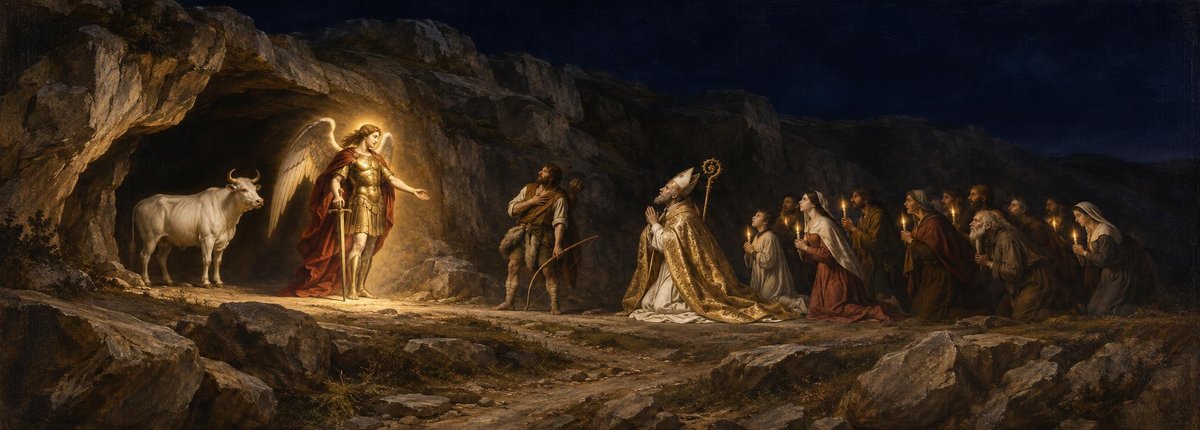
The Breviary relates that a bull from the flocks of a certain Gargano strayed far away. After much searching, it was found standing at the entrance to a cave. One of those searching for it shot an arrow to pierce it, and the arrow, “returning, fell upon the shooter himself.” The Sipontines consulted the bishop, who indicated a three-day fast and prayer, and replied that the case should be sought from God.
In Lesson VI, the conclusion of the episode is this: “Three days having passed, the Archangel Michael warns the bishop that the place is under his care, and that, by this sign, he has shown that he wishes worship of God to be offered there in memory of himself and the Angels.” The lesson further recalls that Pope Boniface dedicated in Rome, on the summit of the Circus, a church of Saint Michael, on the third day before the calends of October, the day on which the Church also celebrates the memory of all the Angels. The text states that May 8th is dedicated to the apparition.
This is the account from the Breviary, presented as the book translates it. Later, Righetti calls one of the origins of the feast a mixed account with legend, and this article maintains that caution.
Two origins for the same feast
Mario Righetti, in the liturgical history manual that Prof. Daniel follows in this section, presents two origins for the feast. The first is that it «was originally instituted to commemorate the naval victory, obtained through the intercession of St. Michael, by the Longobards of Sipontum (Manfredonia) on May 8, 663.» The second is a closer date, either 492 or 494, when, according to a narrative mixed with legend, St. Michael appeared in a cave on Mount Gargano.
Righetti concludes that in honor of these ancient traditions, Pius V called the feast of May 8 Apparition of St. Michael. He then states what happened afterward: «It was suppressed in the recent reform of the Calendar by Pope John XXIII (1960).»
The decree that suppressed the feast
The decree of the Sacred Congregation of Rites that suppresses it is Decree IV, Variations in the Roman Breviary and Missal according to the new Code of Rubrics, published in the Acta Apostolicae Sedis in 1960. In number 8, it lists the festivals removed from the calendar. Among them, under point d, is “the Appearance of Saint Michael the Archangel (May 8)”. Accompanying them are, for example, the Chair of Saint Peter in Rome and the Invention of the Holy Cross. It is a documented fact, with volume and page number.
Where the sources diverge
Professor Daniel emphasizes a discrepancy among sources and the fact that the work does not provide a definitive answer. Righetti places the naval victory of the Lombards on May 8, 663. Gabriele Burrini writes that it occurred on May 8, 650. The 1927 Breviary only recounts the apparition under Gelasius I and the story of the bull, without providing any dates for the victory. Furthermore, Pope John Paul II, during his visit to Monte Sant’Angelo in 1987, stated that Gelasius I “gave his assent in 493 to the dedication of the cave” and made his first visit there.
The text that underpins May 8th is the Liber de apparitione in the edition of Waitz in the Monumenta Germaniae Historica of 1878, and it does not include a year or day of the month. Regarding the dedication of the church, the passage states only that it should be done primarily “on the day when the victory was given,” without specifying that day. The summary that Paola Giovetti provides of the text adds between parentheses “May 8th,” but this data does not appear in the edition of Waitz.
Result: No primary source consulted decides between 650 and 663. The matter remains open, and this article leaves it so.
## The Title «Apparitio»: What Can and Cannot Be Said
Regarding the name of the feast, the book checked a Roman Breviary promulgated by Pius V, in a Venetian edition whose copy does not bear a date on the title page. In the May calendar, on the 8th, it reads “Apparition of St. Michael. Duplex,” and the office begins on page 395, with lessons that are the same as those reproduced in the 1927 Breviary. The 1942 Breviary still reads “8 Apparition of St. Michael the Archangel, duplex major.”
Then the title “Apparitio” appears in the Breviary of Pius V. However, this does not confirm Righetti’s statement that it was Pius V who thus named the feast, because the book does not say who introduced the title. The author is clear on the limits: all he can assert is that the feast of May 8 existed in the Latin calendar until 1960, narrating the appearance on Gargano, and was suppressed from the general calendar in that year.
Even after this, the Missal of 1962 still mentions it, in the section for masses in certain places, without a specific form. It directs the recitation of the “Benedicite” Mass of September 29, with the Creed only if the feast were celebrated in first class.
## Frequently Asked Questions
Havia outra festa de São Miguel além da de 29 de setembro?
Sim. Até 1960 o calendário latino trazia, em 8 de maio, a «Apparitio S. Michaelis», com lições que narram a aparição do Gargano. Foi suprimida do calendário geral nesse ano.
De onde veio a festa de 8 de maio?
Segundo Righetti, ela foi instituída para recordar uma vitória naval dos longobardos de Sipontum, que ele data de 8 de maio de 663. Ele menciona também um relato misturado com lenda sobre uma aparição em uma caverna do Gargano, em 492 ou 494.
Em que ano foi a vitória e a aparição?
As fontes divergem e a obra não decide. Righetti dá 663 para a vitória, Burrini escreve 650, e João Paulo II fala de 493 a propósito de Gelásio I. O texto que fundamenta a festa, o Liber de apparitione, não traz data.
Foi Pio V quem deu à festa o nome «Apparitio»?
Righetti diz que sim, mas o livro não confirma. O título consta do Breviário de Pio V, o que não prova que ele o tenha introduzido.
Quando e por quem foi suprimida?
Em 1960, pelo decreto IV da Sagrada Congregação dos Ritos, publicado nas Acta Apostolicae Sedis, no contexto da reforma do calendário de João XXIII.
## References
- Breviary Roman… Part Spring – Pars verna. Tenth Edition, according to the type, amplified with VIII. Regensburg: At the expense and print of Friedrich Pustet, 1927. “On the Feast of St. Michael the Archangel (August 8th),” Lessons IV to VI, pp. 908-909.
- The Roman Breviary, restored by decree of the Sacred Council of Trent, published by order of Pope Pius V. Venice: published by John Variscus and Associates, [no date]. Calendar for May and pages 395 and following.
- Sacred Congregation for Rites. Decree IV: Variations in the Roman Breviary and Missal according to the new Code of Rubrics. In: Acts of the Apostolic See, v. 52, n. 10, p. 706-722 (item 8 on p. 707), August 15, 1960.
- RIGHETTI, Mario. Manual of Liturgical History. Vol. 2. 3rd ed. Milan: Anchor Publishing, 1969. pp. 438-439.
- Waitz, Georg (ed.). “On the Appearance of Saint Michael.” In: Monumenta Germaniae Historica. Scriptores rerum Langobardicarum et Italicarum saec. VI-IX. Hannover: Hahn, 1878. pp. 540-543.
- John Paul II. Address to the People of Monte Sant’Angelo (May 24, 1987).
- Roman Missal. Typical Edition, 1962. Vatican City: Vatican Press, 1962. Mass for certain places, May 8, and the Mass of September 29, p. 670.
- Source: the work Quis ut Deus. Saint Michael the Archangel in the sources of the faith, by Prof. Daniel (Locus Mariologicus).
Responses