The feast of Saint Michael in 1888 and 1962: hymn, lessons, and Mass
By Prof. Dr. Daniel C. Afonso · Updated
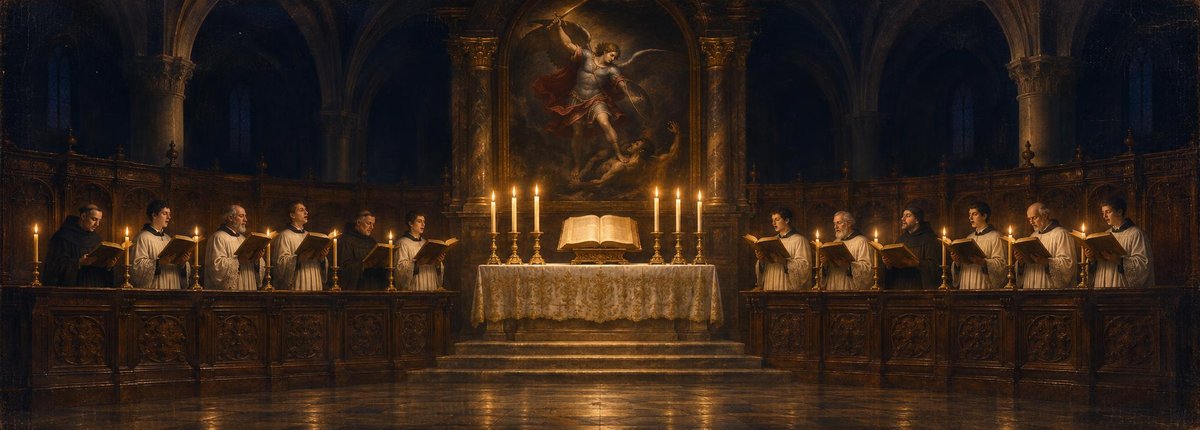
Until 1962, the feast of September 29 still bore in the Roman liturgical books the name “In Dedicatione Sancti Michaelis Archangeli.” Dedication, not simply a feast of the archangel. The work Quis ut Deus, by Prof. Daniel, examines two books that show this ancient form still in active use, the Roman Breviary of 1888 and the Roman Missal of 1962, and notes a fact: in 1960, it was the only first-class angelic feast on the universal Church’s calendar.
In summary
- In 1888: The Roman Breviary calls the feast “In Dedicatione Sancti Michaelis Archangeli” and classifies it as duplex of the 2nd class.
- The hymn: As Vespers sing of Michael as he “unfurls the cross in triumph.” The authorship of the hymn is not noted in the sources consulted.
- In 1962: The Missal still includes “In dedicatione S. Michaelis Archangeli”, of first class, with Rev 1:1-5 and Mt 18:1-10.
- The Alleluia: The verse “Saint Michael the Archangel, defend us in battle” belongs to the 1962 formulary.
- The calendar: in Acta Apostolicae Sedis of 1960, it is the only angelic feast among those of the first class.
The Roman Breviary of 1888
Who enters a church today on September 29 finds the feast of the three archangels. But whoever did so until the beginning of the 1960s would find something else: a feast solely of Michael, with its own name, hymn, and readings. To understand it, the book opens two volumes of the period and reads them with patience, adding nothing to what is written therein.
The Roman Breviary of 1888, in the autumn section, shows that in the 19th century the feast retained its ancient form. There it is called “In Dedicatione Sancti Michaelis Archangeli” and is duplex of the 2nd class. The name recalls that of the ancient sacramentaries, who spoke of the dedication of a basilica to the Angel. Therefore, the feast still presented itself as the dedication of a church of Michael and not merely as the feast of the archangel.

The Vespers hymn, translated from Latin by Professor Daniel, begins by praising Jesus among the Angels, and then shifts to Michael. The text records that in the celestial court there is a dense crown of heads, and that Michael is the bearer of salvation that “unfurls victorious the cross.” The hymn then depicts him casting down the dragon. The conclusion is a plea:
“Let us follow this Prince against the head of pride, that we may receive from the throne of the Lamb the crown of glory.”
The book makes two observations regarding the hymn. The first is that the Latin verse «Sed explicat victor crucem Michael salutis signifer» is the source of the incipit of the apostolic letter Michael salutis signifer of 1959, to which the work returns in a subsequent subsection. The second is a caution: the attribution of the hymn to any author is not found in the sources consulted, and therefore the book does not provide it. This article does the same.
What does Gregory the Great say about the names of the archangels?
The collection of the 1888 Breviary is the same as that which is currently prayed, beginning with “Deus, qui miro ordine Angelorum ministeria hominumque dispensas.” In the Matins lesson, the Breviary includes a text by Saint Gregory the Great on angelic names. It reads that the heavenly spirits are given proper names so that, through words, their value in their actions may be indicated:
“These [spirits] are also designated by proper names, so that by the words themselves their value in their operation may be indicated.”
According to the lesson, Michael means “Who is like God?”, Gabriel “Strength of God”, and Raphael “Medicine of God”. The lesson then turns to the ancient enemy, he who, through pride, desired to be like God. At the end of the world, abandoned to his own virtue to be destroyed by the final torment, it is said that he will fight against the Archangel Michael, as John states: “A battle took place with the Archangel Michael.” The formula is that of the lesson itself: it is said that he will fight, and the lesson relies on the text of John.
The Missal of 1962
In 1962, the Roman Missal still includes the feast under the name “In dedicatione S. Michaelis Archangeli,” now of first class. The entrance antiphon is from Psalm 102, and the collection is as read in the Breviary. The epistle is Revelation 1:1-5, and the gospel is Matthew 18:1-10.
The book highlights two details. The first is the verse of the alleluia: “Saint Michael the Archangel, defend us in battle, so that we may not perish in the dread judgment.” The second is the antiphona of the offertory, from Rev 8:3-4: “An Angel stood by the altar of the temple, holding a golden censer, and he was given much incense, and the smoke of the incense ascended before God, alleluia.”
The communion antiphone comes from Dan 3:58: “Give thanks, all you angels of the Lord, to the Lord; sing a hymn and exalt him for ever.” In the post-communion, the Church prays: “Supported by the intercession of your blessed Archangel Michael, we implore you, Lord, that what we have received with our mouths we may also achieve with our spirits.” And in the votive Mass of the Paschal Time, the Alleluia adds: “The sea was moved and the earth trembled when the Archangel Michael descended from heaven.”
The only first-class angelic feast
Regarding the calendar, the book refers to the Acta Apostolicae Sedis of 1960, where Decree III, titled “Calendarium Breviarii et Missalis Romani,” publishes the list of feasts of the first class in the calendar of the Universal Church. Among them is the “Dedicatio S. Michaelis Archangeli,” and it is the only angelic feast on the list.
The list is short. It includes the great feasts of the Lord (Birth, Epiphany, Pasch, Ascension, Pentecost, Trinity, Body of Christ, Heart of Jesus, Most Precious Blood, and Christ the King), the feasts of Our Lady (Immaculate Conception, Annunciation, and Assumption), the two feasts of Saint Joseph, that of husband of the Virgin and that of the Worker, and those of John the Baptist, Peter and Paul, and All Saints. Among them, only one is dedicated to an angel, that of Michael.
Let it be clear what the book affirms and what it does not. It affirms, as documented fact, that in 1960 the feast of Michael appears on the list of first-class feasts and is the only angelic feast on that list. It does not, in this passage, affirm an explanation for this position, and this article does not invent one.
## Frequently Asked Questions
Como se chamava a festa de 29 de setembro em 1888 e em 1962?
Chamava-se «In Dedicatione Sancti Michaelis Archangeli», no Breviário de 1888, onde era duplex de 2.ª classe. No Missal de 1962 conservava o nome e era de primeira classe.
Quem escreveu o hino das Vésperas da festa?
Não sabemos. A atribuição do hino a algum autor não consta das fontes consultadas pela obra, que por isso não a dá.
O que diz São Gregório Magno sobre os arcanjos na lição da festa?
Que os arcanjos têm nomes próprios para que, pelos vocábulos, se indique o que valem na sua operação: Miguel significa Quem como Deus?, Gabriel, Fortaleza de Deus, e Rafael, Medicina de Deus.
É verdade que a festa de São Miguel era a única festa angélica de primeira classe?
Sim, segundo o decreto publicado nas Acta Apostolicae Sedis de 1960, que lista as festas de primeira classe do calendário da Igreja universal. A «Dedicatio S. Michaelis Archangeli» é a única festa angélica da lista.
Que texto bíblico se lia na Missa de 1962?
A epístola era Ap 1,1-5 e o evangelho Mt 18,1-10, segundo o Missal Romano de 1962.
## References
- Breviary Romanum restored by decree of the Sacred Council of Trent… Autumn Part. First edition after the press. Ratisbon, New York, and Cincinnati: Fridericus Pustet, 1888. Vespers feast and hymn, pp. 331-332. Lessons of Saint Gregory (lessons V and VI of Matins), pp. 333-334.
- Roman Missal. Typical Edition, 1962. Vatican City: Vatican Press, 1962. Mass of September 29 and Votive Mass of the Paschal Time, pp. 670-671.
- Sacred Congregation for Rites. Decree III: The Calendar of the Roman Breviary and Missal. In: Acts of the Apostolic See, Vatican City, v. 52, n. 10, pp. 686-705 (listed on p. 700), August 15, 1960.
- Source: the work Quis ut Deus. Saint Michael the Archangel in the sources of the faith, by Prof. Daniel (Locus Mariologicus).
Responses