The feast of Saint Michael arose as the anniversary of a basilica
By Prof. Dr. Daniel C. Afonso · Updated
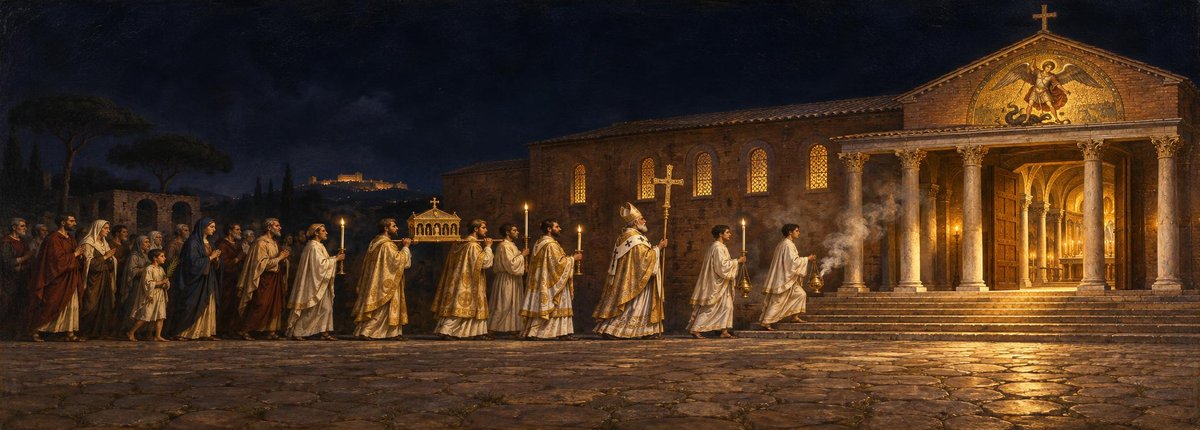
Before becoming a feast of the archangel, September 29 was the anniversary of a church. The oldest liturgical books that preserve it give it titles such as “The Nativity of the Basilica of the Angel in Salaria” and “The Dedication of the Basilica of Saint Michael the Archangel.” That the feast originated as the dedication of a basilica is a documented fact. Which basilica it was remains an open question, as the work Quis ut Deus by Prof. Daniel leaves it undetermined.
In summary
- The oldest: The Veronese Sacramentary places the anniversary of the basilica of the Angel on the Via Salaria on September 30th.
- The name of Michael: the title refers only to the «Angel». The name Michael is read in the following forms.
- Gelasian: records the dedication of the basilica of Michael on September 29, with the collect still prayed today.
- The doubt: Duchesne and Kellner disagree about which basilica it was, and the sources consulted do not allow a decision to be made.
- Degree of certainty: The establishment of the feast as a dedication is a documented fact. The identification of the basilica remains an open question.
The oldest liturgical book
To understand the origin of the feast on September 29, the book begins with the oldest preserved rubric. It is found in the Veronese Sacramentary, also known as the Leonian, in the edition by Mohlberg. Under the day preceding the calends of October, that is, September 30, the book carries the title “Pridie kalendas octobres. Natale basilicae Angeli in Salaria.” In Portuguese, “On the eve of the calends of October. Anniversary of the basilica of the Angel in Salaria.”
Prof. Daniel takes care to note a detail: the title names the “Angel” and not “Michael.” The name of the archangel appears only in the forms that follow. The rubric says “Angel,” and the name is read only in the prayers that follow.

Michael named in prayer
The book cites various forms of the series. In the preface to number 846, the assembly tells God that, in honor of the blessed archangel Michael, places consecrated to his name have been instituted for the divine mysteries. It explains the meaning of the piety of the faithful: although the dwelling place of that sublime and glorious substance is always in heaven, the faithful dare to keep on earth, through these devotions, “a sort of pledge of the ministers who without cease assist in your presence.”
The prayer over the offerings in #847 asks that the people’s offering be acceptable “not by our merits, but through the intercession of your holy Archangel Michael.” The prayer in #854 states: “In honor of the blessed Archangel Michael, we frequent with mystical devotion the places dedicated to your name.” And the final formula in the series, in #855-859, mentions the archangel twice more. The preface in #857 invites us to strive for the heights “which we contemplated in the affection of the blessed Archangel Michael,” and the prayer in #858 begins: “Supported by the intercession of the blessed Archangel Michael, we pray, Lord, that we may also attain with our minds those whom we honor with our bodies.”
In the formularies of Nos. 846 and 854, the veneration of Michael goes hand in hand with the dedication of sacred places. The preface to No. 846 even states that these places on earth hold a pledge of a reality whose dwelling place is in heaven.
Gelasian and the collection that we still pray
Another testimony is the Gelasian Sacramentary in the Alamannic transmission, edited by Mohlberg in 1918. It presents the same type of feast, but on a different day. Under the date «III. Kalendas octobres», which is September 29th, appears the rubric «Dedicatio basilicae Angeli Michaelis». For this date, the book provides the collect that is still prayed today:
“God, who orderest with admirable arrangement the ministries of angels and men, grant us, by thy mercy, that our life on earth may be protected by those who, ever at thy service, assist thee in heaven.”
The text is the same as the 2002 collection, with the order of the words slightly changed. In the Gelasian text, it reads “nostra uita” and today it is “vita nostra”. It is the prayer still recited in the Mass of September 29. Here we see its origin: from a book that placed it in the feast of the dedication of a basilica of the Angel.
# What Mario Righetti Says
To summarize the state of the question before 1969, the book refers to Mario Righetti, in his historical liturgical manual on the liturgical year. Professor Daniel translates the passage and omits the author’s footnotes.
Righetti states that, in Rome, the Leonian Missal contains, on September 30th, five Mass formularies, three of which, in the preface, refer to the dedication of a church in honor of Saint Michael, located on the Via Salaria, six miles north of the city. The Gelasian and Gregorian Missals, in turn, have a dedication of a basilica of Saint Michael, but without the indication of the Via Salaria and placed on September 29th.
Here begins the divergence. According to Righetti, Duchesne considers it to be the same basilica as the Leonian. Kellner, on the contrary, conjectures that it is the church of Saint Michael in Saxia, restored by Pope Symmachus (498-514), now with the title of Saints Michael and Magnus. The Italian author concludes: “In any case, the date of September 29, which was a dedication anniversary, later became the current feast of Saint Michael and was adopted in all Western countries.”
What is certain and what remains open
Professor Daniel distinguishes carefully between degrees of certainty. That the feast of September 29 originated as the anniversary of the dedication of a basilica to the Angel is a fact documented by the liturgical books, as both sacramentaries give it that title.
Which basilica is under discussion, the one on the Via Salaria or Saint Michael in the Sassia? Righetti presents two views, that of Duchesne and that of Kellner, but does not make a decision between them. The work also does not make a choice, and gives the reason: the sources consulted do not allow it. Therefore, this article does not opt for either one, nor suggests that one is more likely than the other.
The distinction is worth preserving. Between what a liturgical book says outright and what scholars conjecture from it, there is a difference that the reader deserves to see, and the work maintains it.
## Frequently Asked Questions
Qual é a mais antiga rubrica conservada da festa de São Miguel?
Segundo a obra, é a do Sacramentário Veronense, ou Leoniano, na edição de Mohlberg, em 30 de setembro: «Natale basilicae Angeli in Salaria», aniversário da basílica do Anjo na Via Salária.
O título do Veronense nomeia Miguel?
Não. O título nomeia o «Anjo». O nome de Miguel lê-se nos formulários seguintes, a começar pelo prefácio do n. 846.
A festa de 29 de setembro começou como festa do arcanjo?
Segundo os livros litúrgicos, começou como aniversário de dedicação de uma basílica do Anjo. O Veronense e o Gelasiano lhe dão esse título. Foi depois que a data se transformou na festa de São Miguel, como resume Righetti.
Que basílica era essa?
A questão fica em aberto. Duchesne a identifica com a do Leoniano, na Via Salária, e Kellner conjetura que seja São Miguel in Sassia, restaurada por Símaco. A obra não decide, porque as fontes consultadas não permitem.
## References
- Mohlenberg, Leo Cunibert (ed.). Sacramentarium Veronense (Cod. Bibl. Capit. Veron. LXXXV[80]). In collaboration with Leo Eizenhöfer and Petrus Siffrin. 2nd improved edition. Rome: Herder, 1966. (Rerum ecclesiasticarum documenta, Series maior, Fontes, 1.) pp. 106-108, nn. 846, 847, 854, 857, and 858.
- Mohlenberg, Kunibert (ed.). The Frankish Sacramentarium Gelasianum in Alamannian Transmission (Codex Sangall. No. 348). Münster in Westfalen: Aschendorff, 1918. n. 1242, p. 191.
- RIGHETTI, Mario. Manual of Liturgical History. Vol. 2: The Liturgical Year in History, in the Mass and the Office. 3rd ed. Milan: Editrice Àncora, 1969. Ch. XII, “The Cult of Angels. St. Michael,” p. 438.
- Source: the work Quis ut Deus. Saint Michael the Archangel in the sources of the faith, by Prof. Daniel (Locus Mariologicus).
Responses