Mass of September 29: What does the Church pray to the archangels?
By Prof. Dr. Daniel C. Afonso · Updated
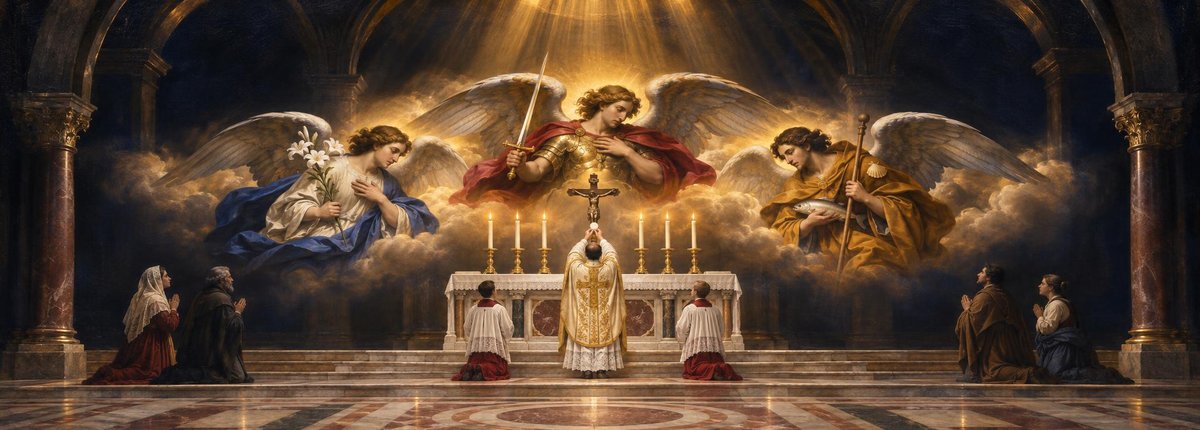
In the Roman calendar currently in use, September 29th commemorates only one feast day, that of the Archangels Michael, Gabriel, and Raphael. The Mass for this day prays that “our life on earth may be protected by those who, at your service, always assist you in heaven.” It is through this formula that the work Quis ut Deus by Professor Daniel opens its study of the feast, before retracing the sources.
In summary
- One feast: On September 29, the Roman Missal of 2002 celebrates Michael, Gabriel, and Raphael together, with a feast day designation.
- Guardians Angels: their feast day is October 2.
- The collection: it is the same as in 1962 and 1888, and almost identical to the Gelasian Sacramentary.
- “What is missing: the verse ‘defende nos in proelio’ from the 1962 Missal is not included in the 2002 formula.”
- Author’s reading: The Litany of the Paschal Vigil shows that the current form of veneration of the Archangels is, in part, the work of a recent reform.
One feast for three archangels
The Roman calendar in use, as reproduced by the Roman Missal of 2002, marks September 29th as the feast of Saints Michael, Gabriel, and Raphael, in Latin “Ss. Michaelis, Gabrielis et Raphaelis, archangelorum.” The rank is that of a feast, Festum. A few days later, on October 2nd, comes the memorial of the Guardian Angels.
The book that contains this calendar is the third typically edited edition of a work whose first typically edited edition was in 1970. The second was in 1975 and the third in 2002. The decree promulgating the edition of 1970 bears the date of March 26, 1970, Maundy Thursday of Holy Week, and the signatures of Cardinal Benno Gut, Prefect, and A. Bugnini, Secretary. All this is documented fact within the Missal itself, and serves to identify the text in question.
What the Mass of that day asks and proclaims
The work translates from Latin the formula of 2002, omitting only the initial dialogue of the preface. The Mass opens with an antiphona taken from Psalm 102, according to the Vulgate: “Bless the Lord, all his angels, powerful in strength, who do his word, to hear the voice of his words.”
Then comes the collection, the prayer that gathers the request of the community:
“God, who orderest with admirable arrangement the ministries of Angels and men, grant us, by thy mercy, that our life on earth may be protected by those who, ever at thy service, assist thee in heaven.”
The prayer speaks of Angels and men side by side. The Angels assist God in heaven, and the men, on earth, ask to be protected by them. In the prayer over the offerings, the Church presents to God hosts of praise and supplicates that they be “brought to the presence of Your majesty by the ministry of the Angels” and received for our salvation. Here the angelic ministry appears as the path that leads the offering to God.
The preface is titled “Of the glory of God in the angels.” In it, the assembly declares that it does not wish to silence the praise due to God in his archangels and angels, and concludes by joining in the celestial song: “The multitude of the angels celebrate your majesty, and we, adoring in exultation, join them.”
The communion antiphone is from Psalm 137: “I will give thanks to you, Lord, with all my heart; before the angels I will sing to you.” The prayer after communion asks: “Strengthened by the heavenly bread, we pray to you, Lord, that, supported by your strength, under the faithful care of your angels, we may walk firmly on the way to salvation.”
Two Facts That Stand Out
As he reads the text, Professor Daniel notes two facts. The first is that the collection is the same as that found in the 1962 Missal, the 1888 Breviary, and, with a slight difference in word order, the Gelasian Sacramentary. This means that the central prayer of the feast is much older than the 2002 Missal.
The second is an absence. The Missal of 1962 included, in the Alleluia, the verse “Sancte Michael Archangele, defende nos in proelio.” It is not present in the 2002 edition. The Communion antiphon and the Preface are new in comparison to 1962. Therefore, the prayer “defende nos in proelio” is not included in the Mass text for the feast, and the author discusses it in the following subsection of the work. This article does not go beyond what the excerpt states.
Michael in the Paschal Vigil Hymn
Michael appears still, named by himself, in the litany of the saints that the Missal of 2002 prescribes for the Easter Vigil. The sequence is this: “Holy Mary, Mother of God, pray for us. Saint Michael, pray for us. All Angels of God, pray for us. Saint John the Baptist, pray for us.” First Mary, then Michael, then the Angels in general, then John the Baptist.
In the litany of the Vigil of 1962, the order was different. There, the three archangels were invoked by name, one after another, “Saint Michael, pray for us. Saint Gabriel, pray for us. Saint Raphael, pray for us,” then all the Angels and Archangels, and only then John the Baptist.
The book records the difference as the first sign that the current form of the veneration of the archangels is, in part, the work of a recent reform. This is the author’s reading of what the two texts show, and not a fact from the Missal. To understand it, Professor Daniel directs us back to the sources, and that is what the following articles in the series do, one passage at a time.
What remains from this first passage?
The modern-day reader who participates in the Mass of September 29th hears, therefore, a formula that blends the very ancient with the new. The collection spans the centuries. The communion antiphona and the preface are more recent. And a verse that the Missal of 1962 included is now absent. The text does not state why, nor does this article.
Therefore, the work does not content itself with describing the Mass of today. It sets side by side the Missal of 2002, the one of 1962, the Breviary of 1888, and the Gelasian Sacramentary, and goes checking, text by text, what remains and what has changed. It is a simple and honest method: before speaking of the feast, to read what the Church effectively prays.
## Frequently Asked Questions
Que festa se celebra em 29 de setembro?
No calendário romano em vigor, tal como o reproduz o Missal Romano de 2002, é a festa dos santos Miguel, Gabriel e Rafael, arcanjos, com o grau de festa.
Quando se celebram os Anjos da Guarda?
Em 2 de outubro, com o grau de memória, segundo o calendário do Missal Romano de 2002.
Quantas edições típicas tem o Missal Romano de 2002?
O Missal de 2002 é a terceira edição típica. A primeira é de 1970 e a segunda de 1975. O decreto de promulgação de 1970 traz a data de 26 de março desse ano.
A oração «defende nos in proelio» está na Missa atual de 29 de setembro?
Não. O versículo do aleluia «Sancte Michael Archangele, defende nos in proelio» estava no Missal de 1962, mas não consta do formulário de 2002. A obra trata dessa oração numa subseção posterior.
## References
- The Roman Missal, established by decree of the Sacred Ecumenical Council of Vatican II, promulgated by Pope Paul VI and revised under the care of Pope John Paul II. Third Typical Edition. Vatican City: Vatican Press, 2002. General Roman Calendar (September 29th and October 2nd), title page and decree of 1970, Mass for September 29th, Paschal Vigil Litany.
- Roman Missal. Edition typica 1962. Vatican City: Vatican Press, 1962. Holy Saturday, Vigil Mass, p. 199.
- Source: the work Quis ut Deus. Saint Michael the Archangel in the sources of the faith, by Prof. Daniel (Locus Mariologicus).
Responses