Joseph, son of David: how Jesus inherits the promise made to David
By Prof. Dr. Daniel C. Afonso · Updated
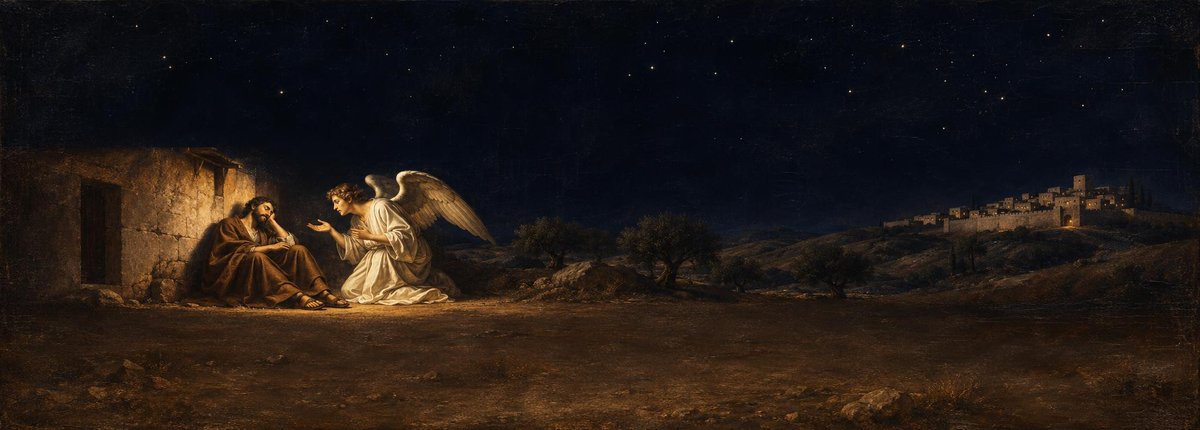
When appearing in a dream, the angel does not merely call the carpenter from Nazareth by name: he says “Joseph, son of David” (Mt 1:20). With this title, the Gospels connect Jesus to the promise made to King David, and the Church teaches that Jesus inherits it through Joseph’s legal paternity, which arises from his marriage to Mary and is manifested in the moment when he gives the child a name.
In summary
- The title: “son of David” is given to Joseph by the angel (Mt 1:20), and Luke calls him “of the house of David” (Lk 1:27) and “of the house and family of David” (Lk 2:4).
- The Promise: 2 Samuel 7 announces a descendant of David whose throne will be established forever, and to whom God will be a father.
- The inheritance: Jesus is heir of David through Joseph’s legal paternity (Redemptoris Custos 7).
- The Sign: Joseph gives Jesus his name, thereby welcoming him as his son.
- What is of faith: that Jesus descends from David. That Mary was also of the house of David is an inference from tradition.
A title given to Joseph
In the Gospels, the title “son of David” usually designates the Messiah. Yet in Matthew, it also appears in an angel’s words to Joseph: “Joseph, son of David, do not fear to take Mary as your wife, for that which is conceived in her is from the Holy Spirit” (Mt 1:20). The same Gospel begins by stating that Jesus is “son of David, son of Abraham” (Mt 1:1). Thus, the title moves from son to the man who will be the legal father of the son. Translations from the Greek.

Luke says much the same thing in another way. The angel Gabriel is sent “to a virgin betrothed to a man named Joseph, of the house of David” (Lk 1:27). And Joseph, from Galilee, goes up to Bethlehem, “the city of David,” because he was “of the house and lineage of David” (Lk 2:4). Twice, the evangelist emphasizes from whom Joseph descended. In Lk 1:27, the expression “of the house of David” follows Joseph’s name in the Greek text, and this is how the Redemptoris Custos (n. 2) reads it.
The promise of 2 Samuel 7
The background is the promise that the prophet Nathan conveys to David. God tells him that he will raise up a descendant after him, “who shall come forth from you,” and that he will establish “the throne of his kingdom forever.” And he adds: “I will be to him a father, and he shall be to me a son” (2 Samuel 7:12-14, from the Hebrew). The New Vulgata translates: “Ego ero ei in patrem, et ipse erit mihi in filium”
When Gabriel speaks to Mary, the angel’s words repeat the promise: “The Lord God will give you ‘the throne of David, your father,’ and he will reign ‘over the house of Jacob forever’ (Lk 1:32-33). Thus, the New Testament reads the birth of Jesus as the fulfillment of 2 Samuel 7. And Pope Francis reminds us in his letter Patris Corde: Joseph is ‘a descendant of David (cf. Mt 1:16.20), from whom Jesus should come according to the promise made to the king by the prophet Nathan (cf. 2 Sam 7)’. He adds that Joseph, ‘as husband of Mary of Nazareth,’ is ‘the hinge that joins the Old and New Testaments.'”
How David’s Heritage is Inherited, Not through Joseph
The difficulty is evident. The Gospels affirm that Jesus was conceived by the power of the Holy Spirit. How can he be the heir of David through the line of Joseph? The Church’s response lies in the marriage. In Redemptoris Custos, John Paul II writes that it is important «to defend Mary’s marriage to Joseph, because it is from this marriage that the legal paternity of Joseph depends». He draws the consequence: «From this it follows why the generations are listed according to Joseph’s genealogy» (n. 7).
The document cites Saint Augustine, who states that Joseph was Mary’s husband, and thus her father. Augustine notes a detail from the text of Matthew: «he is commanded to give the name to the child, though he was not conceived from his seed». And he concludes: «his fatherly authority is not taken from him, since it is ordered that he give the name to the child». Giving the name is, for Augustine, a sign of this authority. When the angel says «you shall call his name Jesus» (Mt 1:21) and the evangelist reports that Joseph «called his name Jesus» (Mt 1:25), we are witnessing a patristic act.
The scholar Mueller, citing Grimm, summarizes the reasoning: for the proof to be conclusive, Joseph, as the true husband of the Virgin, must have all the parental rights over Mary’s son. Thus, Jesus can succeed in all titles and rights that Joseph held as a descendant of David. The exegete Maria-Luisa Rigato affirms the same: it is through Joseph’s legal paternity that Jesus enters David’s genealogy. For what this paternity means, see The Paternity of Saint Joseph.
And the lineage of Mary?
There is a question that deserves to be separated. The legal inheritance of Joseph does not prevent one from questioning the blood of Jesus. Paul writes that the Son of God was born “of the seed of David according to the flesh” (Rom 1:3). Thomas Aquinas, in answering Faustus, the Manichaean, who denied the descent from David, recalls the answer of Augustine. If the Evangelist calls Joseph the husband of Mary, says that the mother of Christ is a virgin, and says that Christ comes from the seed of David, it remains to believe that Mary was not a stranger to David’s lineage, and that the order of generations is conducted to Joseph first because of the manhood’s dignity (Summa Theologica III, q. 31, a. 2, ad 1).
Let us distinguish, then. Faith affirms, with Scripture, that Jesus is a descendant of David. The Church teaches that the legal fatherhood of Joseph, founded in marriage, is what inserts Jesus into the Davidic genealogy of the Gospels. And it is an inference of the Fathers and theologians, supported by Scripture, that Mary was also of the family of David. The text of Luke does not say this explicitly.
What does this teach us about Joseph?
The title “son of David” is not an ornament. It states that Joseph belongs to the history of the promise, and that God entrusted him with the role of legal father of the Messiah. Redemptoris Custos highlights that his marriage to Mary forms the foundation of this paternity, and Patris Corde sees it as the link between the two covenants. See also the Exhortation on the Guardian of the Redeemer.
There is still a simple lesson. The angel says to Joseph, “Do not be afraid,” and calls him by the name of his family. Before asking him to receive Mary, he reminds him of who he is. Joseph’s obedience is based on an identity: he is the one whom God uses to fulfill the promise made to David.
## Frequently Asked Questions
Por que o anjo chama José de «filho de Davi»?
Porque José descendia de Davi e porque, pela sua paternidade legal, Jesus é herdeiro de Davi. O título liga José à promessa de 2Sm 7, que o Novo Testamento lê cumprida em Jesus (Mt 1,20).
Jesus descende de Davi por José?
Pela paternidade legal, sim. A Redemptoris Custos (n. 7) ensina que o matrimônio com Maria é o fundamento jurídico da paternidade de José, e por isso as gerações são enumeradas segundo a genealogia dele.
O que diz 2Samuel 7 sobre o descendente de Davi?
Deus promete firmar o trono do seu reino para sempre e diz: «Eu serei para ele pai, e ele será para mim filho» (2Sm 7,13-14). O anúncio de Gabriel a Maria retoma essas palavras (Lc 1,32-33).
Maria também era da casa de Davi?
É a crença da tradição, defendida por Eusébio, Agostinho e Tomás. Os Evangelhos dizem expressamente só que José era «da casa de Davi». Trata-se de inferência, não de definição.
Por que importa que José desse o nome a Jesus?
Porque dar o nome era ato próprio do pai. Santo Agostinho, citado na Redemptoris Custos, nota que não lhe é tirada a autoridade paterna, pois lhe é ordenado dar o nome ao menino.
## References
- SACRED SCRIPTURE: Mt 1:1, 16-20-21, 25; Lk 1:26-27, 32-33, 2:4-5; Rom 1:3; 2Sa 7:12-16. Translated from Greek (SBLGNT), Hebrew (WLC), and the New Vulgata.
- John Paul II. Apostolic Exhortation The Cost of the Redeemer (1989), nos. 2 and 7. Text from vatican.va, citing AUGUSTINE Sermo51, 10, 16 (PL 38, 342).
- FRANCISCO. Apostolic Letter Patris Corde (2020), n. 1. Portuguese text from vatican.va.
- Thomas Aquinas. Summa Theologiae III, q. 31, a. 2, ad 1.
- MUELLER, Michael. The Fatherhood of St. Joseph. 1952, pp. 103-104, citing Grimm.
- RIGATO, Maria-Luisa. «The Parents of Jesus». 2008, p. 33.
Responses