Saint Joseph in the genealogies of Matthew and Luke: Jacob or Heli?
By Prof. Dr. Daniel C. Afonso · Updated
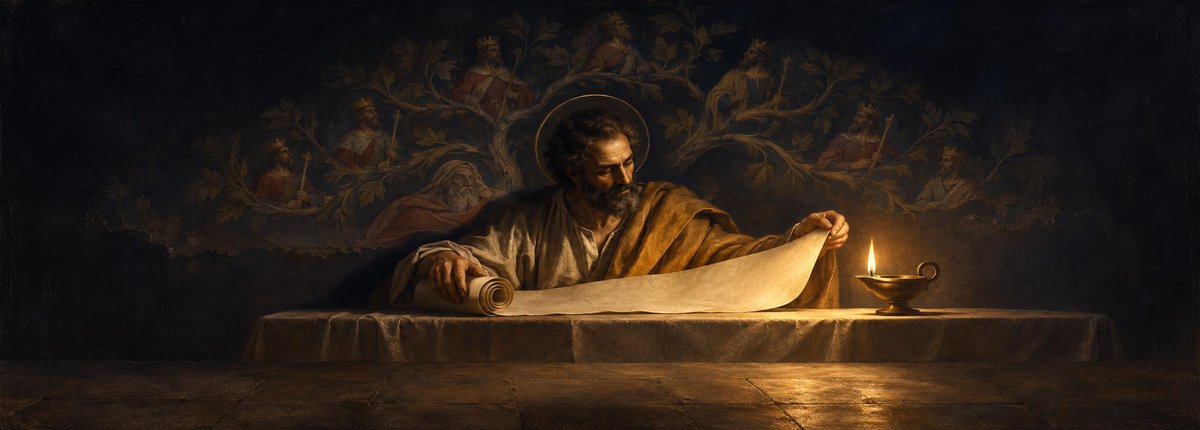
Matthew and Luke present the genealogy of Jesus, and both pass through Saint Joseph, but name different parents for him: in Matthew, “Jacob begat Joseph” (Mt 1:16), and in Luke, Joseph is “the son of Heli” (Lk 3:23). The reason for following the line of Joseph and not that of Mary lies in the legal paternity that marriage conferred, and the earliest explanation for Jacob and Heli, by Julius Africanus, was accepted by Augustine and Thomas Aquinas.
In summary
- The fact: Two lists of ancestors (Mt 1:1-17 and Lk 3:23-38), both reaching back to Joseph, with Jacob in Matthew and Heli in Luke.
- Why Joseph and not Mary: because the genealogy was traced through the male line and because Joseph was, according to the law, the father of Jesus (Eusebius, Jerome, Augustine).
- Jacob or Heli: Julius Africanus explains through the law of levirate: one is the biological father, the other the legal father.
- The Limits: The explanation has difficulties and is not a defined doctrine. It is a solution of exegetes and theologians.
- What is of faith: that Jesus descends from David (Rom 1:3), and that the legal fatherhood of Joseph arises from his marriage to Mary.
Two lists, and both come to Joseph
Matthew opens his Gospel with “the book of the origin of Jesus Christ, son of David, son of Abraham” (Mt 1:1) and traces his lineage down to Joseph. Luke presents the genealogy after Jesus’ baptism and ascends, step by step, to Adam, “son of God” (Lk 3:38). The two lists agree on David, but share few names between David and Joseph. Matthew goes through Solomon. Luke goes through Nathan, another son of David.
The most striking point is at the end of the list. In Matthew, it reads: “Jacob begat Joseph, the husband of Mary, from whom was born Jesus, called Christ” (Mt 1:16). In Luke, Jesus is described as “a son, as was supposed, of Joseph, the son of Heli” (Lk 3:23). For Joseph, Matthew gives the father Jacob and Luke gives Heli.
It is worth noting verse 16 of Matthew. Throughout the list, the verb is «generated». When it comes to Joseph, the evangelist changes: Joseph is «the husband of Mary», and Jesus is the one who «was generated» by her, using the passive verb and a feminine pronoun. Exegete Maria-Luisa Rigato observes that this formula is unique in the entire Bible. Matthew does not hide that Joseph did not generate Jesus.
Why is the genealogy given of Joseph and not of Mary?
The objection is ancient. If Joseph is not the biological father of Jesus, why do the evangelists trace his lineage? The historian Eusebius of Caesarea, in the early 4th century, answers in his Questions to Stephen on the Gospels. The evangelists, he says, lived among Jews, and everyone called Joseph the father of Jesus. If they had followed the line of the mother, this would have been “indecent and alien to the simplicity of the divine Scriptures,” because never before had anyone recorded a genealogy traced through a woman. And Jesus would seem to be a man without a father.
Eusebius adds an argument regarding Mary. The law of Moses commanded marriage within one’s own tribe and family. Thus, by showing Joseph as a descendant of David, the evangelists also trace the lineage of the wife through that of the husband. Jerome states the same in his commentary on Matthew: it is not customary in Scripture to trace generations through women, and Joseph and Mary were of the same tribe, so much so that they were enrolled together in Bethlehem.
Thomas Aquinas collects Augustine’s answer in the Summa Theologica (III, q. 31, a. 2, ad 1): the order of generations extends to Joseph “for the dignity of the man,” and we continue to believe that Mary was a descendant of David because the Scriptures say so. Here it is fitting to distinguish. That Mary was of the house of David is an inference from tradition, supported by Scripture. The text of Luke says only that the angel was sent to a virgin betrothed to a man named Joseph, “of the house of David” (Lk 1:27).
Jacob or Heli: The Explanation of Julius Africanus
How can Joseph have two fathers? Julius Africanus, a Christian writer from Palestine in the third century, answered in a letter to certain Aristides. Eusebius preserved it in the Ecclesiastical History (I, 7). In the Latin text printed by Migne, Africanus writes:
“Matthan, who descended from Solomon, begat Jacob. After Matthan’s death, Melchi, of the lineage of Nathan, begat Eli from the same woman. Jacob and Eli were therefore brothers in the womb. Since Eli died without children, Jacob raised up seed for him, generating Joseph, who by nature was Jacob’s son, but by law was Eli’s son. Thus it is rightly said that both were fathers of Joseph.” (Africanus, in Eusebius, Church History I, 7, in PG 20, col. 99-100, our translation)
The foundation is the law of levirate (Deuteronomy 25:5-6): when a man died without children, his brother took the widow, and the firstborn son was counted as the dead man’s son. Thomas repeats the solution and names the woman, “Estha,” who was married first to Matan and then to Melchi. Among the causes he enumerates, this is the “most true” for him. Matthew places the biological father, Jacob. Luke places the legal father, Heli, and therefore avoids the verb “begot.”
Augustine followed a similar path. For years, he thought that Joseph was born into one family and adopted by another. Later, in the Confessions (II, 7), he states that he should have explained this mode of adoption, for the law adopted children for the dead, and that the name of the woman, the mother of Jacob and Eli, did not satisfy the African.
## Difficulties and Other Answers
The solution of Africanus is not without problems. The scholar Joseph Lienhard observes that there is no certain proof that levirate applied to half-brothers of the same mother, and notes that Africanus places Melchizedek as Joseph’s grandfather, when in Luke he appears further back in the list. Thomas knew other answers: that Luke gives a genealogy only “putative”, that the parents of Luke are parents “spiritual”, or that of Augustine, in which an evangelist names the father and the other a maternal grandparent or a relative. He also records that Damascene made Mary descend from Melchizedek, but prefers to believe that she also descended from Solomon.
Faith does not depend on any of these hypotheses. It is up to exegesis to discuss the names. The reader needs only to know that the ancients saw the problem and studied it, and that no answer destroys the unity of the Gospels.
What is at stake: the legal paternity of Joseph
The theological significance of the genealogy lies in the marriage. The exhortation Redemptoris Custos (n. 7) teaches that the marriage to Mary is the legal foundation for Joseph’s paternity, and concludes: “It is from this marriage that the legal paternity of Joseph depends. This is why the generations are listed according to Joseph’s genealogy.” The document quotes Augustine: “Wasn’t Joseph the husband of Mary?” On this paternity, see Paternity of Saint Joseph, and about who he was, Who was Saint Joseph.
What is of faith and what is opinion
Let us distinguish the degrees. It is of faith, because it is written in Scripture, that Jesus descends from David: Paul writes that he was born “of the lineage of David, according to the flesh” (Rom 1:3). It is the teaching of the Church, expressed in the magisterium of John Paul II, that the genealogy passes through Joseph because of the legal paternity that marriage confers upon him. It is a theological explanation, defended by Africanus, Augustine, and Thomas, that Jacob and Heli are both the biological and legal father. And it is an inference from tradition that Mary was also of the house of David.
## Frequently Asked Questions
Por que a genealogia de Jesus é a de José e não a de Maria?
Porque nas Escrituras a genealogia se traça pelo varão, e porque José era, perante a lei, o pai de Jesus. Eusébio, Jerônimo e Agostinho dão essa resposta, e a Redemptoris Custos (n. 7) a retoma ao falar da paternidade legal de José.
José era filho de Jacó ou de Heli?
Mateus diz Jacó e Lucas diz Heli. Júlio Africano explica que Jacó foi o pai de sangue e Heli o pai legal, pela lei do levirato. Agostinho e Tomás aceitaram a explicação, que tem, porém, dificuldades e não é doutrina definida.
O que é o levirato?
É a lei de Dt 25,5-6: se um homem casado morria sem filhos, o irmão se casava com a viúva, e o primeiro filho era contado como filho do defunto, para que o nome dele não se perdesse em Israel.
A genealogia de Lucas é a de Maria?
O texto de Lucas não diz isso: escreve que Jesus era «filho, como se pensava, de José, filho de Heli». Tomás cita Damasceno, que fazia Maria descender de Melqui, mas prefere outra explicação.
Mateus 1,16 diz que José gerou Jesus?
Não. O verbo «gerou» aparece para todos os antepassados, mas a lista termina com «José, o esposo de Maria, da qual nasceu Jesus». Mateus separa a geração de Jesus da de José.
## References
- SACRED SCRIPTURE: Mt 1:1-17; Lk 1:27; 3:23-38; Rom 1:3; Deut 25:5-6. Translations from the Greek (SBLGNT) and the New Vulgata.
- “Eusebius of Caesarea. Ecclesiastical History I, 7 (letter of Julius Africanus to Aristides). In: MIGNE, J.-P. Patrology Graeca, vol. 20, cols. 99-100.”
- Eusebius of Caesarea. Evangelical Questions to Stephen I, 7-9. In: Migne, J.-P. Patrology Graeca, vol. 22, cols. 887-891.
- Jerome (Hieronymus)Commentarii in MatthaeumI, 1. In: MIGNE, J.-P. Patrologia Latina, vol. 26, col. 24.
- Augustine RetractationesII, 7. In: MIGNE, J.-P. Patrologia Latina, t. 32, col. 655-656.
- Thomas Aquinas. Summa Theologiae III, q. 31, a. 2, ad 1 and a. 3, ad 2.
- John Paul II. Apostolic Exhortation Redemptoris Custos (1989), n. 7. Vatican.va Portuguese text.
- Lienhard, Joseph T. St. Joseph in Early Christianity. 1999, pp. 13-14.
- Rigato, Maria-Luisa. «The Parents of Jesus». 2008, pp. 37-38.
Responses