The Announcement to Mary According to Saint John of the Cross (III part)
The Sacrament of the New Presence of Logos
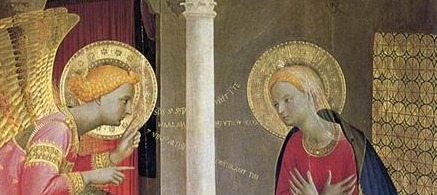
The sacrament of the new *Presence of Logos* resides entirely in the hands of the Angel and the Virgin, the true fire of the three icons. Yet, within the convent cell, the book in Mary’s hand is also a *sacrament of the Word*: held tightly against her heart, open by her thumb, supported on her middle finger, her index finger points to a word not written. The book, a symbol of prayer and familiarity with Sacred Scripture, signifies the presence of the Word made flesh within Mary, as it was present in Sacred Scripture. With this *visual analogy* between Mary and Sacred Scripture (*Virgo liber Verbi*), the event of Incarnation is bathed in light, and Mary is designated as the book upon which God wrote His Word.The Book on Mary’s Knees
The book resting on the Virgin’s knees recalls the prophecy of Isaiah: “*Therefore, the Lord himself will give you a sign: Behold, a virgin shall conceive and bear a son, and his name shall be Emmanuel* (Is 7:14).” Furthermore, in Marian patristic literature, the Virgin is often associated with the image of a book, described as *Liber Generationis Christi* (Ernest of Prague) or *Liber Dei manu scriptus* (Ephrem the Syrian). It is considered a *mystical book*, offering God’s Word to human knowledge.Catherine of Siena Writes:
*”The glorious Virgin Mary was that sweet field where the seed of the incarnate Word of the Son of God was sown. Blessed and sweet field of Mary, this Word was scattered in her flesh like the seed cast upon the earth, which by the heat of the sun germinates and between flower and fruit bears the taste of the soil. So it truly happened through the heat and fire of divine charity that God had for human generation when He sowed the seed of His Word in Mary’s field.”*Mariology of Thomas Aquinas
The composition of the Annunciation depicted everywhere is attuned to Marian theology of Thomas Aquinas:*”The announcement made to the Most Holy Virgin concerning her conception of Christ was an event of appropriate dignity. First, for congruity, so as to unite the Son of God with the Virgin, that is, to instruct her in her mind before conceiving Him in her flesh; secondly, to offer God a free gift of her reverence, and she responded readily: ‘Behold, I am the handmaid of the Lord’; finally, to make clear that a kind of spiritual marriage was being established between the Son of God and human nature. For this, the announcement required Mary’s consent.” (I.)**”Saint Bede states that it was very fitting for the Virgin to be consecrated to the divine port by an angel sent from God. Indeed, the first cause of human sin had come from a creature similar when the serpent was sent by the devil to deceive the woman.” (2.)*“And the name [Gabriel], says Gregory, was absolutely consistent with his office. Indeed, Gabriel means ‘Strength of God’, and he who came to conquer the powers of evil, Lord of Powers and Mighty in battle, was announced from the Strength of God” (Ad 2, ch. 4).
“The angelic announcer appeared to the Mother of God in a bodily vision. In fact, he came to announce the Incarnation of the invisible God. Even the appearances of the Old Testament were all preordained for the coming of the Son of God in flesh. And it was a sight befitting the dignity of the Mother of God that she was receiving the Son of God not only in her mind but also in her body. Not to mention that everything that comes before our eyes is apprehended with greater certainty than an object of a single image. That’s why Chrysostom says that the Angel was visible to the Virgin. And since the Angel was making a very great revelation, a very solemn vision was offered to the Virgin” (ch. 3).
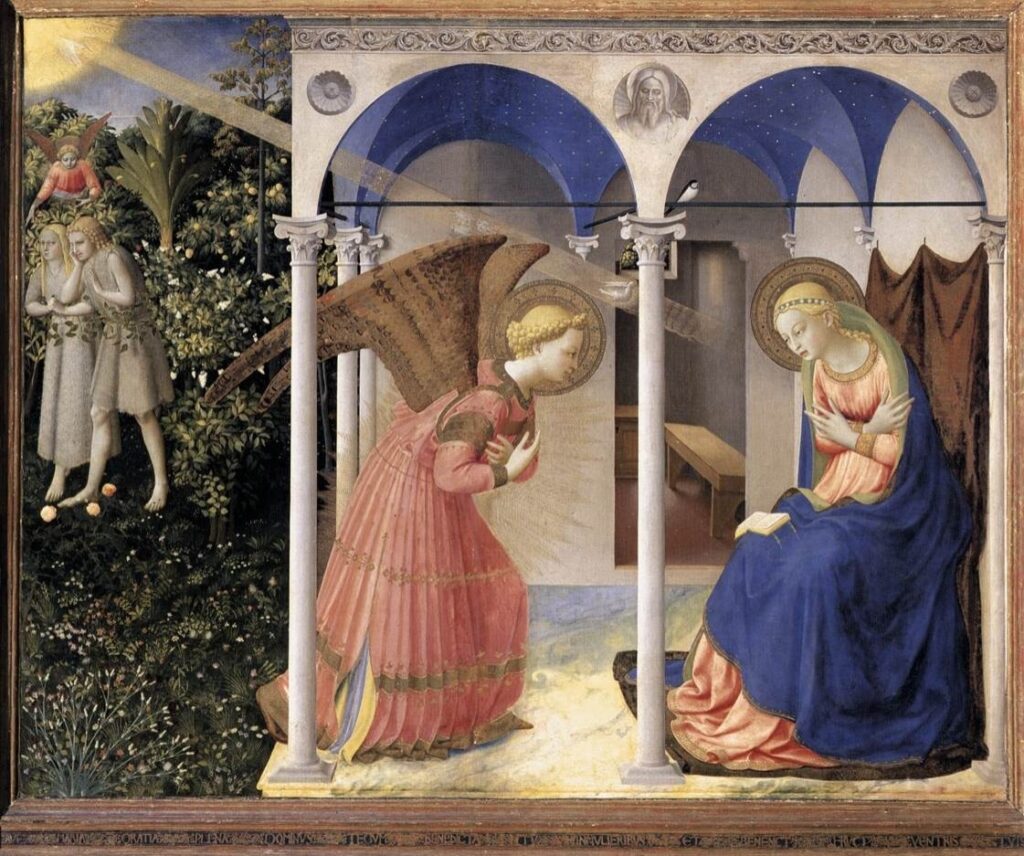
Among the many Annunciated Virgins painted by Angelico, the most brilliant in light and color are those of Prado and Montecarlo, now in S. Maria delle Grazie in S. Giovanni Valdarno. The former already existed for some time when the church was consecrated in October 1435. The design is entirely Renaissance in structure and perspective, and in the abolition of the golden background. But something remains unsaid in the figures; the columns are very thin, the Garden of Eden is very close to the two progenitors, so large and not too distant, that it seems contemporary to the evangelical scene.
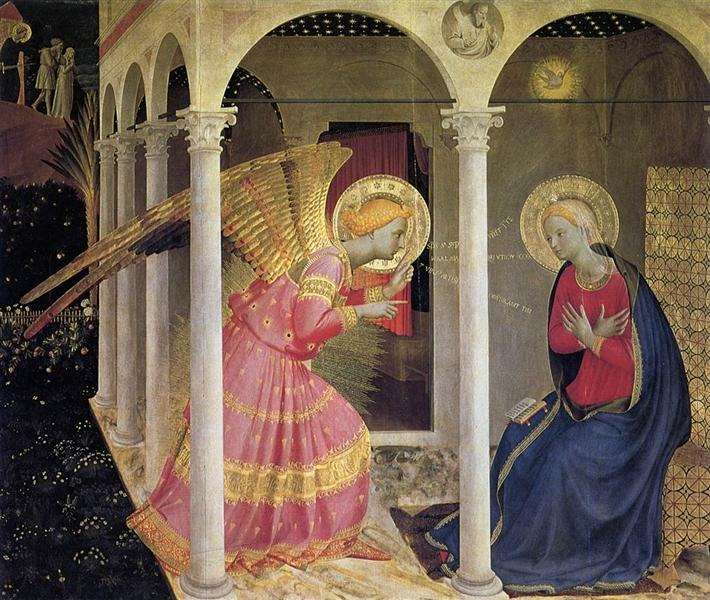
On the other hand, in the Annunciation of S. Giovanni Valdarno, theological progress is more evident. The space is definitely dominated, the architecture of the porch is proportional and has an eloquent perspective in the arches receding upwards to the left, where, in minimal and distant dimensions, is the expulsion from paradise. The figures are alive, they speak with gestures and eyes, so much so that the written words seem a superfluous Gothic refinement. The modest and serene Virgin, after the tranquilizing words of the Angel, has a transparent veil and an alliance on her finger, and is modeled in the hands and head with an admirable sense of volume, emerging from the curved lines of the extended neck and the body set against the back. An open book rests on her lap. The intensity of color and the richness of details in the environment, finely descriptive, satisfy the gaze of the worshipper.
Final Note
When we observe a person in a moment of joy, wonder, or anticipation, we see these emotions reflected in their hands simultaneously. The hands, after the face, are the most spiritual part of the body. Strong and vigorous hands can be tools for work, attack, and defense, but they can also reveal the soul and welcome others’ souls, just as delicate hands like Mary’s do.We use our hands to embrace another when we shake them, so too in liturgy where a true language is at play before God: the soul receives God and wishes to give itself over. The open and spread hands of the Virgin correspond to Gabriel’s spread and joined hands. Both are united and gathered in receiving God’s gift and adoring that gift.Looking at Mary’s and the Angel’s hands, it’s natural to think of God’s hands entwined with his creatures in the Lord Jesus.When we gaze upon the *Anunciations* of Fiesole (now at El Prado) and Cortona, brilliant in light and color, even to the one in the cell of Saint Mark’s dormitory, the step is immense: the disappearance of gold, vibrant colors, the expulsion from Eden, the words of the dialogue between the angel and Mary. Nature takes a back seat, though it acknowledges that the *hortus conclusus*, a well-known symbol of virginity that prepared Mary for divine motherhood, also plays its part. Even the architecture, though strengthened, opens fully to reveal the mystery and welcome the celestial message, previously restricting its view.The two figures are defined by chaste colors: the *iridescent wings* of the heavenly messenger blend with the *dense blue* of Mary’s cloak spread open like a book to the divine Word.Graduate Studies in Mariology
Wishing to deepen your formation in Mariology? Discover the Graduate Studies in Mariology from Locus Mariologicus: an academic formation that combines theological rigor, spiritual life, and the living tradition of the Church.
Would you like to study Mariology seriously?
This article draws on the works of the Locus Mariologicus library. The Postgraduate Programme in Mariology takes you to the same sources with academic guidance: Scripture, the Church Fathers and the Magisterium, from the first dogma to contemporary questions.



Responses