The Annunciation to Mary according to Blessed Angelico (Part II)
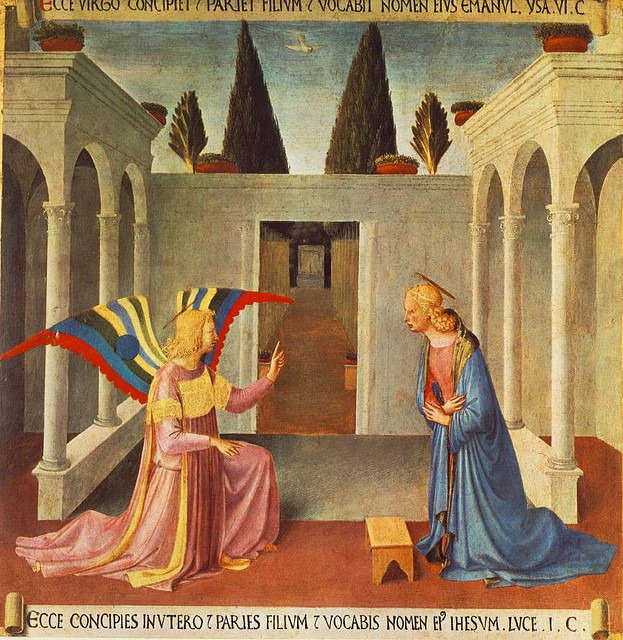
In the Annunciation of cell 3, the space is simplified.
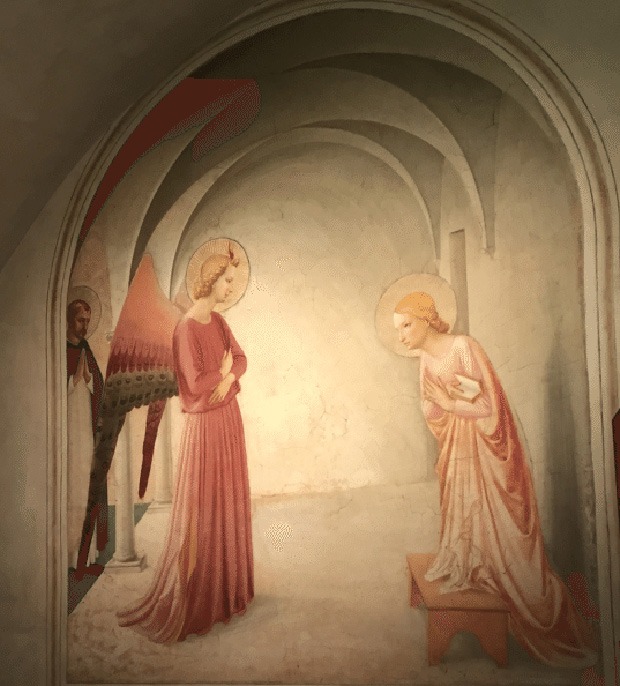
Only the entryway of the room can be seen, at the far right. The event still takes place on the raised porch of the enclosed lawn, but the woods beyond the boundary wall, glimpsed on the left, have disappeared, and the lawn is only hinted at on this side of the wall. One wing of the portico has disappeared. The room opens to the east, from which comes the light that marks the shadows on the floor at the center and on the wall at the right. It is everything, not just a part as in the corridor, that has become a superfluous scene: it is to the reserved contemplation of the Friars Preachers that the fresco is addressed, as the presence in the painting of Saint Peter of Verona, the Dominican martyr, seems to confirm.
The impression is once again strong and immediate, a direct echo of the Song of Songs:
“You are a garden enclosed, my sister, my bride, a garden enclosed and a fountain sealed” (4:12).
The room again opens to the east, and we, facing the light of sunset, see the event taking place between heaven and earth, in a kind of extension of the intimacy of the cloistered room on both sides of the wall. The space is complex and very elegant. Beyond, there is no Eden. The wooded garden of the corridor Annunciation has been transformed into a very tidy garden with palm trees and terracotta vases. The cypresses, lined up there behind the palisade, are here arranged along a scenic avenue with a boundary wall, which, together with the crowning of the cloister, is also decorated with terracotta vases facing the central fountain. It is the garden of the Song that the beloved personifies:
“a garden fountain, a fountain of living water” (Song 4:13a, 15a)
Facing the central window that brings the light of the east into the corridor fresco, there is neither the emblem of the dove, on which the ritual celebration of the panel for the silver cabinet insists,

nor the adoring silence that hovers over the mysterious contemplation of the convent cell. Facing this centrality, which is precious in its reminiscences of the Song (the cellar of wine) and of Catherine of Siena (the cell of blood and the cell of self-knowledge), Friar John Angelico places Mary simply seated on a refectory bench, not on the throne where he had placed her in Cortona or Montecarlo, almost with a complete elevation, since she faces Gabriel and is beyond him, clothed in a tunic of light and a mantle of shadow, her eyes dreamy as always, her lips moving, very lightly reaching toward the Angel, between the room and us.
In the convent cell, Mary is kneeling on a small stool. Her whole body is absorbed into the pink garments, heightened by the light that comes from the East.
Here we have the utmost abstraction and intimacy. The lines of the arched portico are reduced to a minimum and draw us into the scene. Space and proportion are entrusted to a very delicate nuance, almost a semblance. The archangel seems to rise from the earth, simple and imposing, with a recollected gesture and a reverent attitude. Mary is on her knees, without a mantle, surprised in prayer, with a half-open book in her hand, which may signify the memory of the prophecies: rendered in an impalpable pink that makes her seem transparent, she is attentive, more than to the angel’s words, to the Spirit coming upon her and to the fulfillment of the mystery. It is indeed the moment of the Incarnation of the Word: Fiat. The gentle curve of the arches connects the figures from above and expresses their dialogue: message and listening, proposal and welcome.
The wonder of this painting comes from the absolute sobriety of the whole, which corresponds to the renunciation of any description in the Gospel account: the lightness of the color of the two figures is accompanied by the dawn glow of the floor and plaster, on which the vaults of affection are drawn as shadows by the morning light coming from outside.
Thomas Aquinas’s Commentary on the Angelic Salutation (1.1.2) describes the scene in this way: “Mary is full of grace also in the sense that the grace of her soul overflows into her body […] so that her flesh conceived the Son of God. According to Hugh of Saint Victor, the love of the Holy Spirit burned so strongly in her heart that it worked wonders in her flesh, to the point that the God-Man was born”.
The practice of adoring the Incarnation of the Lord is suggested by the Franciscan Meditationes Vitae Christi of Pseudo-Bonaventure, and Blessed Angelico will retain it both in the Annunciation panel and in the Nativity panel.
In the silver cabinet made for the Santissima Annunziata of the Servants of Mary in Florence, the insistence on chapter 4 of the Song of Songs continues:
“How beautiful you are, my friend, how beautiful you are!
Your eyes are doves among your curls…
your lips are a purple thread, your mouth is flooded with grace…
you are all lovely, my friend, there is no stain in you
… heart, my sister, bride,
you have captured my heart with a single glance” (Song 4:1, 3, 7, 9)
Placing her on her knees on the ground, not on the bench, which she visibly disregards, Friar John highlights the event that took place between earth and heaven, between Mary and the Spirit who, in the central fountain, comes to her. She is in ceremonial dress, celebrating the sacred nuptials: a red tunic and a blue mantle which, identical to the garment of the Incarnate Word, will change only in the panels that follow the Resurrection, where she is united to the glory of her Lord, analogously to what happens to Jesus in the Transfiguration, in the washing of the feet and on the Via Crucis, in the Resurrection, or when Mary shares His glory.
An open-air variant: the architecture opens at the back onto a garden, the so-called Hortus conclusus, to symbolize Mary’s virginity in conception and in childbirth. Here, too, the Holy Spirit is present in the form of a dove among the tips of the cypresses. The Angel points to heaven with his hand, and the inscriptions on the upper and lower margins record, respectively, the prophecy of Isaiah and the Angel’s announcement. In the Annunciation scene, built on a central perspective, Mary is recollected in prayer in a luminous atrium that recalls the Hortus conclusus, an anthology of Marian symbols. The cypresses that can be seen behind Mary allude to those of Mount Zion:
I grew as tall as the cypresses of the mountains of Hermon (Sir 24:13-17).
The balustrade open to the landscape in the background points to Mary as the porta coeli. With thoughtful and attentive prudence, Mary receives the word of the angel, who extends his finger to point to heaven. The setting, full of architectural references alluding to the new temple in which God will come to dwell with men, is placed in a loft open to the sky and the horizon, in the morning light that foreshadows the glory of midday. The traditional lectern book is replaced by sheets that record in Latin the prophecy of Isaiah and the words of the angel: “Behold, you will conceive in your womb and bear a son, whom you will call Jesus” (Lk 1:26-38).
In the corridor, where Gabriel entered through the arch that made him bow, the architectural space of Man would contain neither the Angel nor Mary, who, in the three paintings, have larger-than-life proportions; and now he leans intensely toward the Virgin in a pause of impossible stillness, holding back his wings of setiform irises, in the elaborate tunic trimmed at the hems and on the chest and embroidered at the bottom and on the sleeves, his face in pure profile, turned more toward us than toward her.
In the panel, he too is placed in adoration on his knees. The suggestion also comes from the Franciscan reverence owed by every creature to the Word who became flesh in Mary.
Postgraduate Program in Mariology
Would you like to deepen your formation in Mariology? Discover the Postgraduate Program in Mariology of Locus Mariologicus — an academic formation that unites theological rigor, spiritual life, and the living tradition of the Church.





Responses